

The Treasure Coast is home to the Indian River Lagoon, one of the most biodiverse estuaries in North America and also one of the most transient communities in Florida, shaped by retirees, military families, and seasonal residents who often arrive already in second marriages. That demographic reality is part of why Florida's divorce rate sits above the national average, and why residents of Martin County, St. Lucie County, Indian River County, and Jupiter face a different statistical landscape than couples in Massachusetts or New York.
Key Takeaways
- The U.S. divorce rate has fallen to a 40-year low of roughly 14.2 per 1,000 married women, but Florida remains above the national average.
- Oklahoma leads the nation at 20.7 divorces per 1,000 married women; New Jersey and New York consistently rank among the lowest divorce rates.
- Florida's elevated rate reflects its demographics — retirees, second marriages, military families — not a flaw in state law.
- Florida does not recognize legal separation, so all formal splits proceed as dissolution of marriage under Florida's chapter 61.
- State divorce statistics are population averages; they tell you nothing about how a Martin County or St. Lucie County judge will handle your specific case.
How the U.S. Measures Divorce Rates and Why the Numbers Are Hard to Compare
The Two Measurement Systems Behind Every Divorce Statistic
Understanding divorce rates by state requires knowing how they are measured. Two agencies track divorce in the United States: the National Center for Health Statistics (part of the CDC) publishes a crude divorce rate — divorces per 1,000 total population — while researchers at Bowling Green State University use a refined divorce rate: divorces per 1,000 married women. The refined measure is more useful because it controls for how many people are actually married, which matters in states with the lowest marriage rates where the pool of at-risk couples is smaller. The most cited modern source for state-level comparisons is the 2020 American Community Survey, specifically the 2020 Year Experimental PUMS dataset analyzed by researchers at Bowling Green State University, including Krista K. Westrick-Payne, whose work on the women refined divorce rate has become a standard reference. The U.S. Census Bureau's American Community Survey provides the underlying data most researchers rely on today. When comparing state rankings, always verify which measure the source uses — crude and refined rates can produce very different results, and the year experimental pums methodology is particularly important to confirm when evaluating state-level estimates.
Why Some States' Data Is Missing
Several states — including California, Hawaii, Indiana, Minnesota, and New Mexico — do not consistently report divorce numbers to the national vital statistics system, according to CDC documentation. New Mexico appears in some researcher datasets drawn from the American Community Survey — specifically the 2020 Year Experimental PUMS — but not in NCHS counts. Any ranking that lists all 50 states without noting these gaps deserves skepticism. This is one reason the 2020 American Community Survey and its 2020 Year Experimental PUMS data became the preferred framework for researchers studying high divorce rates at the state level, revealing significant state level variation that crude counts alone could not capture.
What the National Divorce Rate Actually Looks Like Today
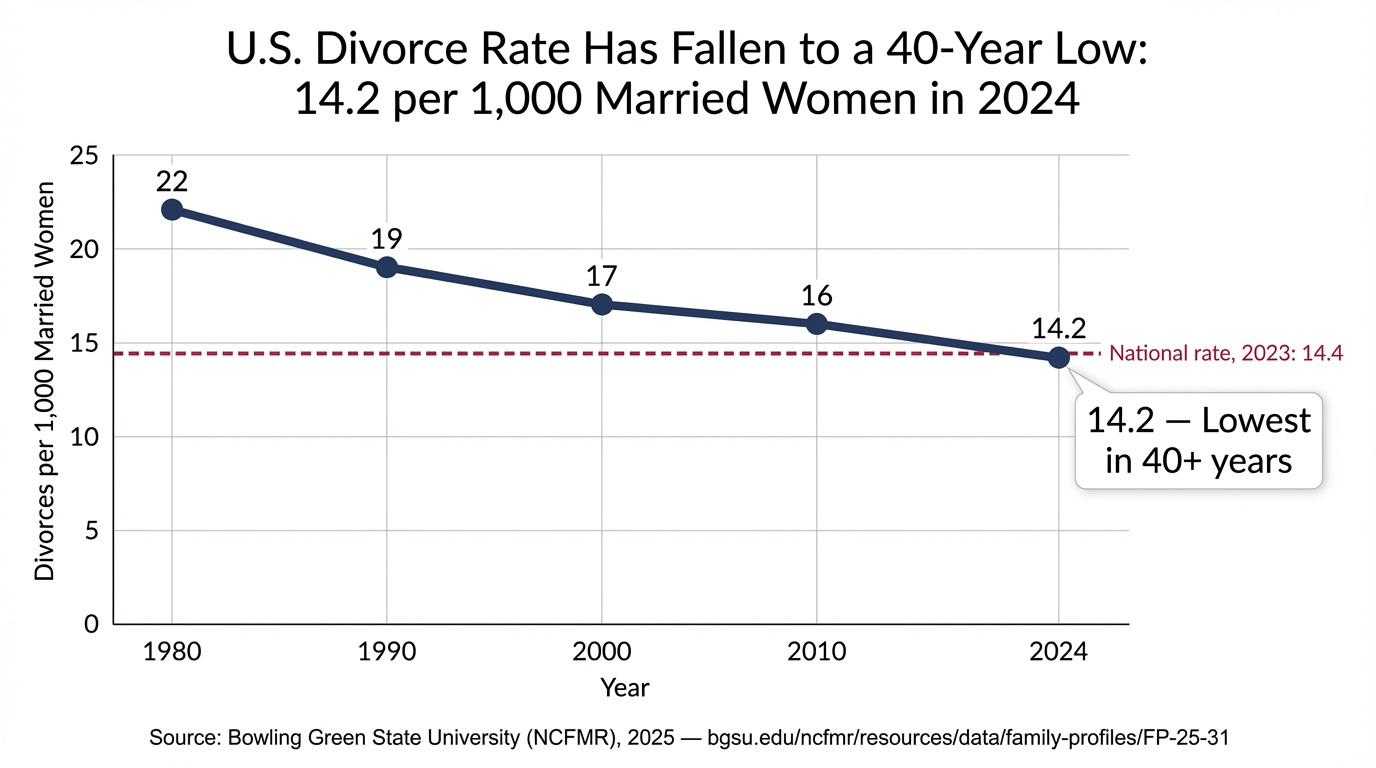
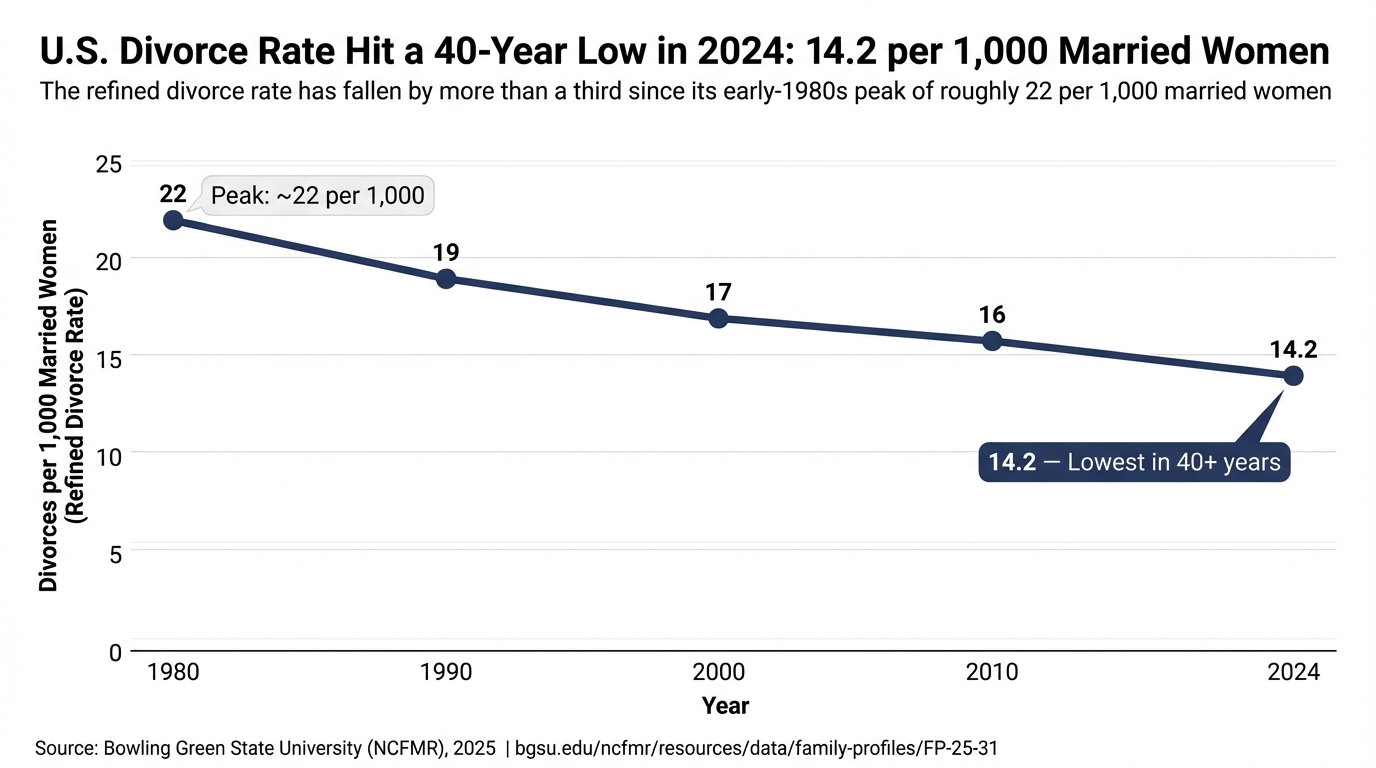
The U.S. divorce rate has been declining for four decades, with the 2024 figure representing what researchers describe as a 40 year record low. According to Bowling Green State University's National Center for Family and Marriage Research, approximately 987,000 women divorced in the U.S. in 2024, putting the refined rate at 14.2 per 1,000 married women — nearly the lowest in 40 years. The rate in 1980 peaked at 22.6 per 1,000 married women; today's figure represents a 37% decline from that peak, and U.S. Census Bureau data show the divorce rate for women ages 15 and older fell from 9.8 per 1,000 in 2012 to 7.1 per 1,000 in 2022 — roughly a 28% decline over that decade. A falling national rate does not mean divorce is disappearing — it largely reflects the fact that Americans are marrying less often overall.
Divorce Rates by State: Which States Have the Highest in the Country
The Top Five Highest-Rate States
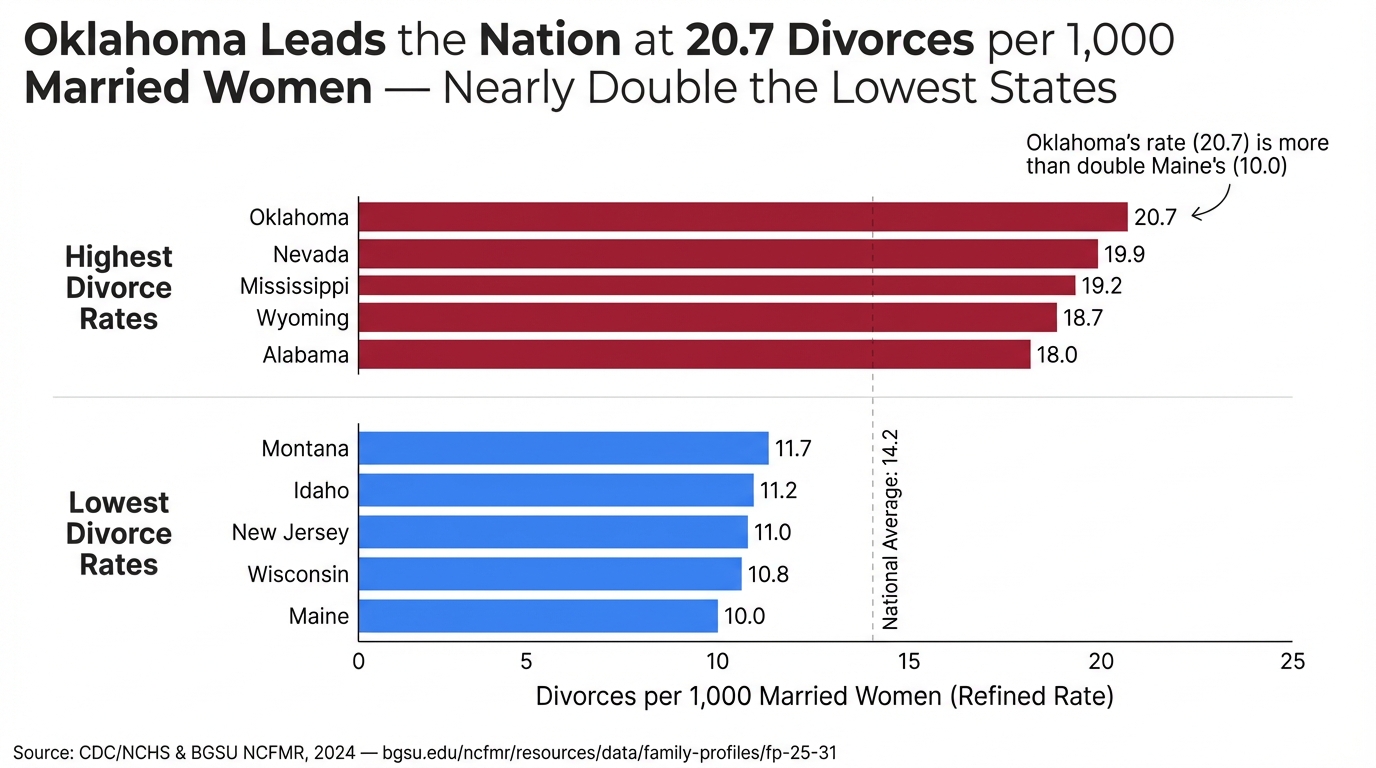
According to Bowling Green State University's 2024 family profile, Oklahoma leads the nation with high divorce rates at 20.7 divorces per 1,000 married women, followed by Nevada (19.9), Mississippi (19.2), Wyoming (18.7), and Alabama (18.0). All five sit well above the national refined rate of 14.2 — these five highest divorce rates cluster in states with younger average marriage ages and lower median incomes. Historically, Nevada, Arkansas, West Virginia, and South Carolina have also ranked near the top, driven in part by Nevada's permissive divorce laws and Arkansas's younger marriage demographics. Researchers using the 2020 American Community Survey and 2020 Year Experimental PUMS data — including work published as a family profile no. series by BGSU — consistently find these same states clustering near the top.
The Demographic and Economic Factors Behind High-Rate States
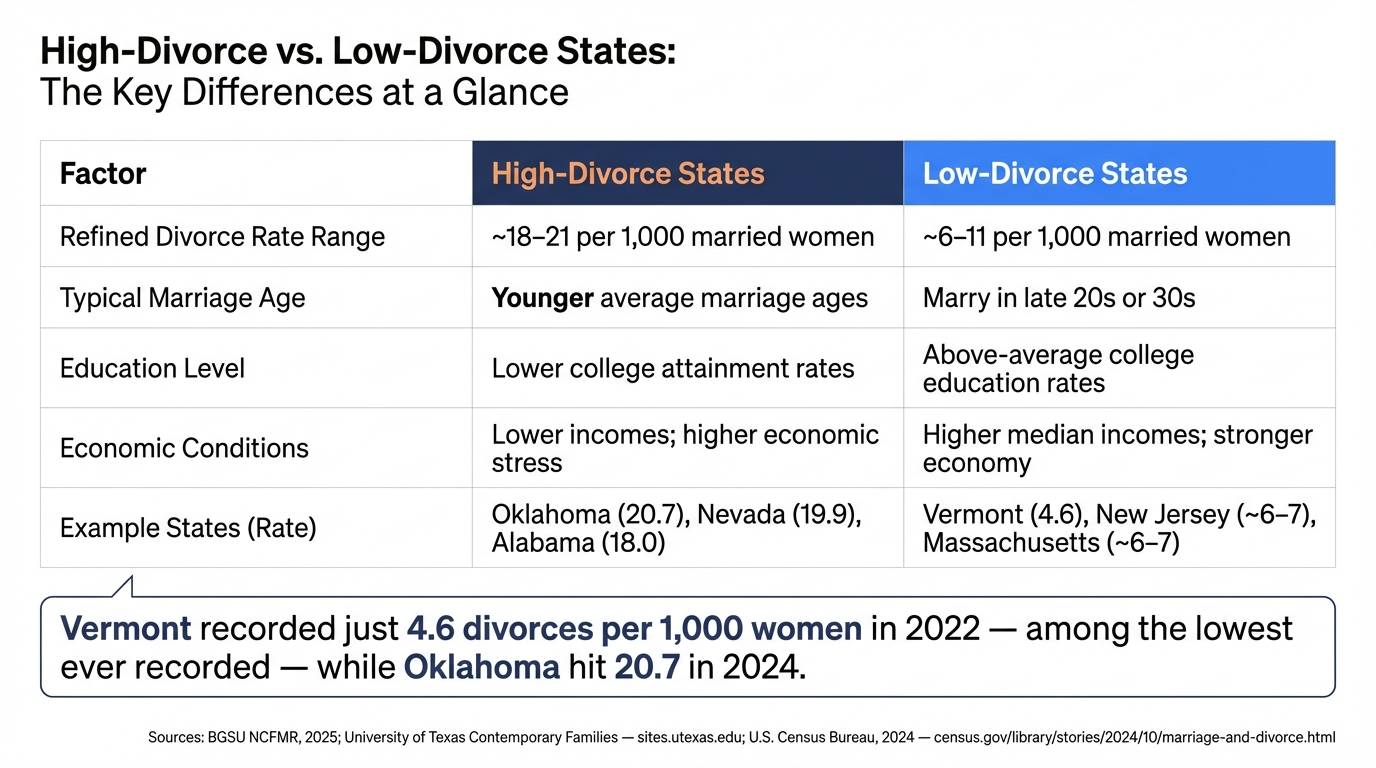
When examining divorce rates by state, the pattern among high-rate states is consistent: younger average marriage age, lower median household income, and lower rates of college education all correlate with elevated figures, according to National Center for Family and Marriage Research data. Researchers sometimes refer to a "Bible Belt paradox" in which more religious regions exhibit relatively high divorce rates. Analyses of state-level divorce rates using American Community Survey data, such as the National Center for Family & Marriage Research's geographic variation report, suggest that higher divorce in some Southern states is linked to factors like younger age at first marriage and greater economic stress, rather than religious beliefs alone.
Which States Have the Lowest Divorce Rates and What They Share in Common
The Consistently Low-Rate Northeastern States
New Jersey and Massachusetts rank among the lowest using the refined divorce rate — approximately 11 per 1,000 married women in 2024, according to Bowling Green State University data. New York also consistently ranks near the bottom of the national list. According to the National Center for Family & Marriage Research's report using 2022 American Community Survey data, Vermont is among the states with the lowest refined divorce rates nationally, per the same BGSU research. These states share later average marriage ages, higher education attainment, and stronger median incomes — all factors associated with more stable marriages.
Why No Single Variable Fully Explains the Pattern
New Hampshire complicates the tidy narrative: it has relatively high education levels but a higher divorce rate than neighboring northeastern states. Divorce rates by state are population-level patterns that always have exceptions at the individual level. These are statistical probabilities across large populations, not predictions for any specific couple.
Where Florida Ranks Among U.S. States for Divorce
Florida's Rate Compared to the National Average
Florida's divorce rate of approximately 3.4 divorces per 1,000 residents placed it among the higher states in 2022, according to CDC state-level data — above the U.S. average of 2.4 per 1,000. In 2023, Florida's divorce rate was 3.0 divorces per 1,000 residents, which translates to roughly 68,000 divorces that year — about 185 to 190 per day on average. That volume is partly structural: more married residents means more divorces in raw terms.
Second Marriages and Silver Divorce on the Treasure Coast
The Treasure Coast's substantial retiree and snowbird population means a meaningful share of local divorces involve later-in-life couples — what researchers call gray divorce, a trend tracked by the federal government through U.S. census bureau survey data and administrative records. Pew Research Center notes that divorce rates among adults 50 and older have roughly doubled since 1990 even as younger age groups divorce less. For Treasure Coast residents navigating a gray divorce in Stuart, Port St. Lucie, or along Hutchinson Island, property division and spousal support under Florida's equitable distribution framework are typically more complex because couples have accumulated more assets over longer marriages. Our Martin County family law attorneys regularly handle these cases.
Why Divorce Rates Alone Do Not Tell the Full Story for Treasure Coast Residents
What State Statistics Cannot Tell You About Your Case
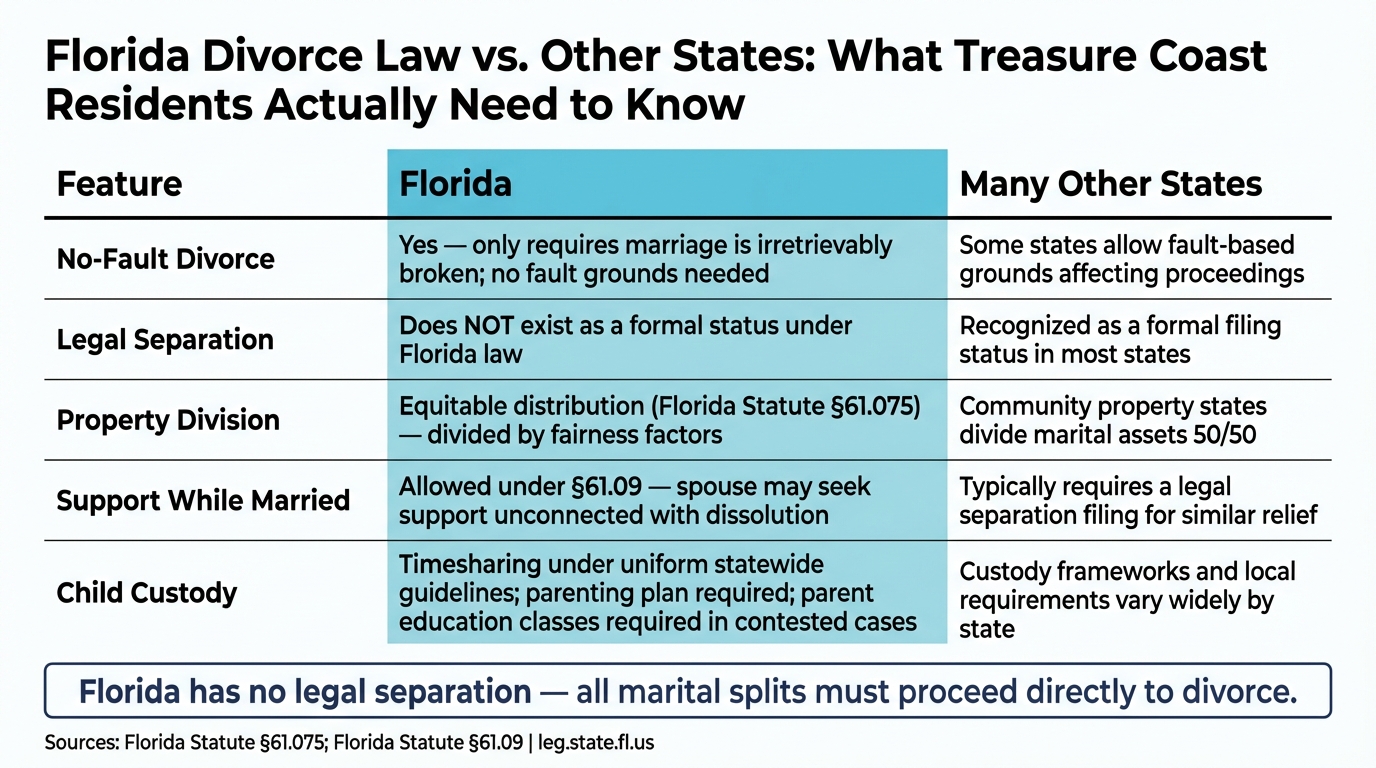
Divorce rates by state reflect population averages, and Florida's position in a national ranking has no bearing on how a Martin County judge applies Florida Statute §61.075 to divide your marital assets, or how a St. Lucie County family court evaluates a contested timesharing schedule. The Nineteenth Judicial Circuit — covering Martin, St. Lucie, Indian River, and Okeechobee counties — requires parent education classes and court-approved parenting plans in contested matters. Those local procedures shape your experience far more than where Florida sits in a national chart. If you want to understand how long a divorce takes in Florida specifically, that depends on local caseloads and case complexity, not national averages.
Legal Separation Does Not Exist in Florida
Florida does not recognize legal separation as a formal legal status. Couples who want to live apart without divorcing have no court-supervised separation option — they remain legally married until a dissolution is filed. The Department of Health and Human Services tracks these distinctions because they affect how family data is reported to the human services agencies that administer support programs. Florida law does allow a spouse to seek support unconnected with dissolution under §61.09, which can address alimony or child support while the marriage remains legally intact. This distinction matters for statistics: states that track legal separations separately count those differently, making direct comparisons to Florida's divorce data imprecise.
What Drives People Toward Divorce and What the Research Actually Shows
The Four Horsemen and Other Behavioral Predictors
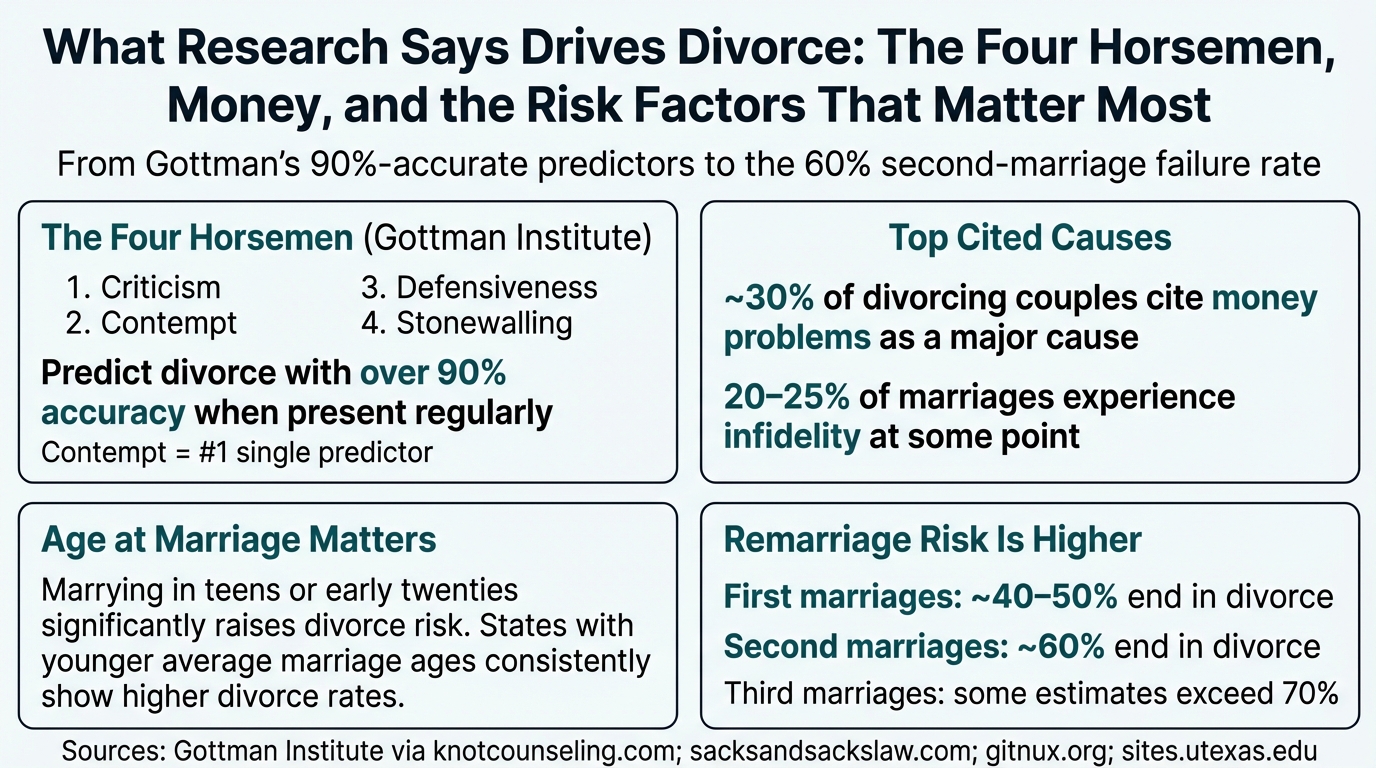
Researcher John Gottman identified four communication patterns — contempt, criticism, defensiveness, and stonewalling — as the strongest behavioral predictors of divorce. Contempt is the single strongest predictor.
How Age at Marriage and Prior Marriages Affect Divorce Risk
Couples who marry before 25 divorce at measurably higher rates than those who marry later, per U.S. Census Bureau data drawn from the American Community Survey. Second marriages fail more often than first marriages — a pattern documented in research summarized by the National Center for Family & Marriage Research at Bowling Green State University, along with other national analyses, which indicates that divorce is more common in second and later marriages than in first marriages, and one that also coincides with shifts in the marriage rate over recent decades. Both trends appear in Florida's demographic data and help explain why divorce rates by state vary so widely — with Florida ranking higher than northeastern states where later marriage is the norm and where marriage rates tend to be more stable. Under Florida's no-fault dissolution law, however, neither party needs to prove a specific cause to proceed — only that the marriage is irretrievably broken, a standard rooted in reforms the 2020 American Community Survey data helped validate by tracking outcomes across states.
Frequently Asked Questions
Which states have the highest divorce rate? Oklahoma currently leads the nation at 20.7 divorces per 1,000 married women, followed by Nevada (19.9), Mississippi (19.2), Wyoming (18.7), and Alabama (18.0), according to Bowling Green State University's National Center for Family and Marriage Research. States with the highest divorce rates share younger average marriage ages and lower median incomes compared to low-rate states, while states with the highest marriage rates are not always the same as those with lower divorce rates.
Which state has the highest number of divorces in raw total? Raw totals and divorce rates measure different things. California, Texas, and Florida record the highest raw numbers simply because of population size. The refined divorce rate per 1,000 married women — derived from the 2020 American Community Survey and used by the National Center for Health Statistics — produces a very different state ranking than raw counts alone.
Where does Florida rank among states for divorce? Florida had a rate of roughly 3.4 divorces per 1,000 residents in 2022, above the U.S. average of 2.4. The state's demographics — high rates of second marriages, a large retiree population experiencing gray divorce, and a transient workforce — push Florida's rate above lower-divorce states like New Jersey and New York. A divorce attorney in Port St. Lucie can help you understand what these trends mean for your specific situation.
What is a gray divorce and how common is it in Florida? Gray divorce refers to divorces among adults 50 and older. The divorce rate for this group has roughly doubled since 1990, per Pew Research Center, even as younger generations divorce less often. Florida's large retiree population along the Treasure Coast makes gray divorce a significant share of local family court filings, and these cases typically involve more complex property division and spousal support negotiations.
Does Florida recognize legal separation as an alternative to divorce? No. Florida has no formal legal separation status. Couples who wish to live apart without divorcing can use private agreements, and Florida Statute §61.09 allows a spouse to seek support while still married — but all court-supervised splits in Florida proceed as dissolution of marriage.
What are the four behaviors researchers say drive most divorces? John Gottman's research identifies contempt, criticism, defensiveness, and stonewalling as the four communication patterns most predictive of divorce, per the Gottman Institute. Surveys also cite financial disagreements and infidelity consistently. Under Florida's no-fault dissolution law, however, neither party needs to prove any of these — only that the marriage is irretrievably broken.
Knowing the Statistics Is a Starting Point, Not a Strategy
Divorce rates by state tell you something about population trends. They cannot tell you how long your divorce will take in the Nineteenth Judicial Circuit, what a Martin County judge will consider fair under equitable distribution, or how a parenting plan will be structured for your children. Florida's family law system operates on its own terms — and so does every individual case within it.
Founding Attorney Shaun Plymale and the team at Treasure Coast Legal serve Martin County, St. Lucie County, Indian River County, and Jupiter in Palm Beach County. If you are weighing your options, the practical next step is a conversation about your specific circumstances — not a national average. Contact Treasure Coast Legal to schedule a consultation at treasurecoastlegal.com/#footer-form or call 772-238-7755.
The information provided in this blog is for general informational and educational purposes only and is not intended as legal advice. Laws and legal outcomes vary based on specific facts and circumstances, and the information contained herein may not reflect the most current legal developments. You should not act or refrain from acting based on any information in this blog without first seeking legal advice from a qualified attorney licensed in your jurisdiction. This blog may be produced, in whole or in part, with the assistance of generative artificial intelligence tools and is reviewed by legal professionals before publication; however, no representations are made as to its accuracy, completeness, or applicability to any specific situation. Reading or interacting with this blog does not create an attorney-client relationship between you and the firm. An attorney-client relationship is formed only through a written agreement signed by both you and the firm. This blog may be considered attorney advertising under applicable laws and ethical rules. Prior results do not guarantee a similar outcome. The firm disclaims all liability for actions taken or not taken based on the content of this blog.