

Key Takeaways
- Florida courts require **clear and convincing evidence** of a statutory ground plus a separate finding that termination serves the **child best interests**, making a termination intentionally hard to obtain.
- **Voluntary termination** and **involuntary termination** follow different tracks, courts, and timelines, so identifying which applies is your first step.
- Terminating rights ends future child support but does not erase past-due arrears, and it cuts off the child's inheritance rights.
- Missing a single TPR hearing after proper service can result in a default termination.
- Reinstatement exists but is rare, requiring waiting at least three years, no adoption, and the child's consent if 13 or older.
Written by Shaun Plymale, Founding Attorney.
The Treasure Coast stretches across Martin, St. Lucie, and Indian River counties, where family courts in Stuart and Fort Pierce handle thousands of domestic relations cases each year. When a Florida court agrees to terminate parental rights, it permanently severs the legal parent child relationship, ending nearly every right and responsibility a parent has. There are two paths: a parent may voluntarily surrender rights, usually for a stepparent adoption, or the state or another parent may file to involuntarily end those rights. This article walks through Florida's statutory grounds under Chapter 39, the court process, the clear and convincing evidence standard, costs, and what to expect.
Voluntary vs. Involuntary Termination Follow Different Paths in Florida
How your case begins changes everything that follows. Foster care entries have declined since 2019, a reminder that termination is pursued when reunification fails.
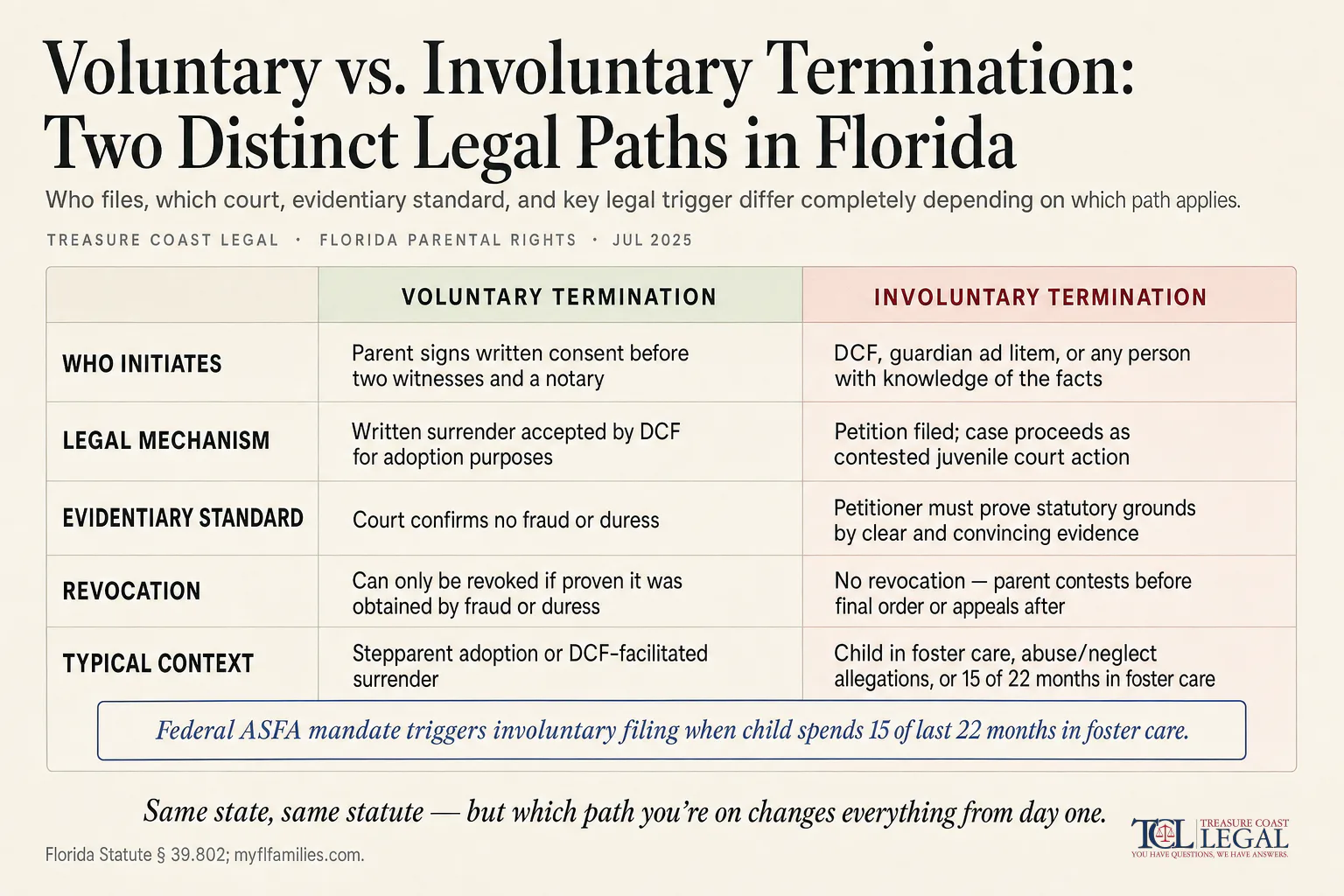
Voluntary Termination Through Consent and Surrender
A parent may pursue voluntary termination by signing a written consent before two witnesses and a notary, typically to permit a stepparent adoption, and this consent permanently affects that person parental rights. Once DCF accepts a surrender for adoption, it can only be revoked if obtained through fraud or duress. This legal process is governed by Florida's Chapter 39 procedures. Voluntary relinquishment does not erase past-due child support.
Involuntary Termination When the State or Other Parent Files
Involuntary termination is initiated by DCF, a guardian ad litem, or another person with knowledge of the facts. The petitioner must prove statutory grounds by clear and convincing evidence, and the parent has full due process rights to contest the parental rights case.
Why the Distinction Changes Your Strategy
The path determines which division of the 19th Judicial Circuit hears your case, what attorney you need, and whether a case plan becomes relevant. Consulting a family law lawyer early can clarify which path applies. Our family law team can confirm which one applies to your situation.
The Legal Grounds Florida Courts Accept to Terminate Parental Rights
Florida Statute § 39.806 lists every ground a court can use, and the petitioner must match the facts to at least one. In our experience working with Treasure Coast families, we often see cases hinge on which ground is alleged and how well it is documented.
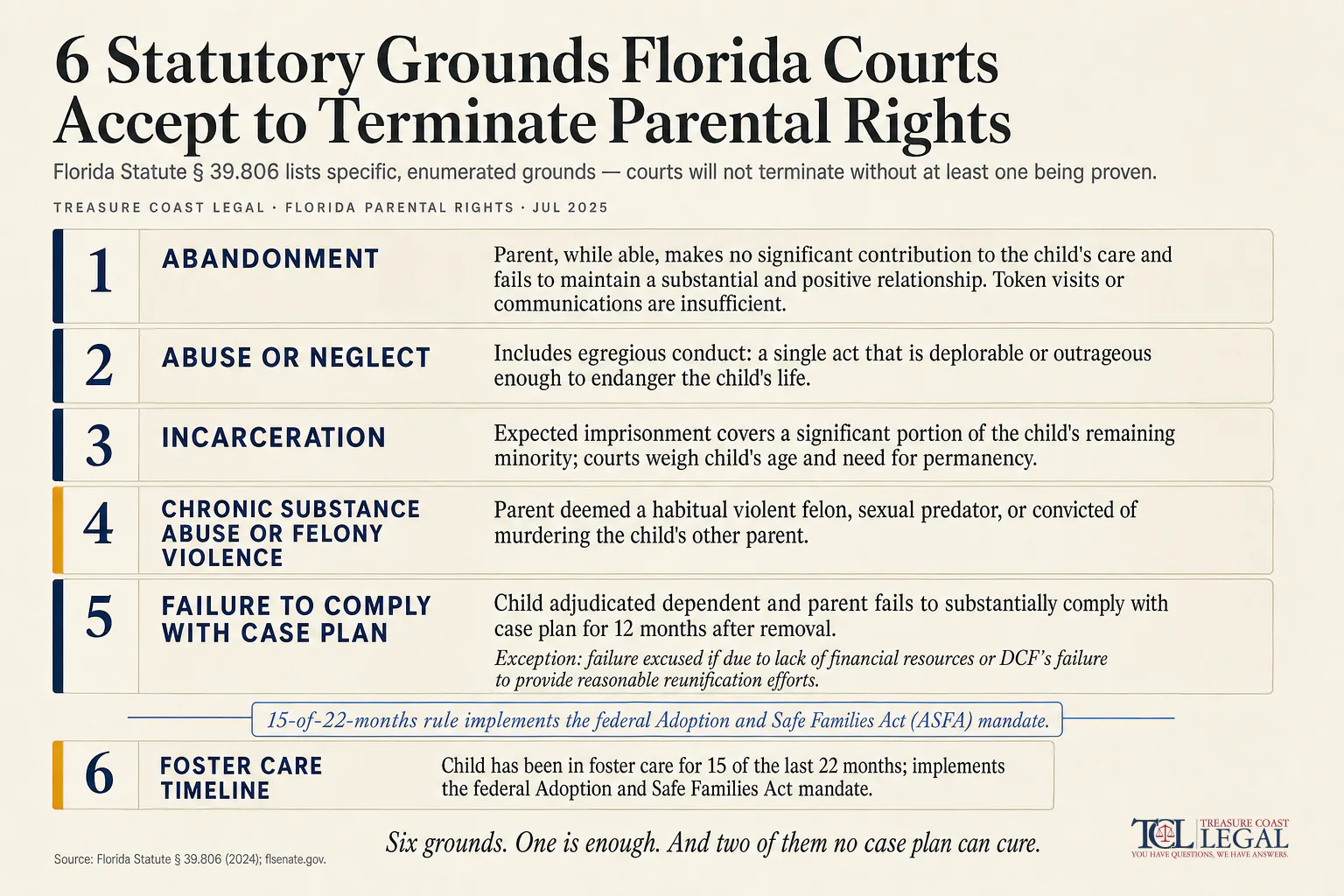
Abandonment, Abuse, and Neglect
Under § 39.01, abandonment means a parent, while able, made no significant contribution to the child's care and failed to maintain a substantial relationship. Token visits do not count; courts examine intent, child abuse allegations, and support history.
Substance Abuse, Violent Felonies, and Egregious Conduct
A parent adjudicated a habitual violent felony offender, convicted of murdering the child other parent, or suffering chronic substance abuse that cannot be corrected faces termination regardless of case plan compliance. Certain convictions — including those involving aggravated child abuse — trigger grounds no treatment program can overcome.
The 12-Month and 22-Month Foster Care Rules
If a child has been in foster care for 15 of the last 22 months and the parent has not substantially complied with a case plan within 12 months of removal, the state may petition a court to terminate parental rights. The clock starts at shelter placement, not at the TPR filing.
What Clear and Convincing Evidence Actually Means in a Florida TPR Case
The standard the petitioner must meet sits between an ordinary lawsuit and a criminal trial, and it shapes the entire hearing.
Higher Than Civil, Lower Than Criminal
Florida requires clear and convincing evidence to terminate parent parental rights, a burden above a preponderance but below reasonable doubt. The Florida Supreme Court in In re Adoption of Baby E.A.W. described it as evidence so precise, explicit, and credible that it produces a firm conviction in the judge's mind, 658 So. 2d 961 (Fla. 1995). Vague allegations without documentation will not meet that bar.
How Courts Weigh the Child Best Interests
Proving a ground is only half the case. The court must separately find by clear evidence that termination serves the child best interests, weighing the factors in § 39.810 such as the child's age, the bond with the parent, and the availability of adoption. Courts also look for clear evidence of harm or risk when evaluating each ground.
Who Can File a Petition to Terminate Parental Rights in Florida
Florida Statute § 39.802 allows DCF, the guardian ad litem, or any other person with knowledge of the facts to file.
DCF, the Guardian Ad Litem, and the State
In dependency cases involving one parents or both, DCF is the most common petitioner. Under the federal Adoption and Safe Families Act, DCF is generally required to file once a child has been in foster care 15 of the last 22 months, unless a documented exception applies. When a court to terminate parental rights is required by federal mandate, DCF has limited discretion. The guardian ad litem may also petition. DCF does not always have discretion; federal funding rules can compel a filing.
Private Petitioners and Stepparent Adoption
A private petitioner, usually the other parent or a prospective adoptive parent, may file but must allege a statutory ground such as abandonment, serious bodily injury, or another enumerated harm. Florida conditions voluntary surrender on a plan for the child, so courts will not approve a private termination simply to release a parent from obligations. Notably, Florida's 2023 family law session brought significant changes to alimony and parenting time statutes, including updates that affect child physical health and wellbeing standards, reinforcing the legislature's focus on the child's best interests across all family proceedings. Stepparent adoption requires the legal father's parental rights to end first, an issue our family law attorneys frequently address.
The Florida TPR Court Process Step by Step
A Florida termination case moves through predictable stages, and knowing them helps you prepare.
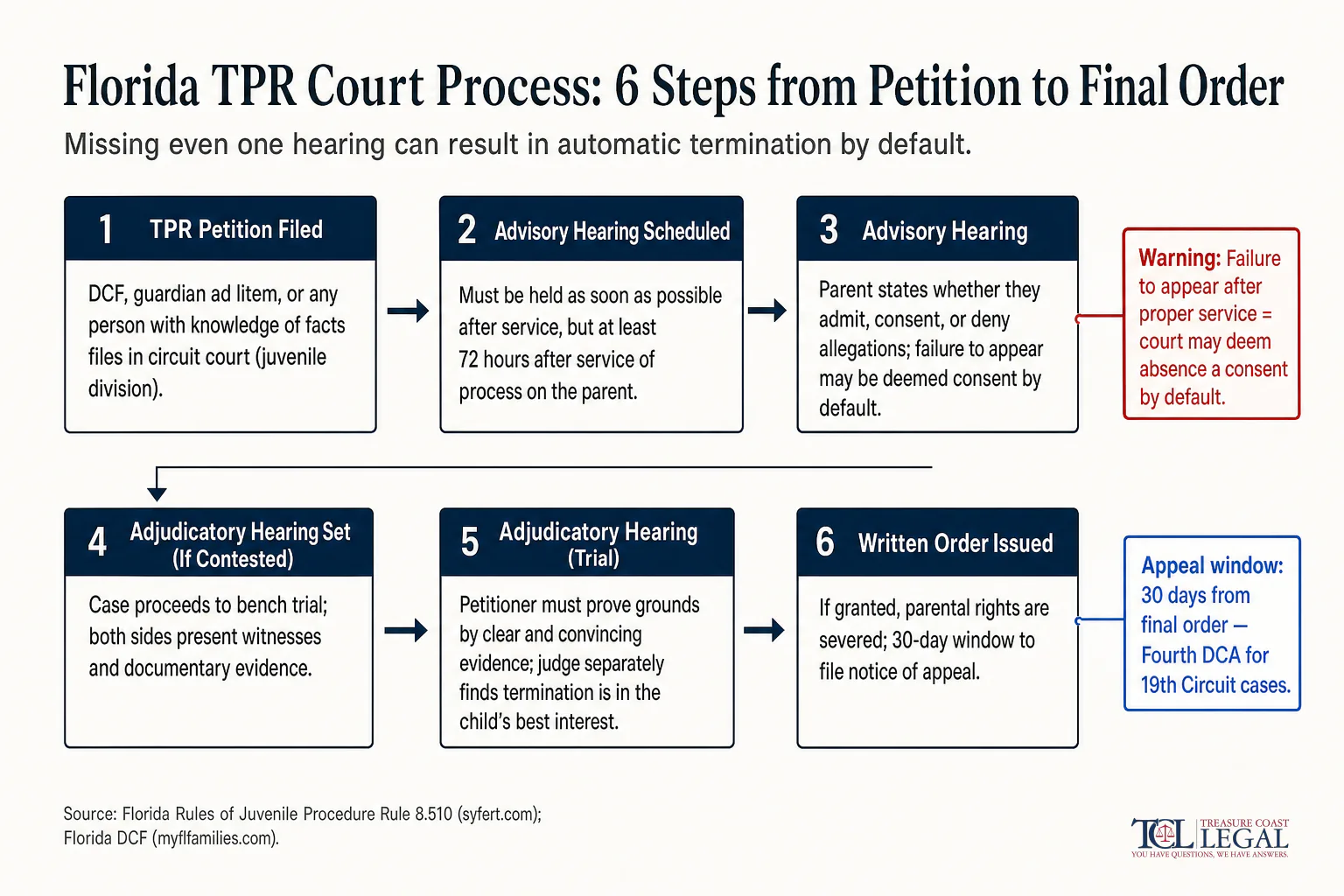
Filing, Service, and the Advisory Hearing
The petition is filed in the circuit court with juvenile jurisdiction, and the parent must be personally served. Under Florida Rule of Juvenile Procedure 8.510, the advisory hearing must be held as soon as possible, and at least 72 hours after service. There the parent states whether they admit, consent, or deny.
The Adjudicatory Hearing
If the parent denies, the court sets an adjudicatory hearing, which functions as a bench trial with no jury. DCF presents caseworkers, therapists, and documents, while the parent presents a defense. Documented case plan participation, even partial, can change a judge's best interest finding.
What Happens After the Judge Rules
If the court terminates rights, the written court order is immediately appealable to Florida's Fourth District Court of Appeal within 30 days. A termination order does not guarantee adoption, and the child may remain in foster care — alongside other children awaiting placement — until a separate proceeding finalizes it.
What a Case Plan Is and Why It Can Determine the Outcome
For most parents in a dependency case, the case plan is the single factor that decides whether they keep their parental rights.
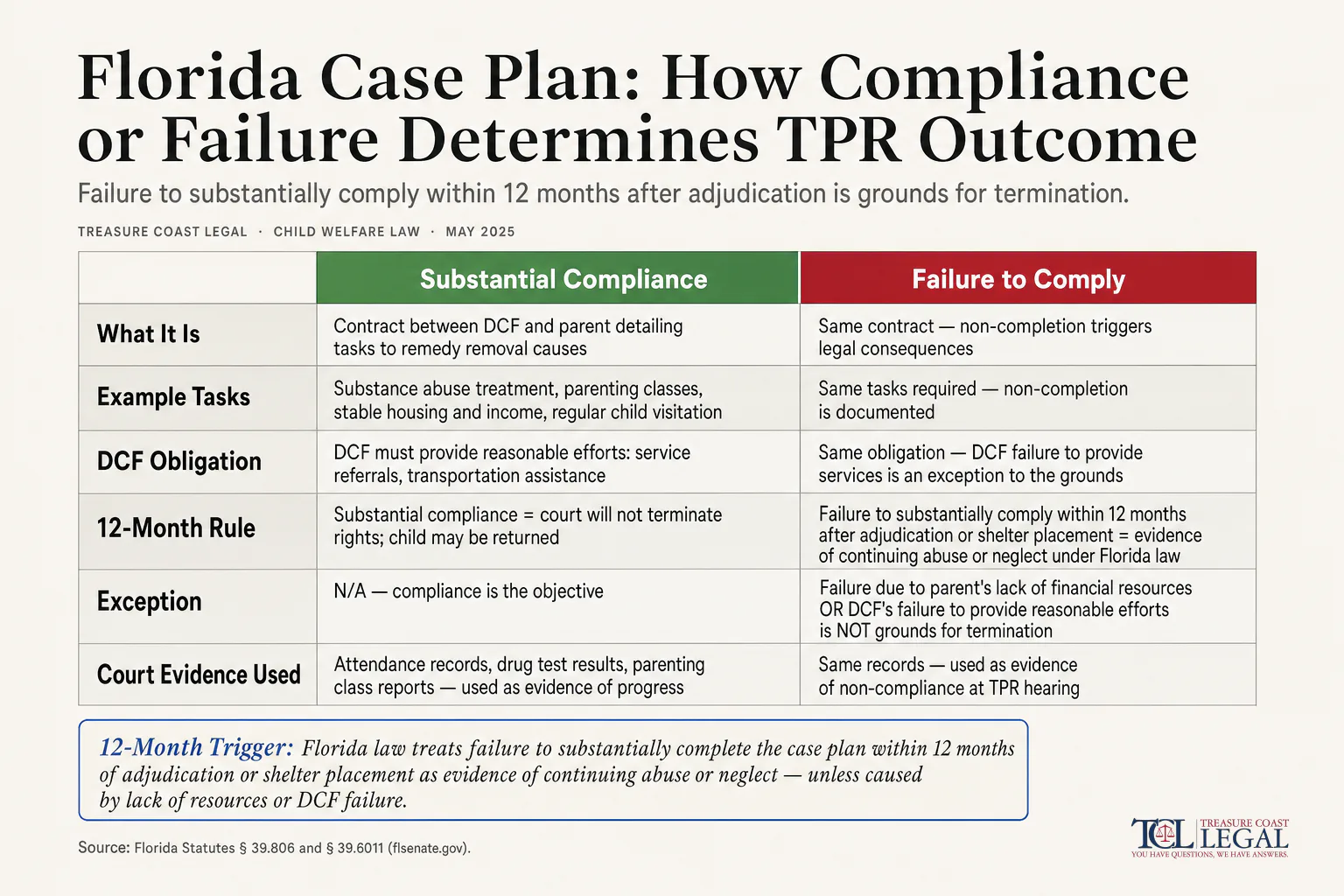
What Florida Requires in a Case Plan
A case plan under § 39.6011 is a written contract between DCF and the parent listing specific steps such as substance abuse treatment, medical treatment referrals, parenting classes, and stable housing. DCF must make reasonable efforts to help the parent comply, including referrals and transportation. Courts scrutinize whether those efforts were genuine before granting termination.
How Failure to Comply Triggers Termination
Under § 39.806, failing to substantially comply within 12 months of removal is evidence of continuing abuse or neglect, unless the failure stemmed from lack of resources or DCF's own shortcomings. Documenting every completed task is the parent's responsibility, because oral confirmations to caseworkers are not enough. Getting legal help early in the process greatly improves a parent's ability to track and prove compliance.
Can Terminated Parental Rights Be Reinstated in Florida
Florida law allows reinstatement, but the path is narrow and rarely used.
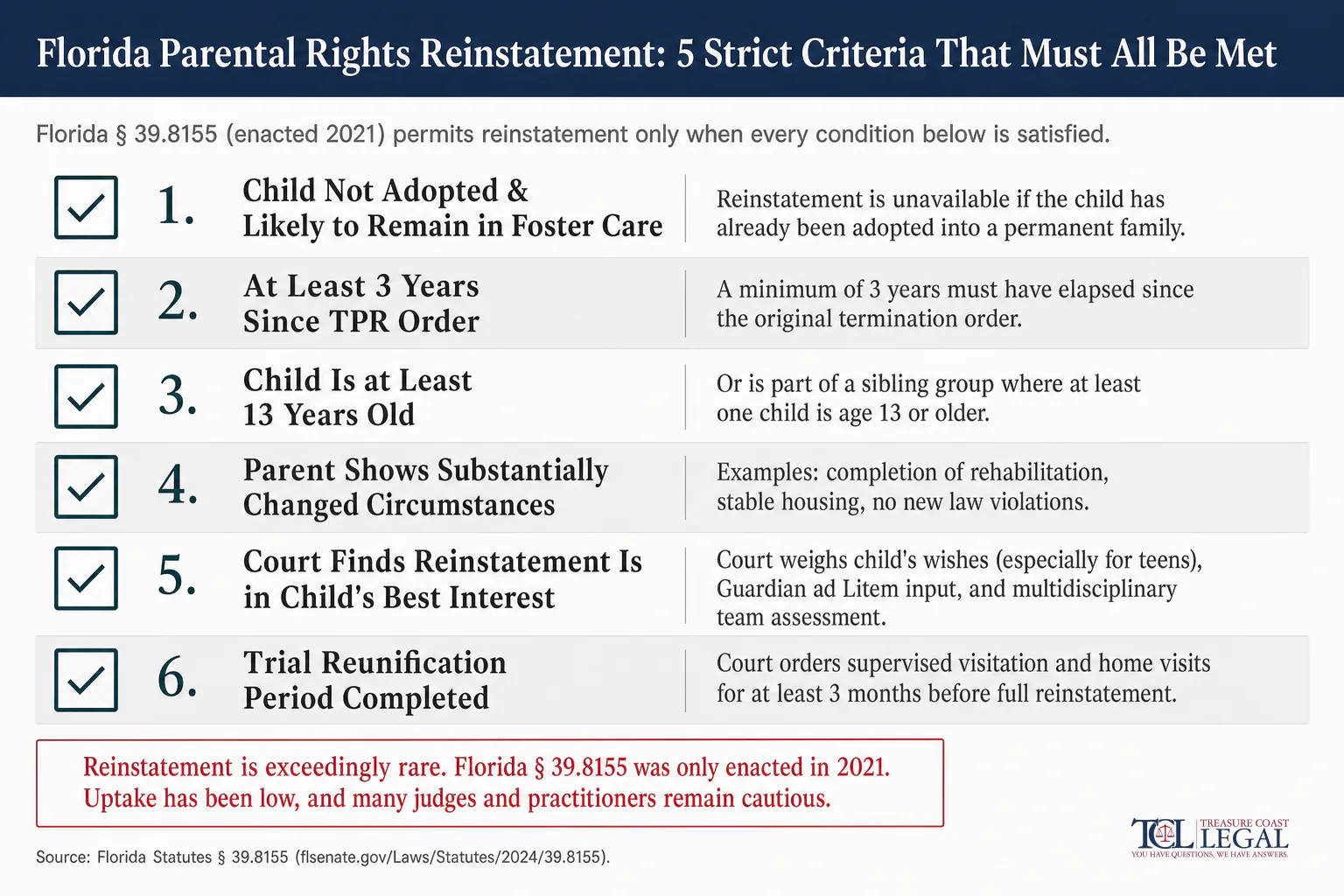
Florida's Limited Reinstatement Pathway
Under § 39.8155, a parent may petition to reinstate rights only if the child has not been adopted, is likely to remain in foster care, at least three years have passed, and the child is at least 13 or there is good cause if younger. Reinstatement requires clear evidence that circumstances have fundamentally changed and that it serves the child best interests.
What a Parent Must Show
The parent must demonstrate rehabilitation, a maintained child parent relationship where possible, and the consent of a child age 13 or older, with input from the guardian ad litem and a multidisciplinary team. Reinstatement is not an appeal but a separate forward-looking proceeding, and successful petitions remain exceedingly rare.
How Termination of Parental Rights Affects Child Support Obligations
Ending parental rights stops future child support but leaves several obligations untouched.
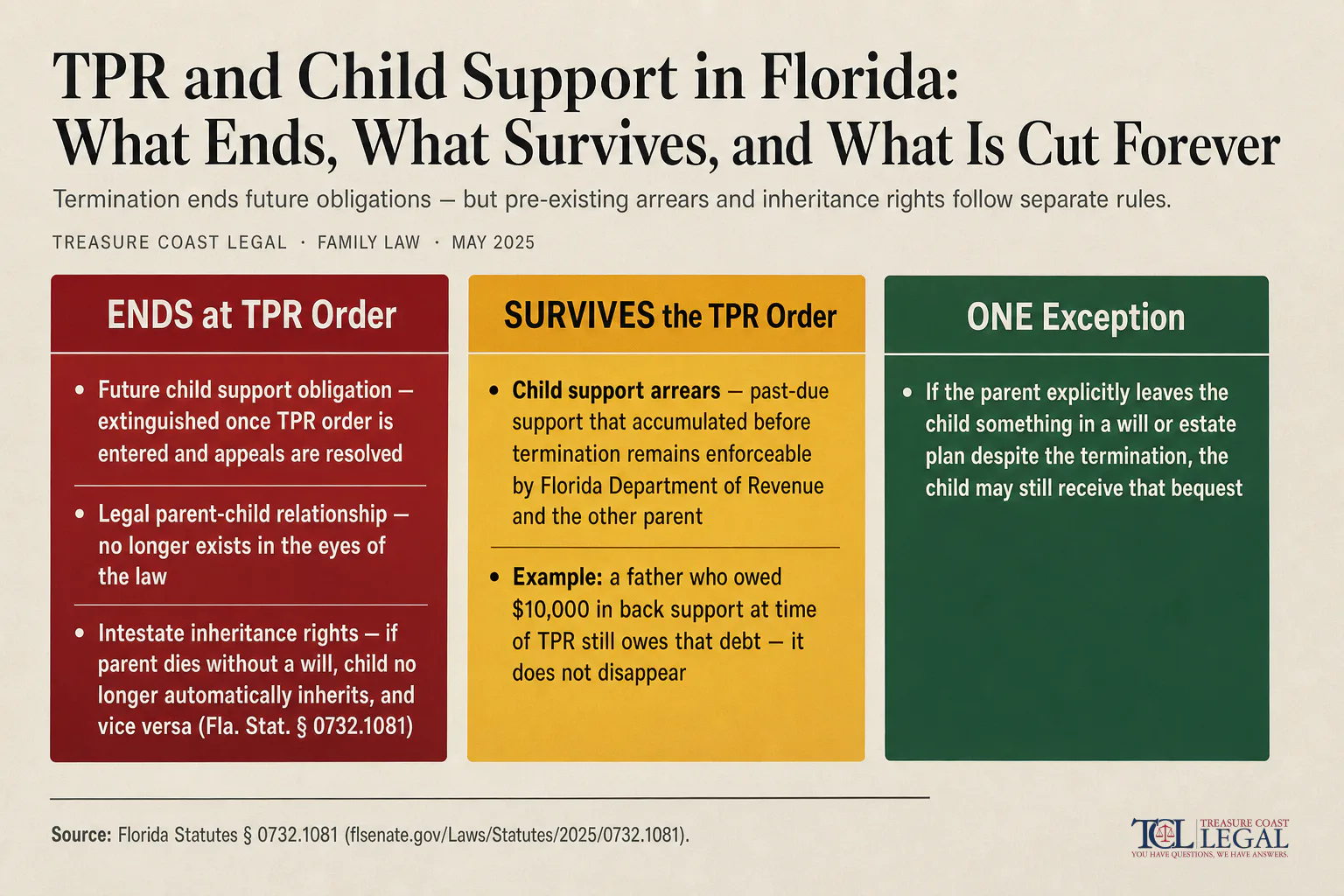
What Ends and What Survives
Once a court terminates rights and appeals are resolved, the parent's future child support obligation ends because the legal relationship no longer exists. Termination is not a backdoor to escape arrears, and past-due balances survive the order.
How Arrears Are Handled After Termination
Florida courts and the Department of Revenue continue enforcing pre-existing arrears after a TPR order, including through tax refund intercepts. A court to terminate parental rights does not have authority to erase those past-due amounts. Under Florida Statute § 732.1081, termination also cuts off the child's intestate inheritance from that parent unless a will specifically provides otherwise.
What Parents Being Served with a TPR Petition Should Do Immediately
Acting fast after service protects rights that a single missed deadline can erase forever.
Your Constitutional Rights in a TPR Proceeding
Parents facing involuntary termination have due process rights including the right to be heard, to present evidence, and, under Florida Statute § 39.807, to court-appointed counsel if they cannot afford an attorney. The U.S. Supreme Court addressed this right in Lassiter v. Department of Social Services. Accepting appointed counsel is not an admission of wrongdoing.
The Worst Thing You Can Do Is Miss a Hearing
Under Rule 8.510, a properly served parent who fails to appear can be deemed to have consented, and the court can terminate parent rights by default. Every hearing notice is a legal deadline.
How the Treasure Coast Courts Handle TPR Cases Locally
Treasure Coast families — from Hutchinson Island to the neighborhoods along US-1 in Stuart and Fort Pierce — navigate the same statewide statutes through a consistent local team of judges, DCF attorneys, and guardians.
Martin County and the 19th Judicial Circuit
TPR cases in Stuart and Palm City — including families along Kanner Highway and the Indian River Lagoon area — are heard in Martin County as part of the 19th Judicial Circuit, which also covers Indian River, Okeechobee, and St. Lucie counties. These parental rights cases proceed under the same statewide rules regardless of county. The circuit's Guardian ad Litem program, with an office in Fort Pierce, appoints volunteers to represent the child best interests, and local judges weigh the guardian's input closely.
St. Lucie County and Fort Pierce Family Court
Families in Tradition, Port St. Lucie, and Fort Pierce file at the St. Lucie County juvenile court, where the regional DCF office for the Southeast Region also operates. Knowing the correct courthouse and division saves critical time at filing.
Frequently Asked Questions About Terminating Parental Rights in Florida
Can you just terminate your parental rights voluntarily to avoid paying child support?
No. Florida courts accept voluntary termination only when another caregiver is ready to adopt and a judge finds it serves the child. Arrears remain enforceable.
How hard is it to terminate parental rights in Florida?
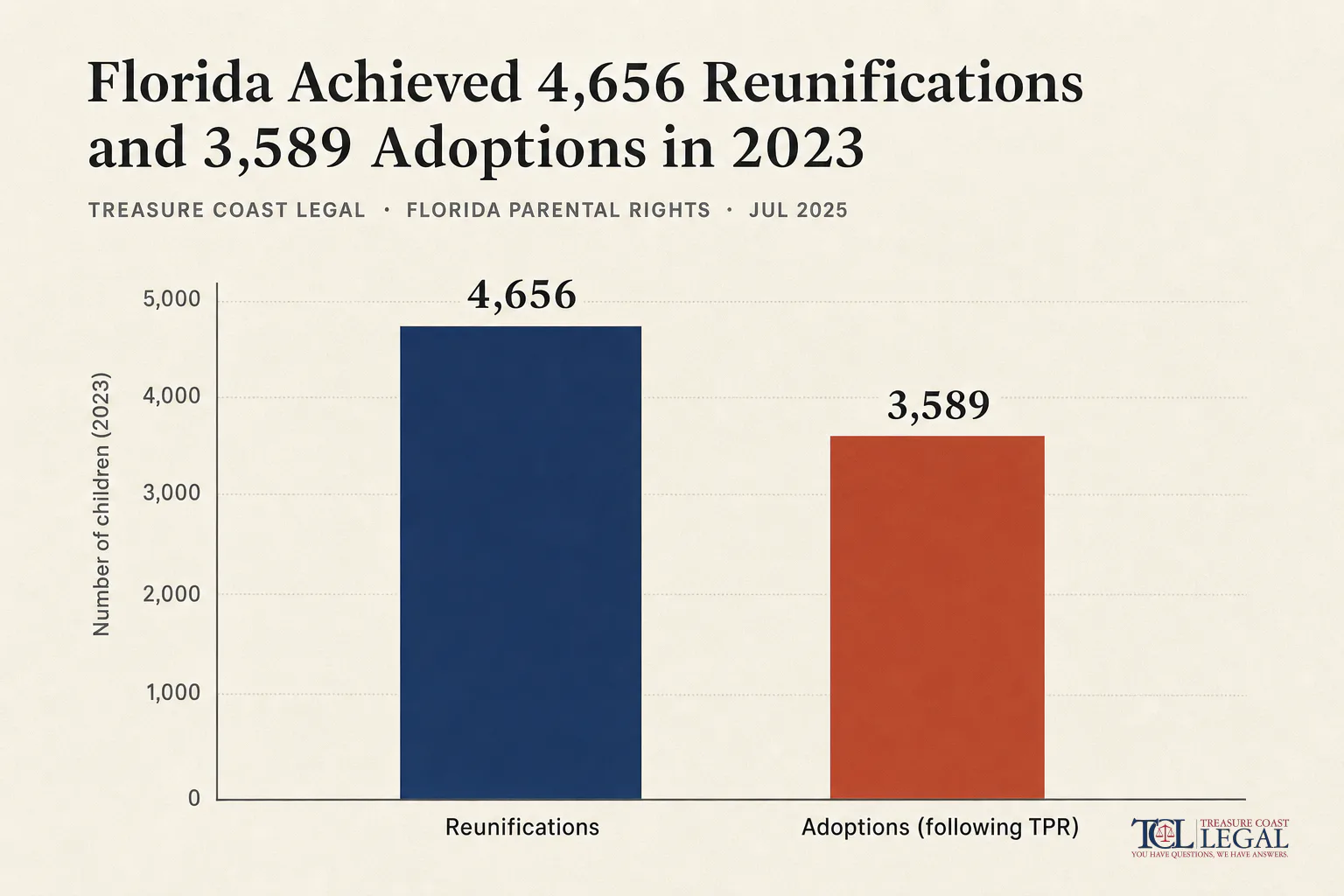
Very hard, by design. The petitioner must prove a statutory ground by clear and convincing evidence and separately prove termination serves the child best interest. The roughly 3,589 adoptions Florida finalized in 2023 are a small fraction of children in the system.
What is the 7 7 7 rule for parents?
The "7 7 7 rule" is not a Florida statutory provision and has nothing to do with terminating parental rights. Florida TPR law is governed entirely by Chapter 39.
How much does it cost to have parental rights terminated in Florida?
A private termination petition carries a circuit court filing fee of $408, according to the Martin County Clerk. Attorney fees vary widely, from a couple thousand dollars for an uncontested matter to over $10,000 for a contested trial. In DCF dependency cases, parents pay no filing fees and may receive court-appointed counsel.
If parental rights are terminated, does the child lose inheritance rights too?
Yes. Under Florida Statute § 732.1081, termination severs the child's intestate inheritance from that parent unless the parent's will specifically includes the child.
What to Do If You Are Facing a TPR Petition on the Treasure Coast
A termination order is permanent, which is why the time to act is before the next hearing. Whether you want to protect a child through stepparent adoption, resolve a child custody matter, comply with a DCF case plan, or defend against a petition, the decisions you make in the first days matter most. Treasure Coast Legal serves families throughout Martin and St. Lucie counties with legal services including TPR defense and stepparent adoption, with offices in Stuart, Fort Pierce, and Port St. Lucie, where founding attorney Shaun Plymale and our team know the 19th Circuit's procedures. Around here, local matters. Schedule a paid consultation through our footer form or call 772-238-7755.
Your Treasure Coast Neighbors
The information provided in this blog is for general informational and educational purposes only and is not intended as legal advice. Laws and legal outcomes vary based on specific facts and circumstances, and the information contained herein may not reflect the most current legal developments. You should not act or refrain from acting based on any information in this blog without first seeking legal advice from a qualified attorney licensed in your jurisdiction. This blog may be produced, in whole or in part, with the assistance of generative artificial intelligence tools and is reviewed by legal professionals before publication; however, no representations are made as to its accuracy, completeness, or applicability to any specific situation. Reading or interacting with this blog does not create an attorney-client relationship between you and the firm. An attorney-client relationship is formed only through a written agreement signed by both you and the firm. This blog may be considered attorney advertising under applicable laws and ethical rules. Prior results do not guarantee a similar outcome. The firm disclaims all liability for actions taken or not taken based on the content of this blog.
Shaun Plymale
Founding Attorney
Treasure Coast Legal