
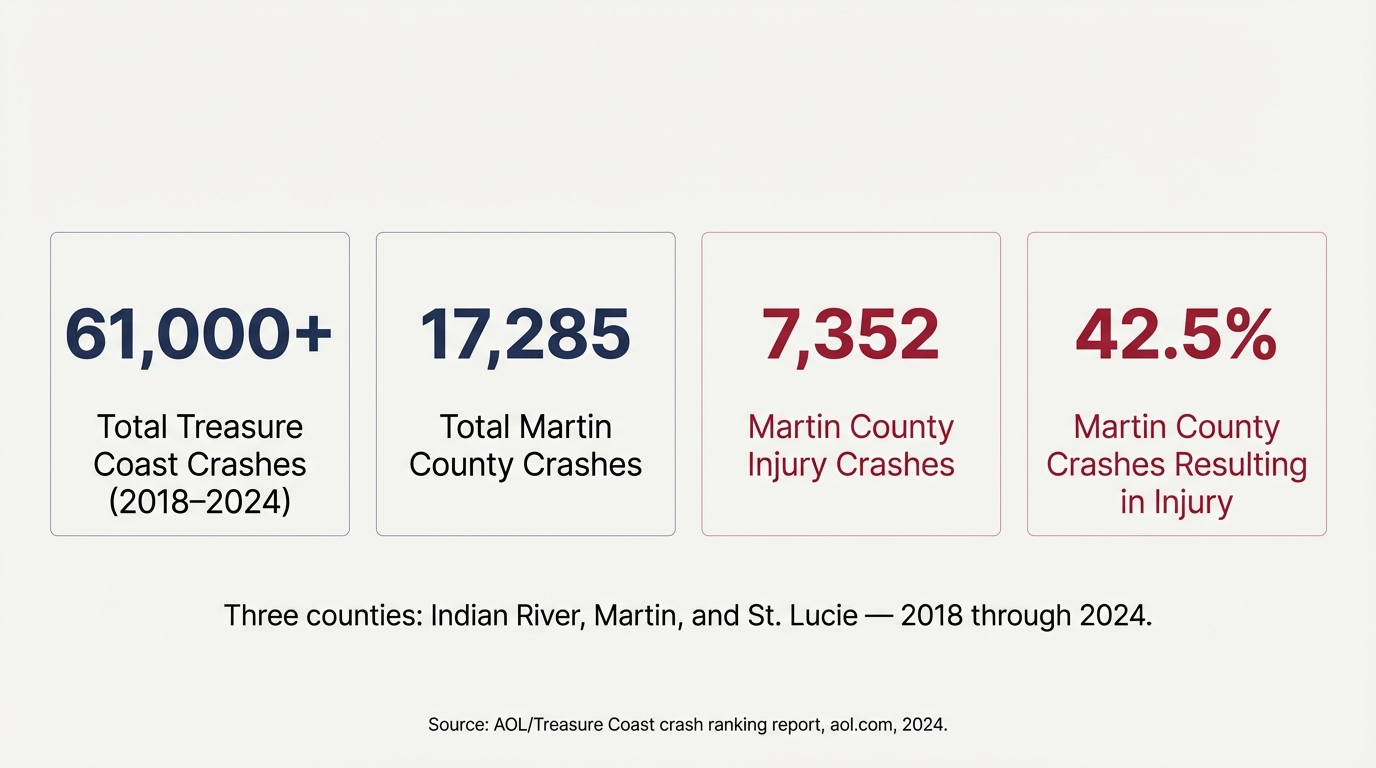
The Treasure Coast takes its name from the 1715 Spanish treasure fleet that sank off St. Lucie County, scattering gold across miles of Atlantic seafloor. Today, a different kind of financial wreckage happens on US-1, I-95, and Port St. Lucie Blvd: car accidents that leave victims unsure which claim to file, what their coverage pays, and whether an insurance company's settlement offer is anywhere close to fair. From 2018 through 2024, the Treasure Coast's three counties recorded over 61,000 vehicle crashes, according to crash data compiled by the Florida Department of Highway Safety and Motor Vehicles.
Two terms often cause confusion for individuals involved in an accident: bodily injury and property damage. The difference between them determines who pays, how much, and how long you wait.
Key Takeaways
- Florida does not require drivers to carry bodily injury liability insurance, meaning the at-fault driver may have zero coverage for your physical injuries — making your own uninsured motorist coverage critical.
- Bodily injury insurance claims pay medical expenses, lost wages, and pain and suffering; property damage claims cover only tangible items like your vehicle and personal property.
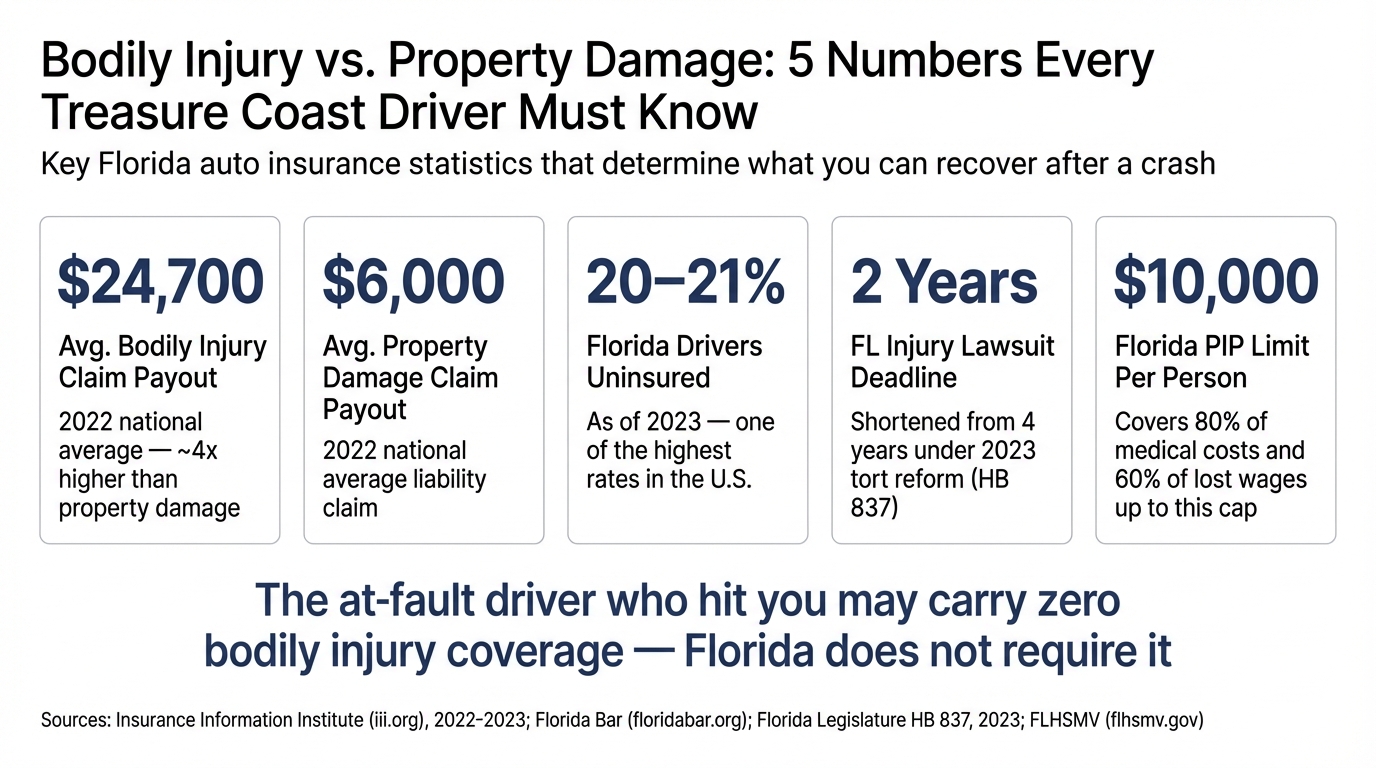
- The average bodily injury liability claim paid roughly $28,278 in 2024, about four times the average property damage liability payout of $6,770.
- Florida's 2023 tort reform cut the personal injury statute of limitations from four years to two years — the clock starts the day of the crash.
- Never settle a bodily injury claim before your doctor confirms maximum medical improvement; settling early and releasing future liability is the most common and most costly mistake Treasure Coast accident victims make.
What "Bodily Injury" and "Property Damage" Actually Mean in a Florida Accident
The Legal Definitions Behind Both Terms
Bodily injury refers to any physical harm caused to a person's body by someone else's negligence. Broken bones, whiplash and other soft tissue injuries, traumatic brain injuries, spinal cord damage, and scarring or disfigurement all qualify. Property damage is harm to tangible items: the vehicle, personal property inside the car, fencing, or any other damaged property belonging to someone else.
As the Florida Bar explains, bodily injury liability coverage pays for injuries or death you cause to others, while property damage liability coverage pays for damage you cause to someone else's property. Florida statutes treat these as two distinct legal categories with separate coverage requirements, separate claims processes, and often separate adjusters inside the same law firm or insurance company. Understanding which type of claim applies to your situation prevents you from filing under the wrong coverage and losing valuable time.
If you were hurt in a rideshare vehicle, these distinctions become even more layered — read our breakdown of what happens when the Uber you're in crashes to see how bodily injury and property damage claims work in that specific context.
How Florida's No-Fault System Affects Both Claim Types
Florida is a no-fault state. Your own Personal Injury Protection (PIP) coverage pays 80% of necessary medical expenses and 60% of lost wages up to a combined $10,000 limit, regardless of who caused the crash, per Florida Statute §627.736. That $10,000 is a single pool shared between medical benefits and wage benefits, not two separate limits. PIP does not cover vehicle repairs and does not compensate pain and suffering. Once your injuries cross the serious injury threshold — permanent injury, significant scarring, loss of an important bodily function, or death — you can step outside no-fault and pursue personal injury insurance claims directly against the at-fault driver.
Property damage claims operate entirely outside the no-fault system. You claim against the at-fault driver's property damage liability coverage regardless of fault rules, and that process begins immediately after the crash.
What Bodily Injury and Property Damage Claims Can and Cannot Recover
Medical Expenses, Lost Wages, and Future Costs
A bodily injury insurance claim covers the full range of economic damages tied to physical harm: emergency treatment at Lawnwood Regional Medical Center or Cleveland Clinic, surgeries, rehabilitation, prescription costs, and future medical bills for ongoing care. It also covers lost wages if your injuries kept you off work — a real factor on the Treasure Coast, where many residents work in marine trades, construction, and tourism. For a deeper look at how these claims play out locally, see our personal injury guide for Fort Pierce accident victims.
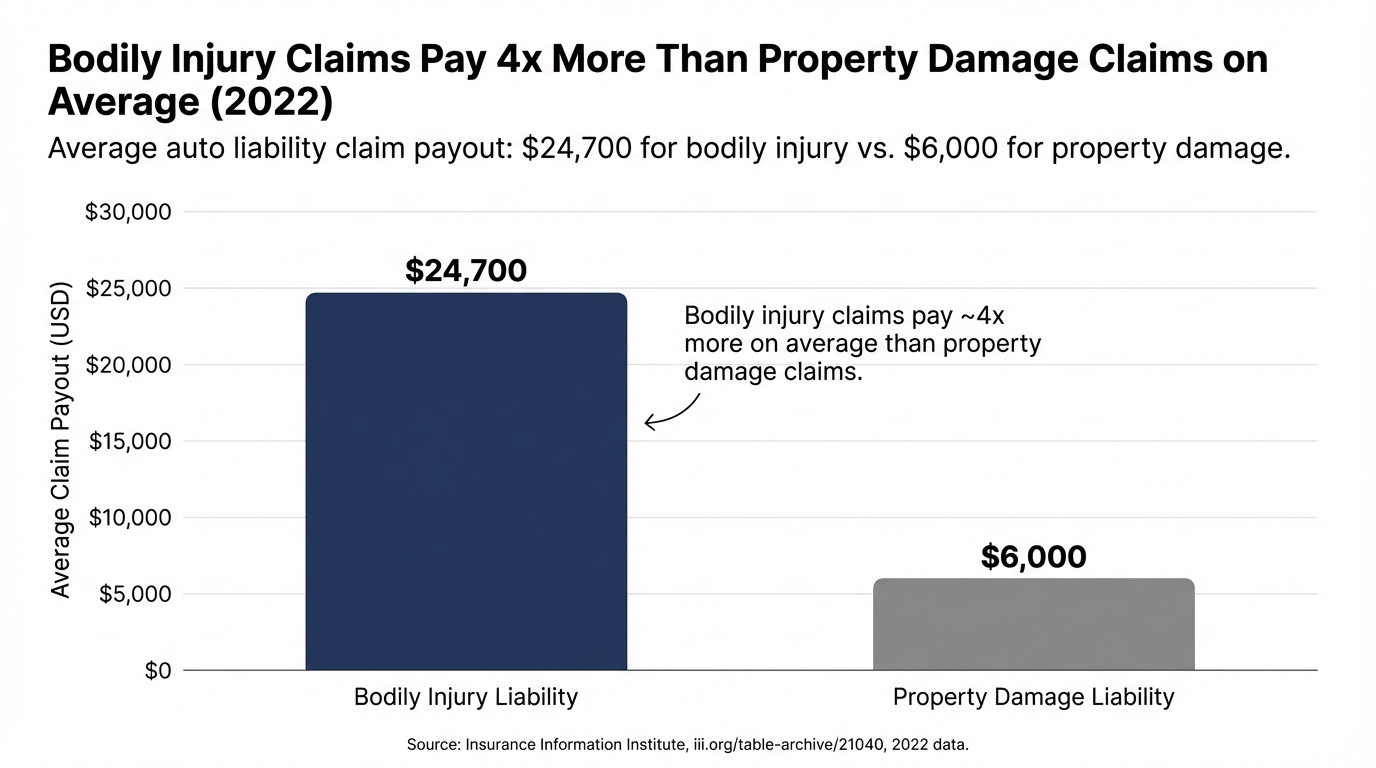
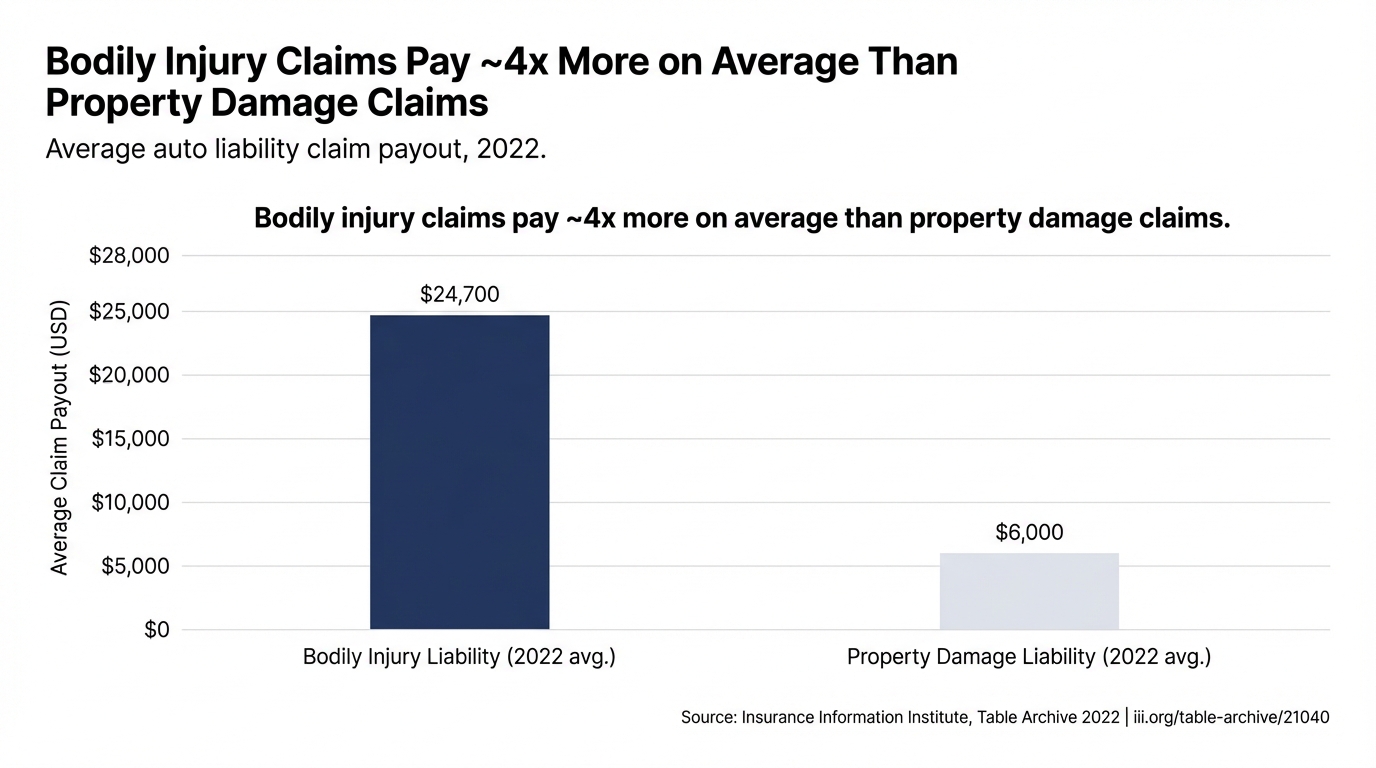
According to Insurance Information Institute data, the average auto liability claim payment for bodily injury was approximately $28,278 in 2024, compared to roughly $6,770 for the average property damage liability claim. That gap reflects the compounding costs of physical injury that a property damage insurance claim simply cannot reach. Bodily injury insurance claims also cover noneconomic losses that no repair invoice can capture, making them among the most significant personal injury cases an attorney handles.
Pain and Suffering and Long-Term Consequences
Unlike a property damage claim, a personal injury insurance claim also reaches noneconomic damages — pain and suffering, emotional distress, and loss of enjoyment of life. These categories frequently represent the largest portion of a fair settlement, and securing fair compensation for them requires thorough documentation. For a crash on Kanner Highway or A1A that leaves a victim with chronic pain or limited mobility, the long term consequences and noneconomic damages can far exceed the initial medical bills.
Insurance companies apply internal formulas to value pain and suffering, and those formulas typically start low. Medical evidence, expert witnesses, and documented lifestyle impact are the tools for challenging them, and workers compensation benefits records can also support lost-income calculations. Florida's 2023 tort reform (HB 837) shifted the state to modified comparative negligence, meaning any percentage of fault attributed to you directly reduces your recovery — and if you are found more than 50% at fault, you are barred from recovery entirely. Thorough documentation of the accident scene is essential to protecting your share of fault and your full recovery.
What a Property Damage Claim Covers and How It Is Valued
Vehicle Repair Costs and Total Loss Determinations
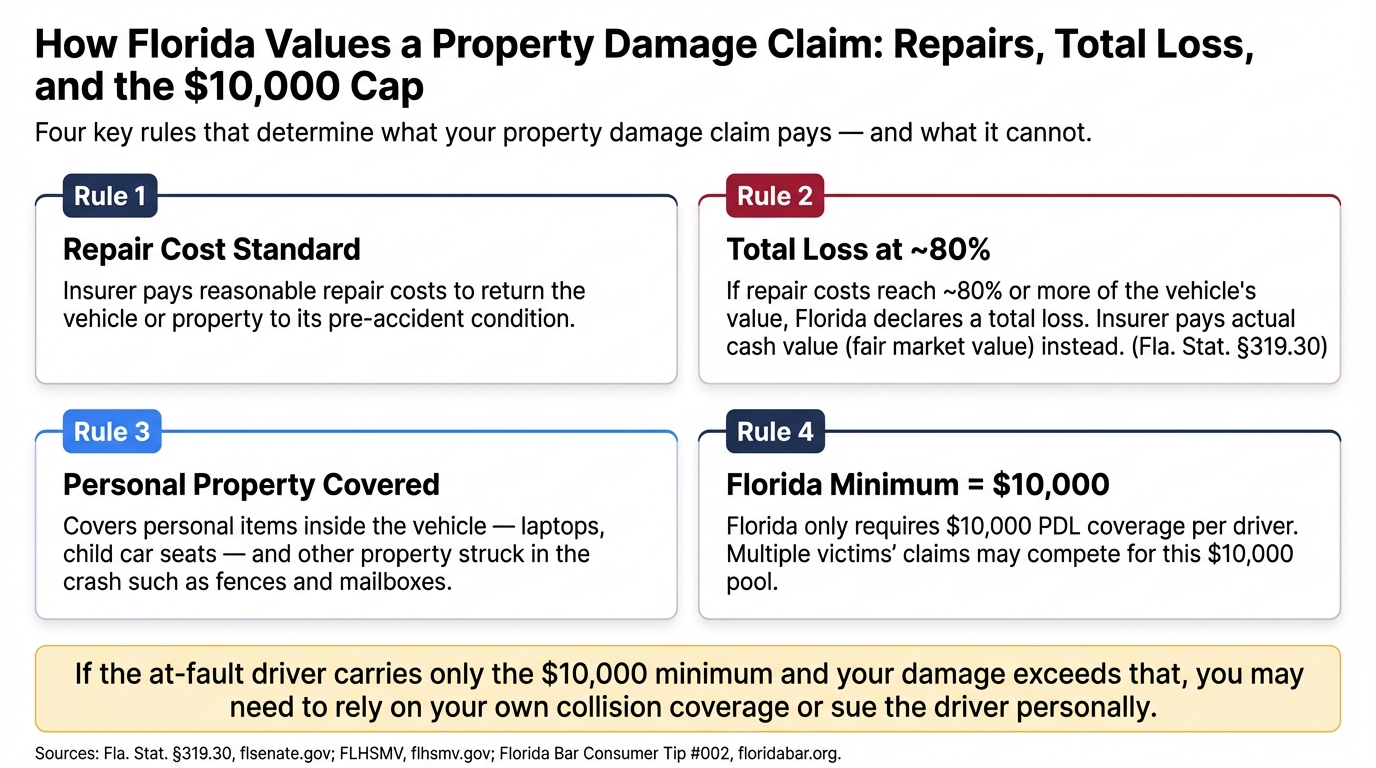
A property damage insurance claim covers reasonable repair costs to restore your vehicle to its pre-accident condition. Under Florida Statute §319.30, if repair costs reach approximately 80% of the vehicle's actual cash value, the insurer declares a total loss and pays fair market value instead. On the Treasure Coast, where salt air and humidity affect vehicle condition, insurers sometimes apply steep condition deductions that undervalue totaled cars — those figures are negotiable with independent appraisals and comparable local listings.
Florida law mandates only $10,000 in property damage liability coverage per driver, per FLHSMV. In a serious accident, multiple victims' property damage claims may compete for that $10,000 limit, leaving some claims only partially paid. Filing property damage lawsuits becomes a realistic option when the at-fault driver's coverage is exhausted and losses are significant.
It is always a good idea to get at least two independent appraisals before signing any release on a total loss vehicle. The insurer's first offer is rarely the ceiling, and a local comparable search can meaningfully raise that figure.
Personal Property Inside the Vehicle and Other Damaged Property
Property damage liability coverage extends beyond the vehicle. Laptops, phones, child car seats, and other personal property destroyed in the crash can be included in a property damage insurance claim. If the at-fault driver struck a fence, mailbox, or storefront along US-1 or Port St. Lucie Blvd, those losses run through the same liability channel.
Renters and homeowners policies sometimes carry medical payments coverage or additional coverage for personal property damaged in auto accidents — a secondary recovery source many Treasure Coast victims overlook entirely. Document every damaged item with photographs before filing your property damage insurance claim.
How Florida's Minimum Coverage Limits Affect What You Can Actually Collect
Florida's Required Minimums and the Coverage Gap Problem
Florida law requires drivers to carry $10,000 in property damage liability and $10,000 in PIP coverage. As the Florida Bar confirms, Florida does not require drivers to carry any bodily injury liability insurance. The driver who rear-ended you on I-95 near Port St. Lucie may legally carry zero coverage for your physical injuries.
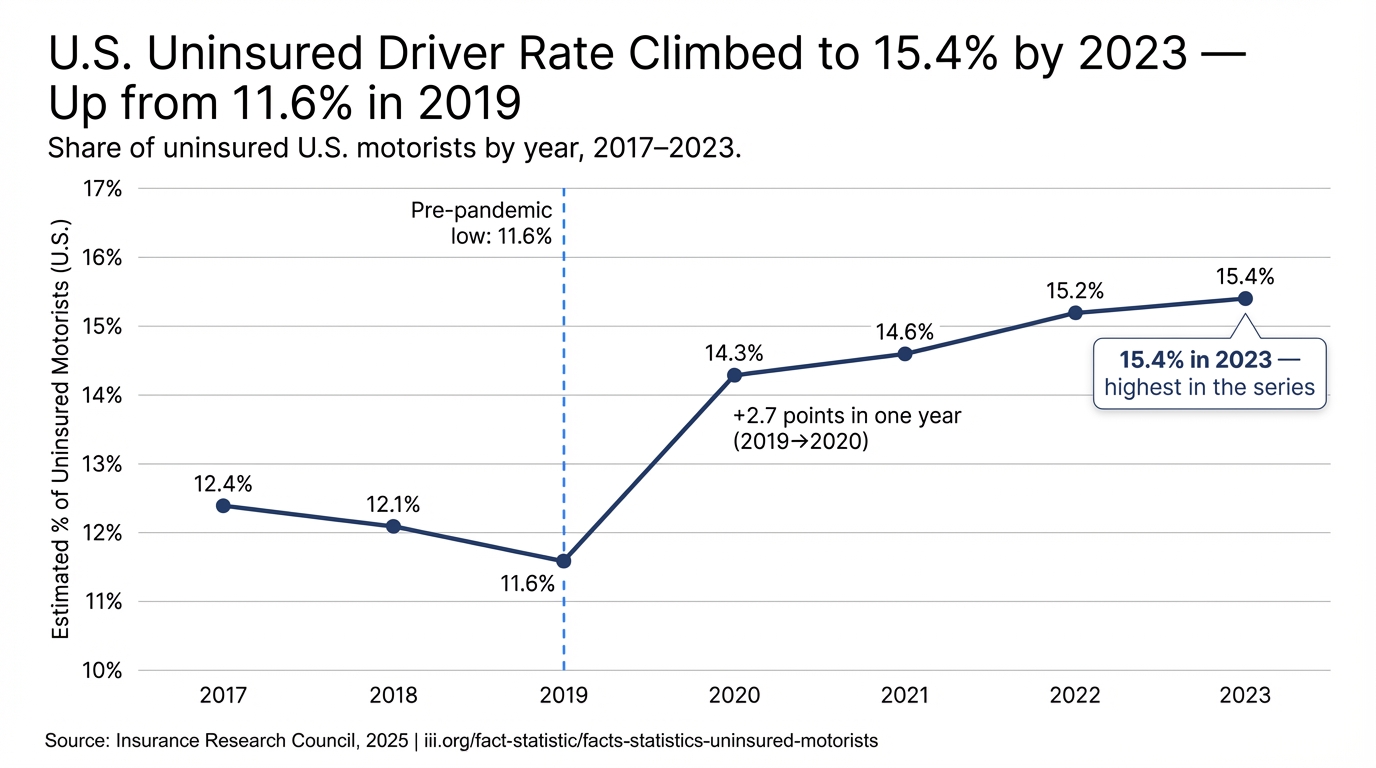
The national uninsured driver rate climbed to 15.4% by 2023, up from 11.6% in 2019, according to Insurance Research Council data. Florida's rate runs even higher — approximately 20 to 21% of Florida drivers were uninsured as of 2023, ranking the state among the top six in the country for uninsured motorists. This percentage does not take into consideration how many Florida Drivers purchase the cheapest coverage available, which does NOT include coverage for bodily injury. When the at-fault driver carries no bodily injury coverage, your own uninsured motorist (UM) coverage becomes your primary source for recovering on personal injury insurance claims. Without it, collecting requires suing the driver personally, which is slow and uncertain.
How Much Bodily Injury Liability Coverage Is Enough
For drivers who do carry bodily injury liability, car insurance coverage policies are sold as split limits. A 100/300/100 policy means the insurer pays up to $100,000 per injured person, $300,000 total for all bodily injuries in one accident, and $100,000 for all property damage. These are legal floors, not recommended levels.
Emergency hospitalization, surgery, and rehabilitation after a serious crash on US-1 can easily exceed $100,000. When medical expenses surpass the policy cap, the shortfall becomes a personal judgment against the at-fault driver. If you own a home, savings, or a boat on the Treasure Coast, carrying bodily injury liability well above Florida's minimums protects those assets as a property owner if you are ever the at-fault party. The same principle applies on the water — our Treasure Coast boat accident guide covers how bodily injury and property damage liability work in marine crash scenarios.
How Insurance Companies Handle Bodily Injury vs. Property Damage Claims Differently
Why Property Damage Claims Resolve Faster
Insurance companies typically resolve property damage claims within days to a few weeks because the value is concrete — repair invoices, market comparables, and replacement costs are documentable numbers. Bodily injury insurance claims take weeks to months, and sometimes years for serious injuries, because the full extent of physical harm and long-term consequences must be established before any responsible attorney advises settling.
According to Insurance Information Institute data, in 2024, 2.50 percent of people with auto liability insurance had a property damage liability claim, while only 0.80 percent had a bodily injury liability claim, according to ISO data compiled by the Insurance Information Institute. Bodily injury claims are less frequent but carry roughly four times the average payout, which is precisely why insurers push hard for early settlements on personal injury insurance claims. Accepting a quick offer before your treatment is complete releases the at-fault party from all future liability, including bodily injury lawsuits you might otherwise bring.
Insurer Tactics That Affect Both Claim Types
Insurance companies are profit-driven entities with professional adjusters trained to minimize payouts to the lowest possible amount on both bodily injury and property damage claims. Common tactics include delaying responses to increase financial pressure, requesting recorded statements to identify inconsistencies, and offering fast low-ball settlements before injuries are fully documented.
Florida's bad faith insurance statute, §624.155, creates penalties when an insurer fails to act in good faith on a valid claim. If an insurer stalls without justification on your property damage insurance claim or personal injury insurance claim, you can file a Civil Remedy Notice. The insurer then has 60 days to pay or correct the violation — failure to do so opens them to a bad faith lawsuit with potential damages above policy limits.
When filing property damage lawsuits or pursuing bodily injury claims through litigation becomes necessary, that bad faith framework is one of the most powerful tools available to Florida accident victims.
What Treasure Coast Accident Victims Should Do Immediately After a Crash
The actions you take in the 24 to 72 hours after a crash on US-1, A1A, or Midway Road directly determine the value of both your bodily injury and property damage claims. Under Florida Statute §627.736, PIP coverage requires an initial medical visit within 14 days of the accident — missing that window eliminates your PIP eligibility entirely. Photograph every angle of vehicle damage, road conditions, and visible injuries to support your personal injury claim. Collect the other driver's insurance information and note their policy limits.
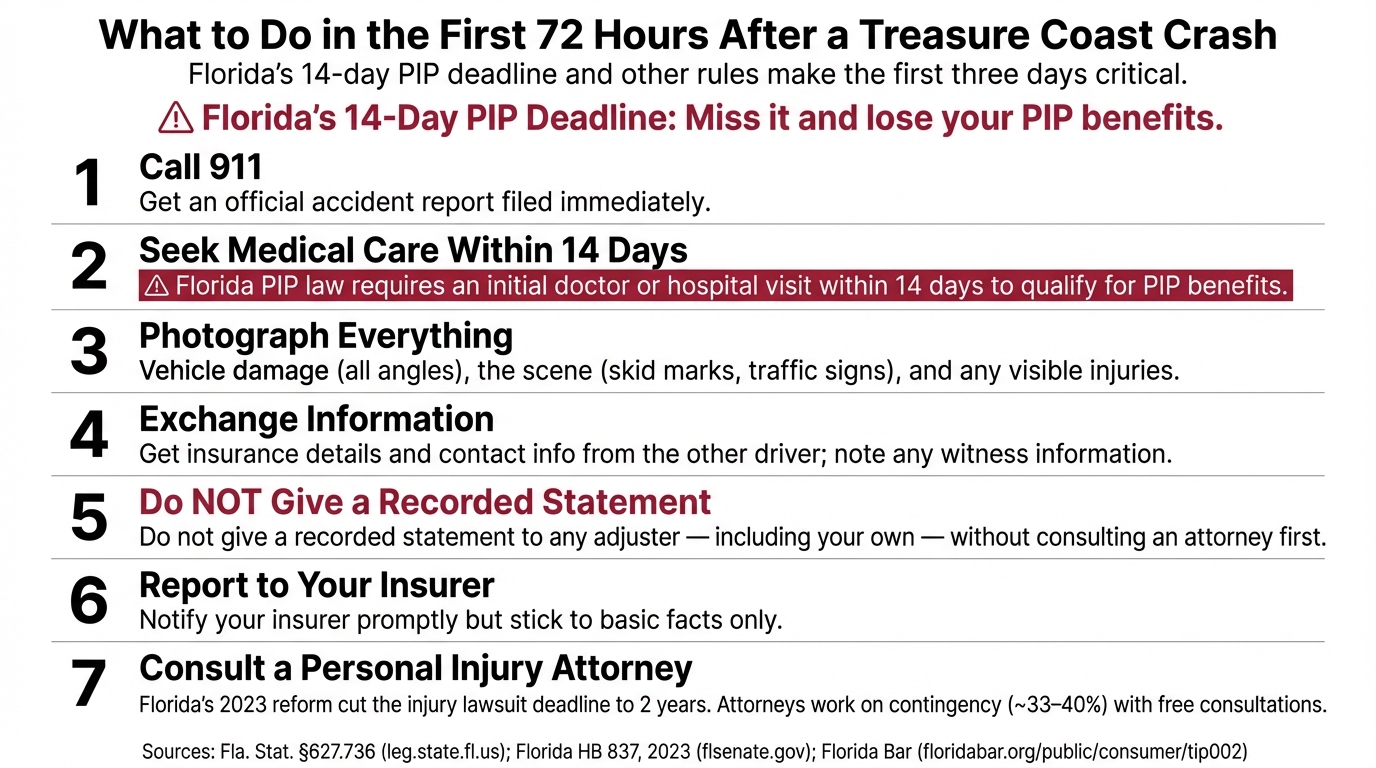
Do not give a recorded statement to any insurance company — yours or the other driver's — without speaking to an attorney first. It is also a good idea to request a copy of the official crash report through the FLHSMV before speaking with any adjuster. Florida's 2023 tort reform reduced the personal injury statute of limitations from four years to two years, per HB 837, so the timeline for protecting bodily injury insurance claims is tighter than most victims realize.
Property damage claims for minor fender-benders with clear liability can often be handled directly without additional legal services. But any crash involving physical injuries, disputed fault, an uninsured driver, or ongoing medical treatment warrants legal representation from a personal injury lawyer. Personal injury attorneys handling Treasure Coast accident claims work on contingency — you pay nothing in legal fees unless the case settles or wins at trial. For accidents that occurred in Fort Pierce, Stuart, or elsewhere in St. Lucie County, our personal injury guide for Fort Pierce walks through the local claims process in detail.
Frequently Asked Questions
What does bodily injury and property damage mean? Bodily injury refers to physical harm caused to a person — broken bones, whiplash, traumatic brain injuries — resulting from someone else's negligence. Property damage refers to harm done to tangible items like a vehicle, fence, or personal belongings. In a Florida car accident, these are two separate claims filed under different coverage types, following different timelines, valuation methods, and legal processes. Bodily injury insurance claims open the door to pain and suffering compensation; property damage insurance claims do not.
What does 100K / 300K / 100K mean? Those numbers represent a split-limit auto insurance policy. The first figure ($100,000) is the maximum paid to one injured person. The second ($300,000) is the total paid for all bodily injuries in a single accident. The third ($100,000) is the maximum for all property damage in that accident. If medical bills or combined injuries exceed those caps, the at-fault driver is personally responsible for the remainder.
What is the average settlement for a property damage claim? According to Insurance Information Institute data, the average property damage liability claim paid approximately $6,770 in 2024. That figure covers only tangible losses to vehicles and property, not injuries. Actual amounts vary based on vehicle value, repair costs, and whether the insurer disputes the claim — and independent appraisals can meaningfully increase a low initial offer. Filing property damage lawsuits is an option when the insurer refuses to negotiate fairly.
Will my insurance go up if I use PIP? Using your own PIP coverage after a crash where you were not at fault generally does not trigger a rate increase, since PIP is no-fault coverage. However, insurance company policies vary, and some carriers do review overall claims history at renewal. Florida law prohibits insurers from raising rates solely because you filed a PIP claim for an accident you did not cause, but reviewing your specific policy language with an attorney or your agent is advisable.
How do personal injury insurance claims and property damage insurance claims differ in Florida? Personal injury insurance claims — also called bodily injury claims — compensate for physical harm, lost income, and pain and suffering caused by another driver's negligence. Property damage insurance claims compensate for the cost of repairing or replacing physical items. In Florida, these run on separate tracks: a property damage insurance claim can often be resolved within weeks, while a personal injury insurance claim may remain open for months or years until the full medical picture is clear. Settling your property damage insurance claim first is generally safe as long as the release language does not inadvertently close out your bodily injury claim.
What to Do If You're Navigating Both Claim Types
After a Treasure Coast crash, the difference between a bodily injury claim and a property damage insurance claim is not a technicality — it is the difference between recovering your full losses and leaving money on the table. Property damage moves quickly and covers what you can see. Bodily injury insurance claims take longer, cover what the accident cost you physically and financially, and require careful documentation before any settlement is final.
Florida's 2023 tort reform narrowed the window to act and raised the stakes for getting the claims process right. If you were injured in a crash anywhere on the Treasure Coast, the team at Treasure Coast Legal can review both your bodily injury and property damage claims in a free consultation and tell you clearly what your case is worth before you accept a dollar from any insurance company.
Call 772-238-7755 or schedule your free consultation here. We're your Treasure Coast neighbors, and we know exactly how local insurers handle these claims.
— Shaun Plymale, Founding Attorney, Treasure Coast Legal
The information provided in this blog is for general informational and educational purposes only and is not intended as legal advice. Laws and legal outcomes vary based on specific facts and circumstances, and the information contained herein may not reflect the most current legal developments. You should not act or refrain from acting based on any information in this blog without first seeking legal advice from a qualified attorney licensed in your jurisdiction. This blog may be produced, in whole or in part, with the assistance of generative artificial intelligence tools and is reviewed by legal professionals before publication; however, no representations are made as to its accuracy, completeness, or applicability to any specific situation. Reading or interacting with this blog does not create an attorney-client relationship between you and the firm. An attorney-client relationship is formed only through a written agreement signed by both you and the firm. This blog may be considered attorney advertising under applicable laws and ethical rules. Prior results do not guarantee a similar outcome. The firm disclaims all liability for actions taken or not taken based on the content of this blog.