

Key Takeaways
- Florida is a no-fault state, so one spouse only needs to state the marriage is "irretrievably broken" under § 61.052. You do not need your spouse's agreement to file.
- At least one spouse must live in Florida for six months before filing, per § 61.021.
- Simplified dissolution requires meeting all four eligibility rules. If you have minor children, it is not available.
- Mandatory financial disclosure is due within 45 days of service, and incomplete disclosure is the top reason cases stall.
- Court filing fees run roughly $397.50 to $408 on the Treasure Coast, with contested cases costing far more once attorney fees are added.
Written by Shaun Plymale, Founding Attorney.
The Treasure Coast earned its name from a 1715 Spanish treasure fleet that wrecked off Fort Pierce, and gold and silver coins still wash ashore there today. Far more common than buried treasure is the courthouse paperwork that follows the end of a marriage. Florida recorded more than 76,000 divorces in a single recent year, according to the CDC's National Center for Health Statistics. Knowing how to get divorce in Florida starts with one decision, whether your case follows the simplified dissolution track or a regular dissolution. This walkthrough for Martin County, St. Lucie County, and the broader Treasure Coast covers what to file, when, and what happens through the final judgment. For a head start, our Martin County divorce attorneys can walk you through your options.
Florida Is a No-Fault State and That Changes Everything About Your Case
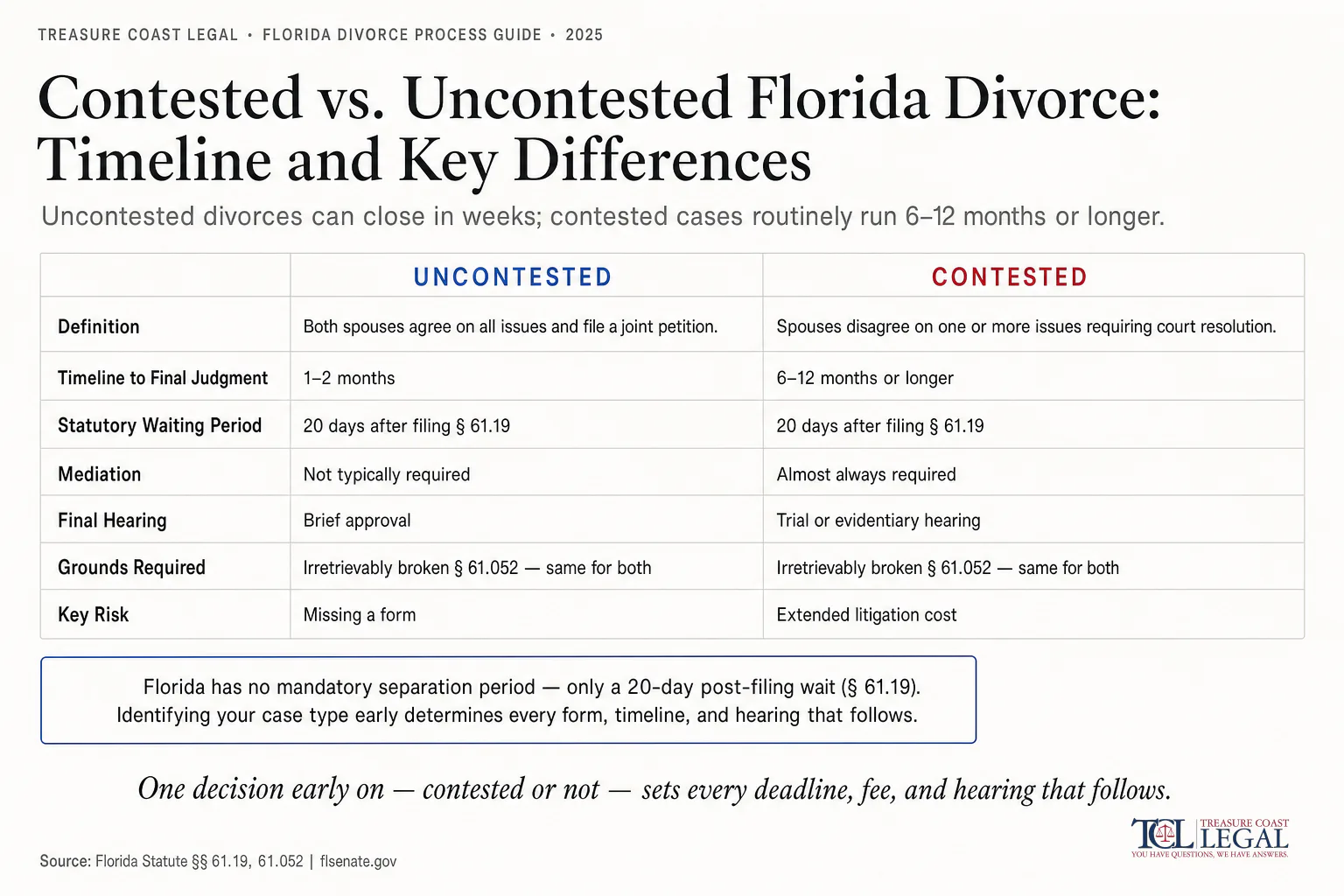
Florida is not a fault divorce state, meaning you do not need to prove your spouse did anything wrong. That single fact shapes the entire legal process.
What "Irretrievably Broken" Actually Means in Court
Under Florida Statute § 61.052, a court will grant a divorce if the marriage is "irretrievably broken" or if one spouse has been adjudicated mentally incapacitated for at least three years. Irretrievably broken simply means one party believes the marriage is over, no evidence, no fault, no blame. You do not need your spouse to agree the marriage is finished, and the legal requirements to meet this standard are minimal.
Florida Residency Requirement You Must Meet Before Filing
One spouse must have lived in Florida for at least six months before filing, per § 61.021. You typically prove this with a Florida driver's license or voter registration card. If you recently moved to the Treasure Coast, confirm your six-month mark before filing.
The Difference Between Contested and Uncontested Divorces in Florida
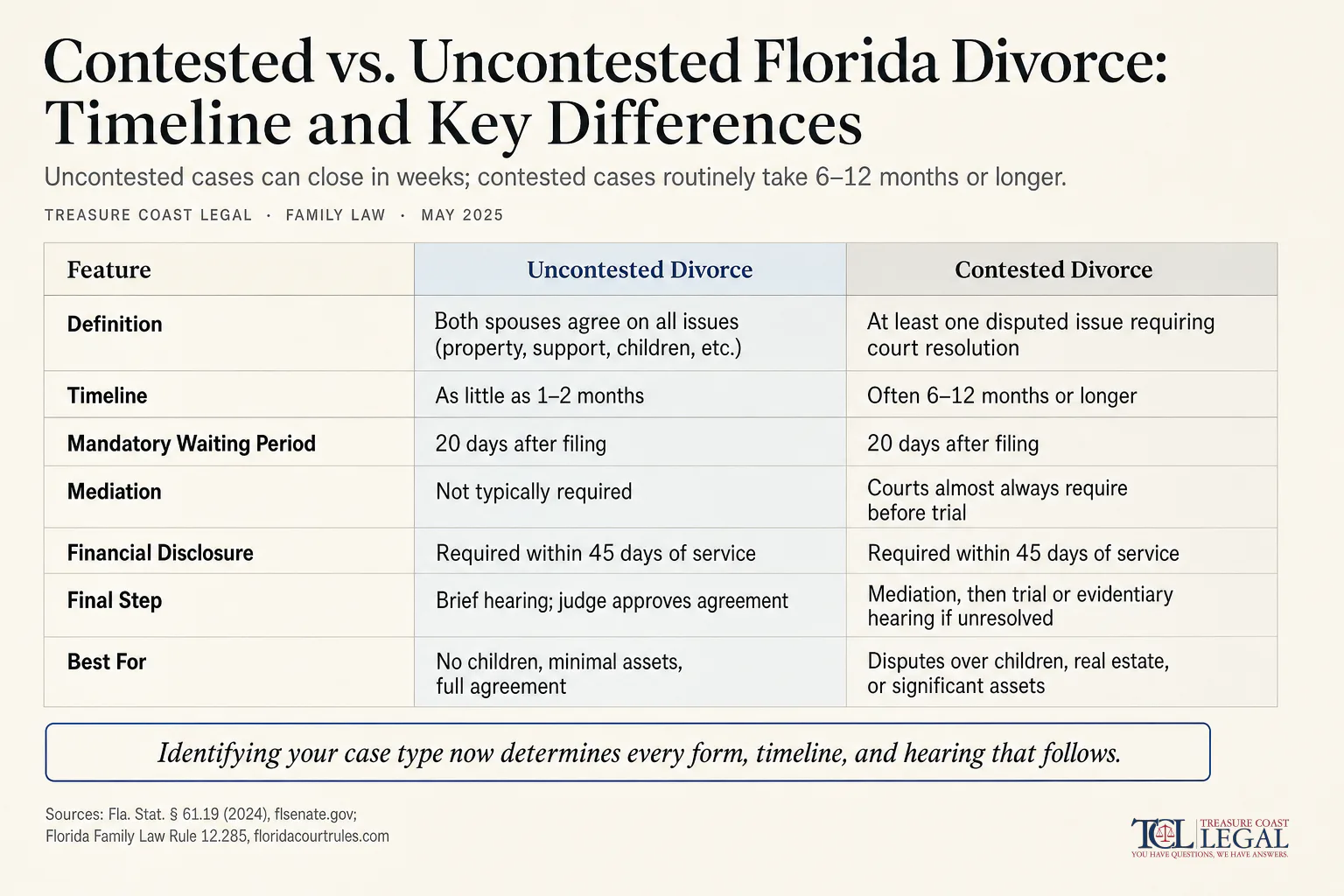
An uncontested divorce means both spouses agree on every term, including property division, child support, timesharing, and spousal support. A contested divorce has at least one disputed issue requiring court intervention. The distinction drives your timeline, and our guide on how long a divorce takes in Florida breaks down what to expect.
Simplified Dissolution Is Only an Option If You Meet Every Requirement
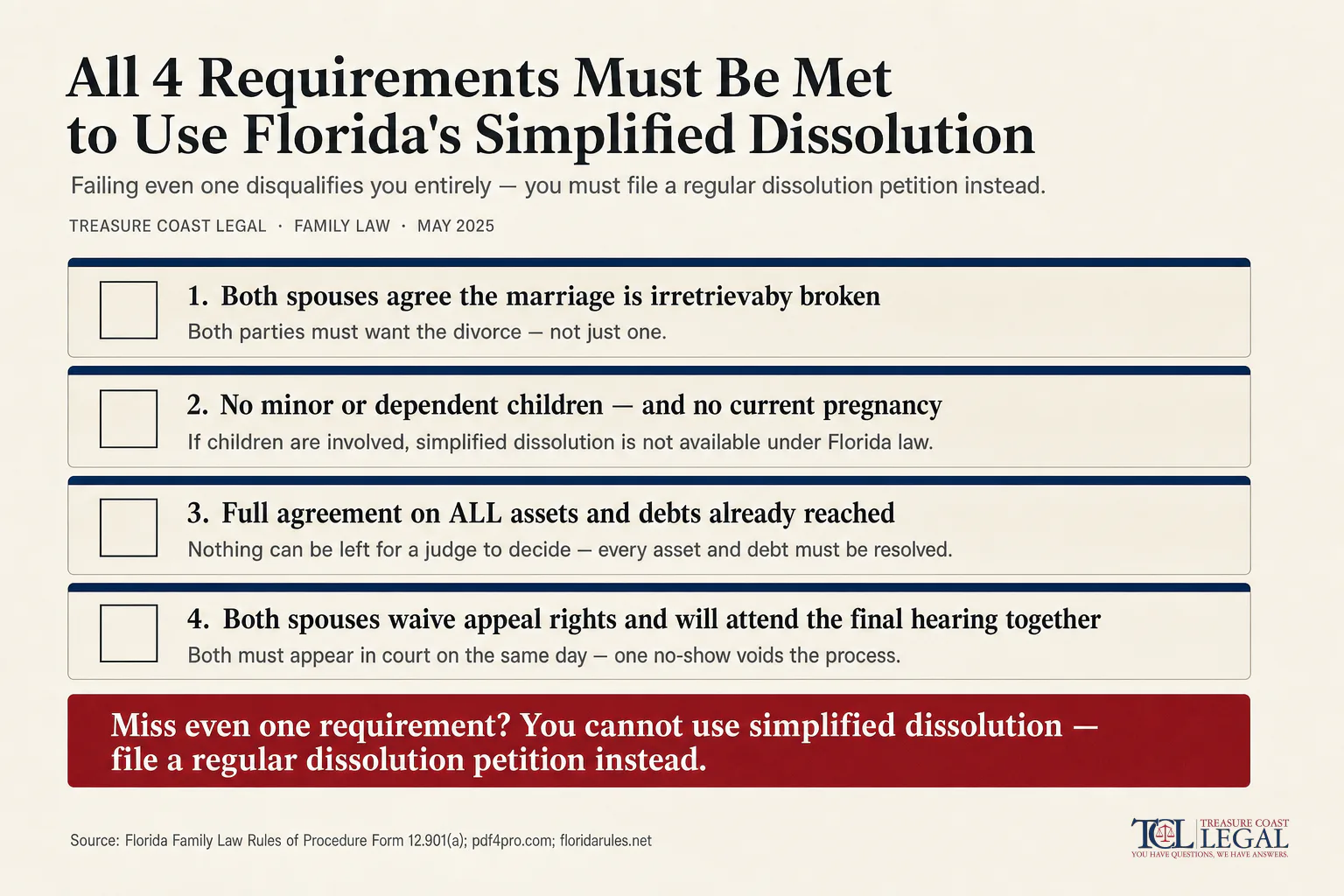
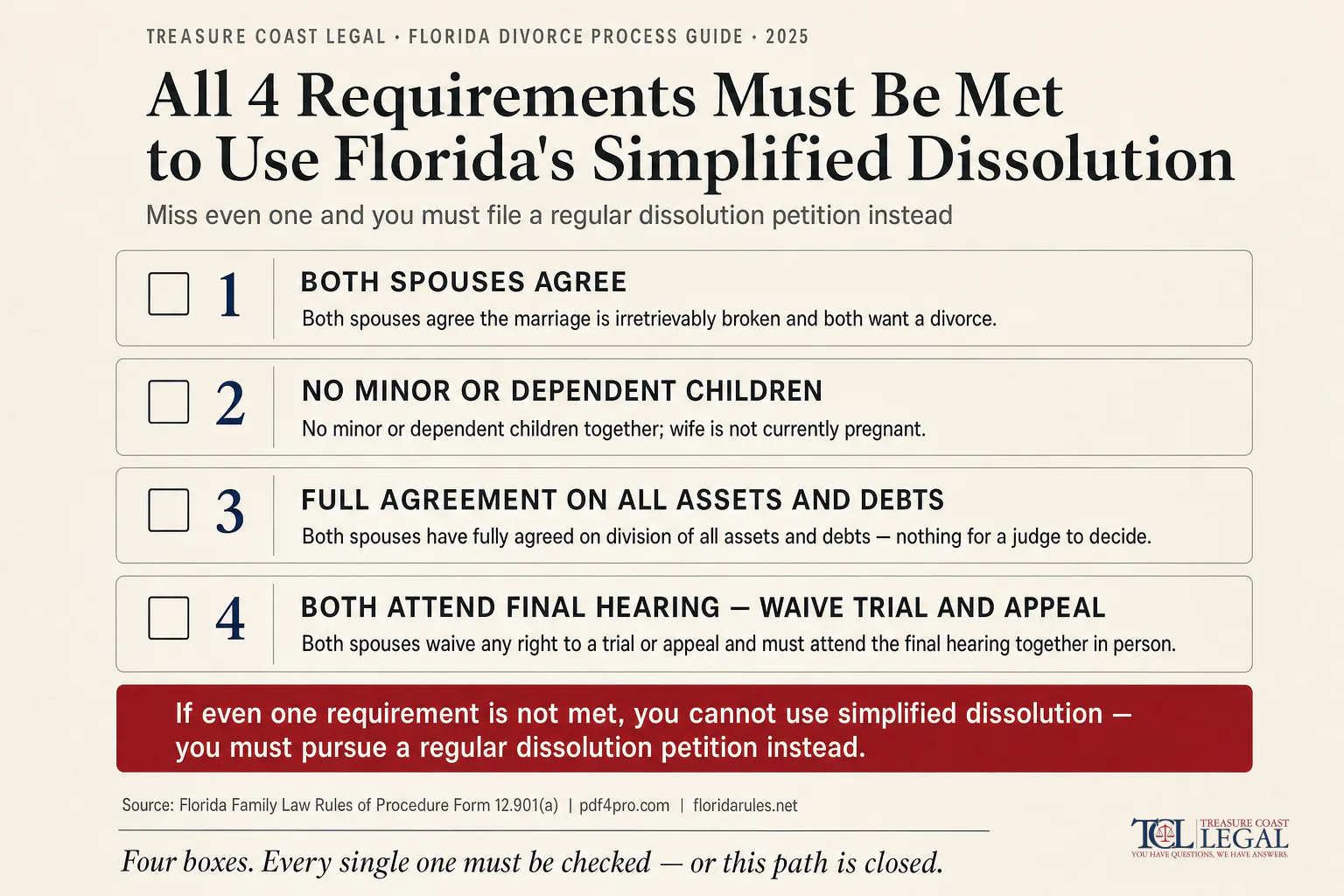
Many Treasure Coast residents want the fastest, cheapest path, but Florida's simplified dissolution has strict rules. Failing even one disqualifies you entirely.
The Four Requirements for a Simplified Dissolution in Florida
Under the official instructions to Form 12.901(a), all of the following conditions must be true, both spouses agree the marriage is irretrievably broken, they have no minor or dependent children together and the wife is not pregnant, they fully agree on dividing all assets and debts, neither spouse seeks alimony, neither wants any discovery beyond financial affidavits, both waive trial and appeal, both are willing to appear at the clerk's office to sign the petition, and both attend the final hearing. If you have children, simplified dissolution is not available.
What a Simplified Divorce Step by Step Looks Like
Both spouses jointly complete and sign the divorce papers, file at the circuit court clerk's office (100 SE Ocean Blvd in Stuart for Martin County, or 201 South Indian River Drive in Fort Pierce for St. Lucie County), pay the filing fee, and attend one joint final hearing. Because Florida's only waiting period is 20 days, a simplified dissolution can reach a final judgment in about 30 days.
Why Simplified Dissolution Breaks Down More Often Than People Expect
Any disagreement over personal property, any hidden debt, or any newly discovered asset forces conversion to a regular dissolution. Under Florida Family Law Rule 12.105, if even one requirement is unmet, you must pursue a regular dissolution petition. When there is any financial complexity, start with regular dissolution to avoid refiling.
The Step-by-Step Filing Process for a Regular Florida Dissolution
For most Treasure Coast families with minor children, significant assets, or a long term marriage, the regular dissolution process applies. Here is each stage in order.
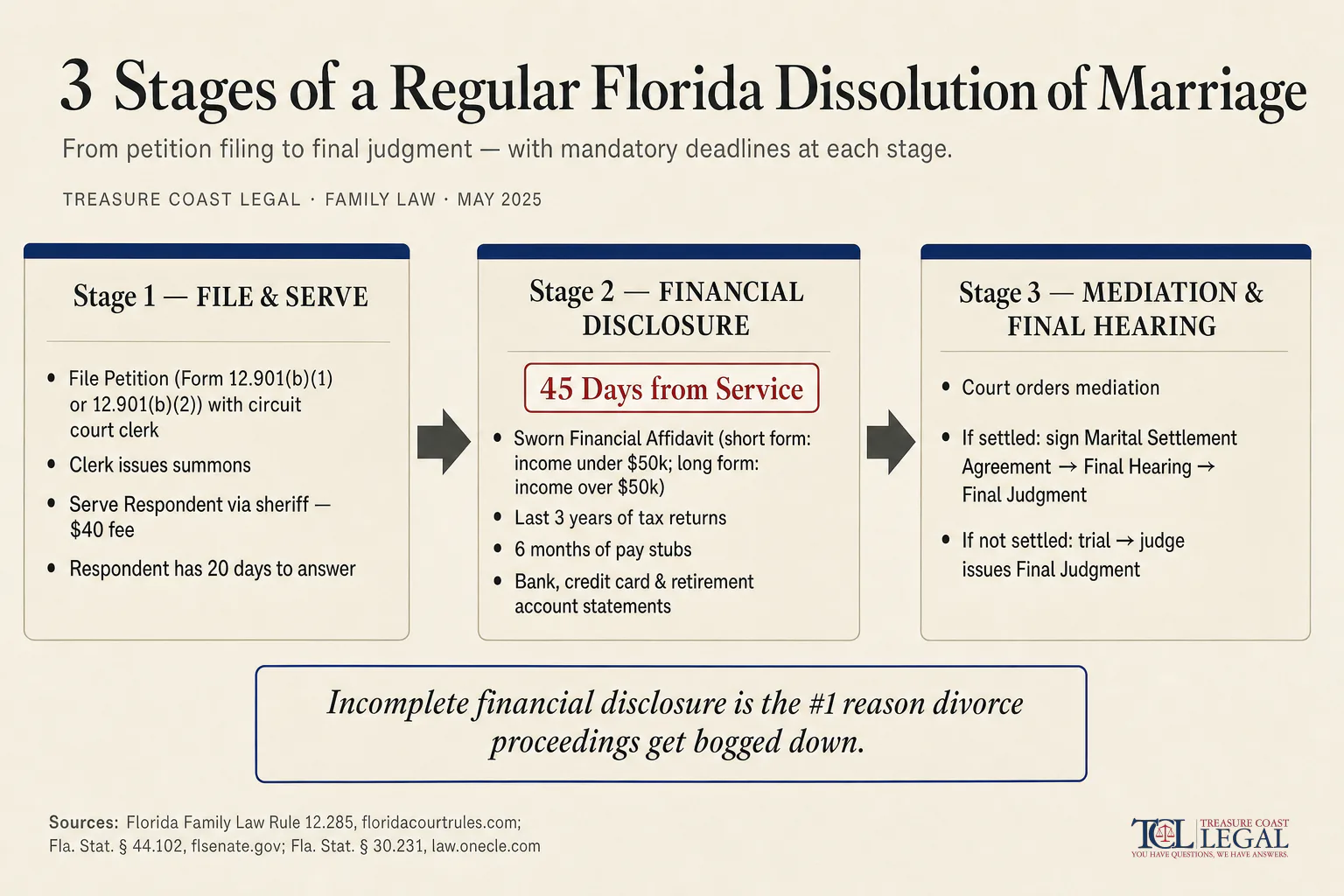
Step 1 File the Petition and Serve Your Spouse
The petitioner files a Petition for Dissolution of Marriage (Form 12.901(b)(1), or (b)(2) if children are involved) at the circuit court clerk office and pays the filing fee. The clerk issues a summons, which must be served on the other spouse, usually by sheriff for a $40 fee under Florida Statute § 30.231. The other party then has 20 days to respond.
Step 2 Mandatory Disclosure and Financial Affidavits
Florida Family Law Rule 12.285 requires both parties to exchange mandatory disclosure within 45 days of service. This includes the family law financial affidavit, three years of tax returns, six months of pay stubs, bank statements, and a child support guidelines worksheet if children are involved — all financial information that must be exchanged promptly. Incomplete financial disclosure is the most common reason Florida divorce cases stall, so gather your legal documents before you file. Our Martin County asset division attorneys can help you prepare a complete disclosure.
Step 3 Mediation, Agreement, and the Final Hearing
Most Florida circuit courts require mediation before a contested final hearing. Under Florida Statute § 44.102, cases involving timesharing disputes are referred to mediation. If mediation produces a marital settlement agreement, the judge approves it at a brief final hearing, converting your court case to uncontested and usually resulting in a faster final judgment.
What Happens to Children, Support, and Property During a Florida Divorce
Florida does not use the word "custody." It uses timesharing. Understanding how Florida law handles children, child support, and property before you file prevents costly surprises.
Florida Timesharing and Parenting Plans Are Mandatory When Children Are Involved
Every Florida divorce involving minor children requires a court-approved parenting plan under Florida Statute § 61.13. The plan must specify each parent's timesharing schedule, decision-making responsibilities, and dispute resolution, using Supreme Court Approved Form 12.995(a). A judge will not enter a final judgment in a case with minor children until an approved parenting plan is in place. Our overview of child custody in Stuart, FL explains how courts weigh timesharing, and if you may need to move later, read about the legal challenges of relocation with children.
How Florida Calculates Child Support
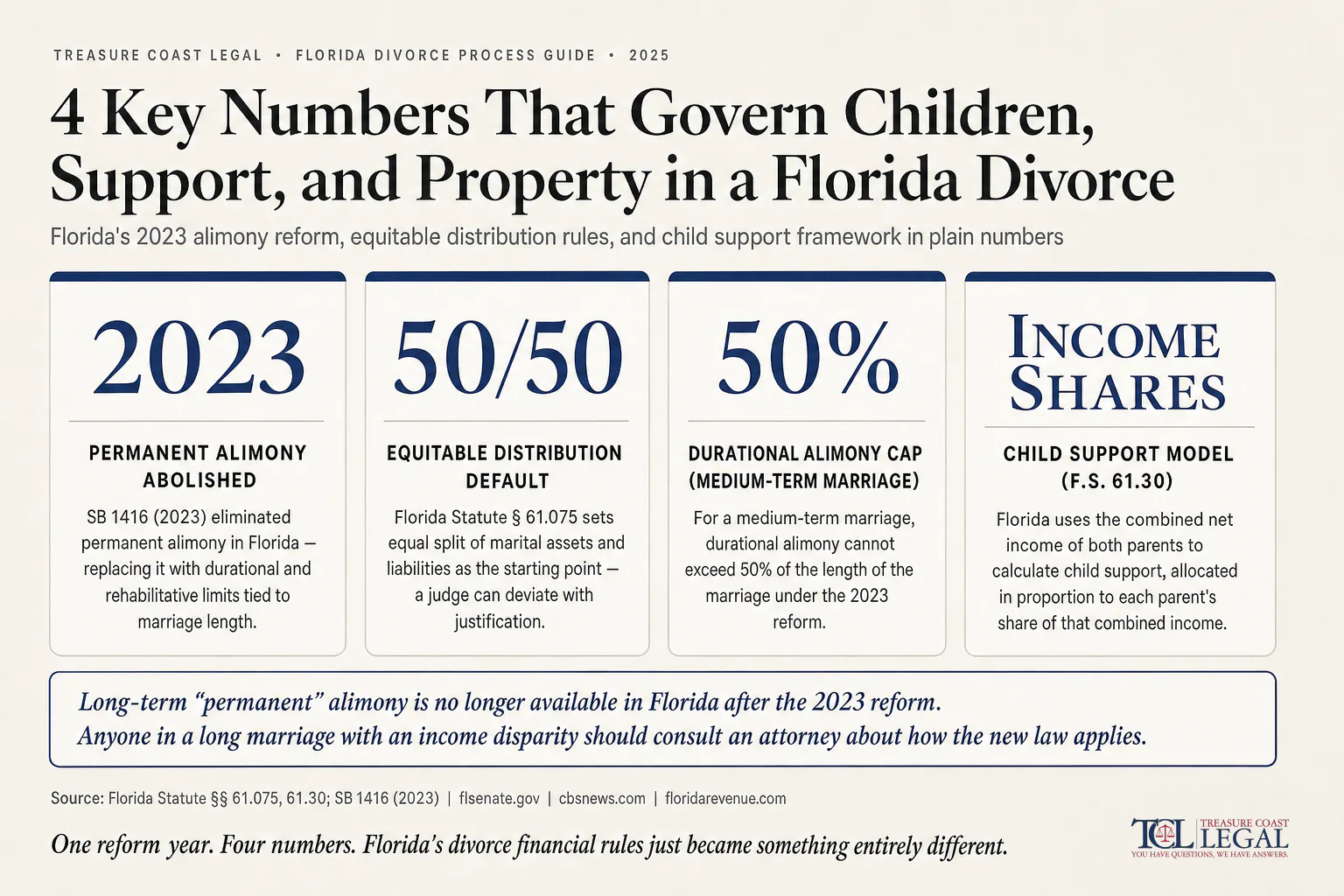
Florida uses an income shares model under § 61.30, combining the net income of both parents along with health insurance and childcare costs. As the Florida Department of Revenue explains, the total is allocated between parents in proportion to their incomes. Run the child support guidelines worksheet before negotiations begin so you know the presumptive number a judge would order.
Property Division and Spousal Support Under Florida's Equitable Distribution Rules
Florida divides marital property equitably, not always equally, under § 61.075. Spousal support changed sharply in 2023: the Legislature abolished permanent alimony through SB 1416, replacing it with bridge-the-gap, rehabilitative, durational, and temporary alimony tied to the length of the marriage. Our breakdown of the 2023 Florida alimony reform covers what changed, and if circumstances shift later, see whether you can modify alimony agreements in Florida.
How to Get Divorce in Florida Without an Attorney: Real Risks to Know
Florida allows self-representation, called pro se, and the florida courts self help website provides forms. The risks scale directly with case complexity.
When Handling Your Own Florida Divorce Is Realistic
Simplified dissolution with no children, minimal shared property, and full agreement is the clearest case for pro se filing. If your only shared asset is a joint bank account and you have no children, self-representation may be manageable.
Where Pro Se Divorce Filing Breaks Down on the Treasure Coast
Mistakes in the financial affidavit, an incomplete parenting plan, or a missed disclosure deadline can lead to dismissal, delays, or court hearings you did not anticipate, or a final judgment you cannot later modify. Local clerks can accept paperwork but cannot give legal advice, as the Florida Courts Help Center confirms. One free consultation with a Port St. Lucie divorce attorney can identify those landmines before you file.
How Much It Costs to File for Divorce in Florida
Here are real numbers without overpromising.
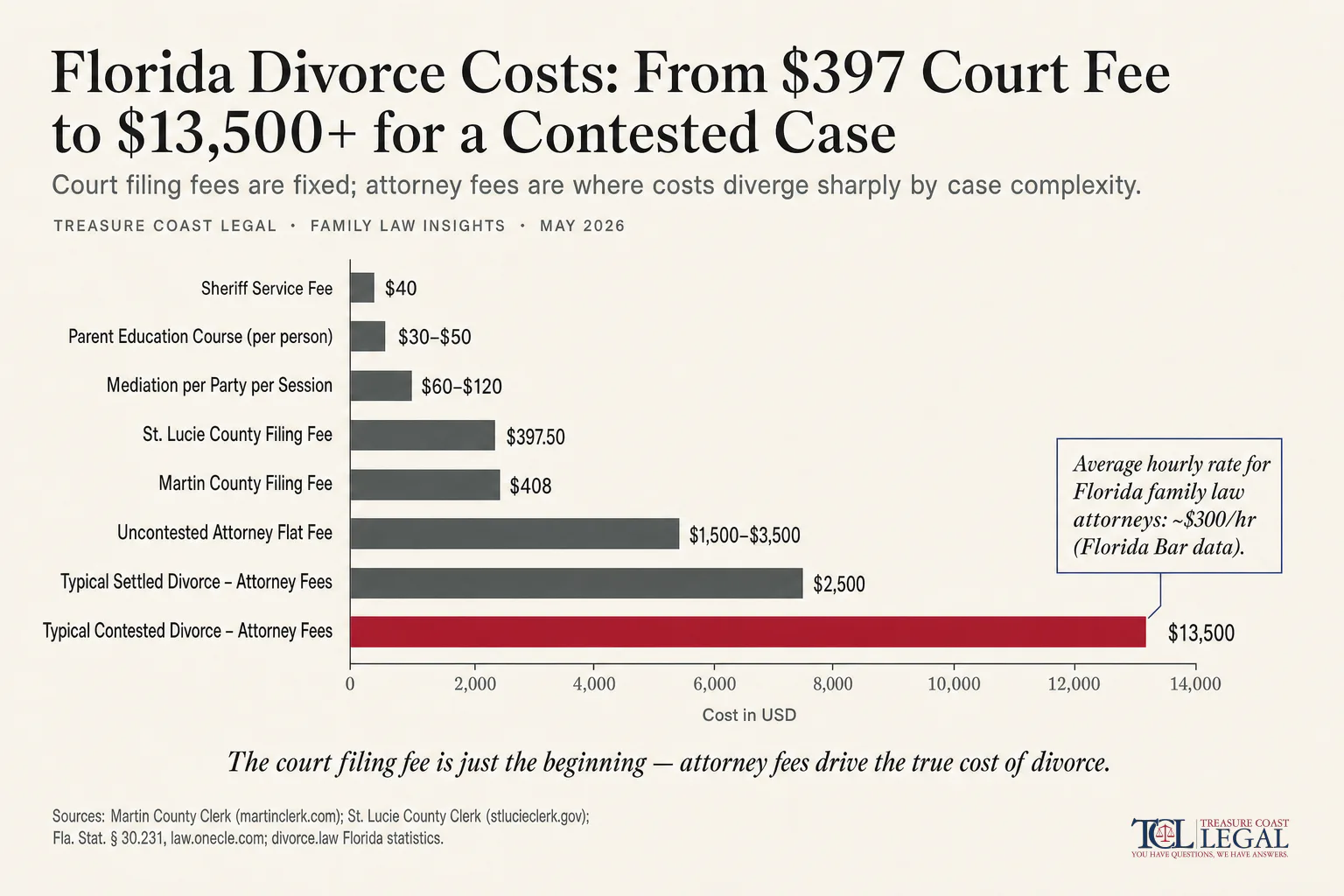
Florida Court Filing Fees and What Drives Them Up
The base filing fee for a petition is about $408 in Martin County and roughly $397.50 in St. Lucie County. Add a sheriff service fee of around $40, certified copy fees, and a mandatory parenting class fee when minor children are involved. Budget a minimum of $500 in court costs before attorney fees.
Attorney Fees in Florida Divorce Cases and When They Are Worth It
Uncontested divorce fees often run as flat-fee arrangements between $1,500 and $3,500. Contested cases bill hourly. According to Nolo's 2019 national consumer survey, divorce attorneys nationwide charged an average of about $270 per hour, and Nolo's separate study of family-law billing rates found that typical hourly rates in 2019 ranged from roughly $200 to just over $300 per hour, and total legal fees can escalate quickly in complex cases. According to a 2019 national consumer survey by Nolo, divorces that settle before trial typically cost several thousand dollars in attorneys' fees, while cases that proceed to trial frequently reach five-figure legal bills—averaging about $11,600 when one or two issues go to trial and about $21,500 when three or more issues are tried. Florida Statute § 61.16 lets a court order one spouse to pay the other's attorney fees. In contested cases involving children or significant property, those fees are almost always lower than the cost of a bad outcome, so seeking legal assistance early can save money in the long run. For more, our family law and divorce video library covers common questions.
Frequently Asked Questions About Getting Divorced in Florida
What is the first step to getting a divorce in Florida?
Confirm you meet the six-month residency requirement under § 61.021, then file a Petition for Dissolution of Marriage at the circuit court clerk's office where either spouse lives.
How much does it cost to file for divorce in FL?
The base court filing fee is about $408 in Martin County and $397.50 in St. Lucie County, plus service of process around $40, a parenting class if children are involved, and mediation costs in contested cases.
What is the 10 10 10 rule for divorce?
The 10/10/10 rule is a federal military rule, not Florida law. If a couple was married at least 10 years, the service member served at least 10 years, and those periods overlapped, the non-military spouse can receive military retirement payments directly from the Defense Finance and Accounting Service, per its DFAS guidance. See our guide to Florida military divorce.
Can a person with Alzheimer's get a divorce?
Yes, but it is complex. Florida law allows divorce when one spouse has been adjudicated mentally incapacitated for at least three years under § 61.052. If a spouse has Alzheimer's but has not been formally adjudicated incapacitated, the court will likely require a guardian ad litem first.
Your Next Step Toward a Florida Divorce That Protects What Matters
A Florida divorce filed incorrectly, rushed, or settled without understanding equitable distribution or the 2023 alimony changes can produce a final judgment you live with for decades. Our team guides Treasure Coast families through both uncontested and contested dissolution cases from Stuart to Fort Pierce to Port St. Lucie, handling parenting plans, child support worksheets, financial affidavits, mediation, and litigation. Around here, local matters, and we are your neighbors who happen to be lawyers. Schedule your free consultation or call 772-238-7755 today.
Your Treasure Coast Neighbors,
Shaun Plymale, Founding Attorney
The information provided in this blog is for general informational and educational purposes only and is not intended as legal advice. Laws and legal outcomes vary based on specific facts and circumstances, and the information contained herein may not reflect the most current legal developments. You should not act or refrain from acting based on any information in this blog without first seeking legal advice from a qualified attorney licensed in your jurisdiction. This blog may be produced, in whole or in part, with the assistance of generative artificial intelligence tools and is reviewed by legal professionals before publication; however, no representations are made as to its accuracy, completeness, or applicability to any specific situation. Reading or interacting with this blog does not create an attorney-client relationship between you and the firm. An attorney-client relationship is formed only through a written agreement signed by both you and the firm. This blog may be considered attorney advertising under applicable laws and ethical rules. Prior results do not guarantee a similar outcome. The firm disclaims all liability for actions taken or not taken based on the content of this blog.
Shaun Plymale
Founding Attorney
Treasure Coast Legal