
Key Takeaways
- Florida offers two divorce paths. Simplified dissolution requires full agreement and no minor children. Everything else uses the standard dissolution packet.
- Every official Florida divorce form is free at floridacourts.gov. Paying a third party offers no legal advantage.
- Cases with children require a parenting plan, a child support guidelines worksheet, and a uniform child custody jurisdiction act affidavit.
- Florida imposes a mandatory 20-day waiting period from filing before a final judgment can be entered.
- Retirement accounts, hidden assets, or a contested parenting plan are signs a free form is not enough.
*Written by Shaun Plymale, Founding Attorney.*
Fun fact: The Treasure Coast got its name from the Spanish treasure fleets that sank off its coastline during a 1715 hurricane, scattering gold and silver coins that still wash ashore today.
A Martin County resident sits down to find the right divorce forms for Florida and immediately hits a wall of packet numbers and contradictory instructions. This guide shows which forms apply, where to download them free, how to file them in Stuart or Fort Pierce, and what happens next.
Florida Has Two Divorce Paths and the Forms Are Completely Different
Simplified Dissolution: The Shorter Route
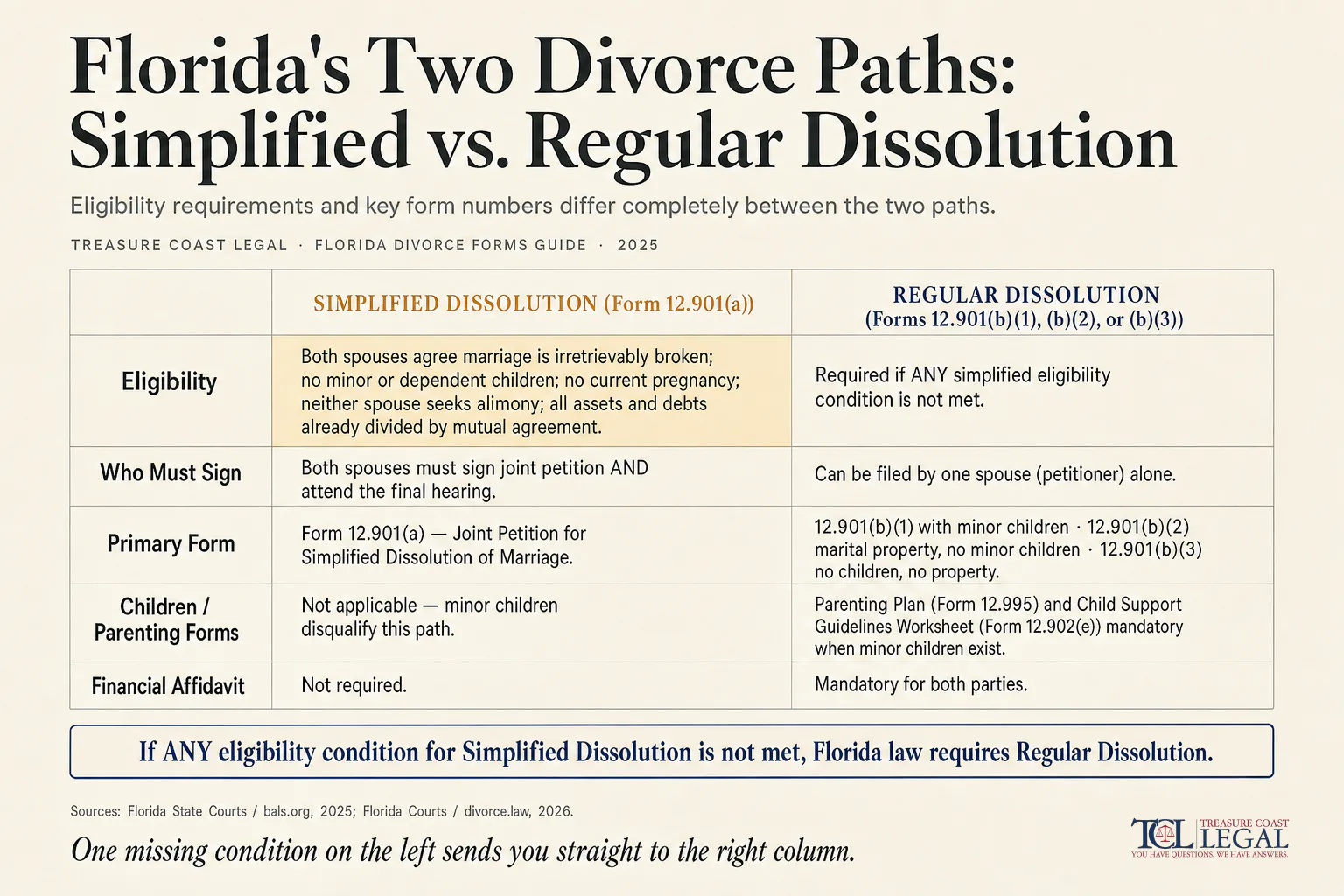
Simplified dissolution is available only when both spouses agree the marriage is irretrievably broken, have no minor children and no pregnancy, neither seeks alimony, and all assets and debts are already divided. Both spouses sign the joint petition using Form 12.901(a). Confirm eligibility on the Florida Courts self-help center before downloading anything.
Regular Dissolution: What Most People Actually Need
When dependent children, child support, time sharing, or contested property are involved, you must use the standard dissolution packet, which requires more forms including a parenting plan and child support guidelines worksheet. Many of these cases benefit from divorce mediation before they reach a judge.
How Florida Courts Organizes Its Form Packets
The Florida Supreme Court has approved four petition forms covering every scenario, numbered into self-help packets on floridacourts.gov. Bookmark it as your authoritative source.
The Core Divorce Forms for Florida You Will Need to Complete
The Petition for Dissolution of Marriage
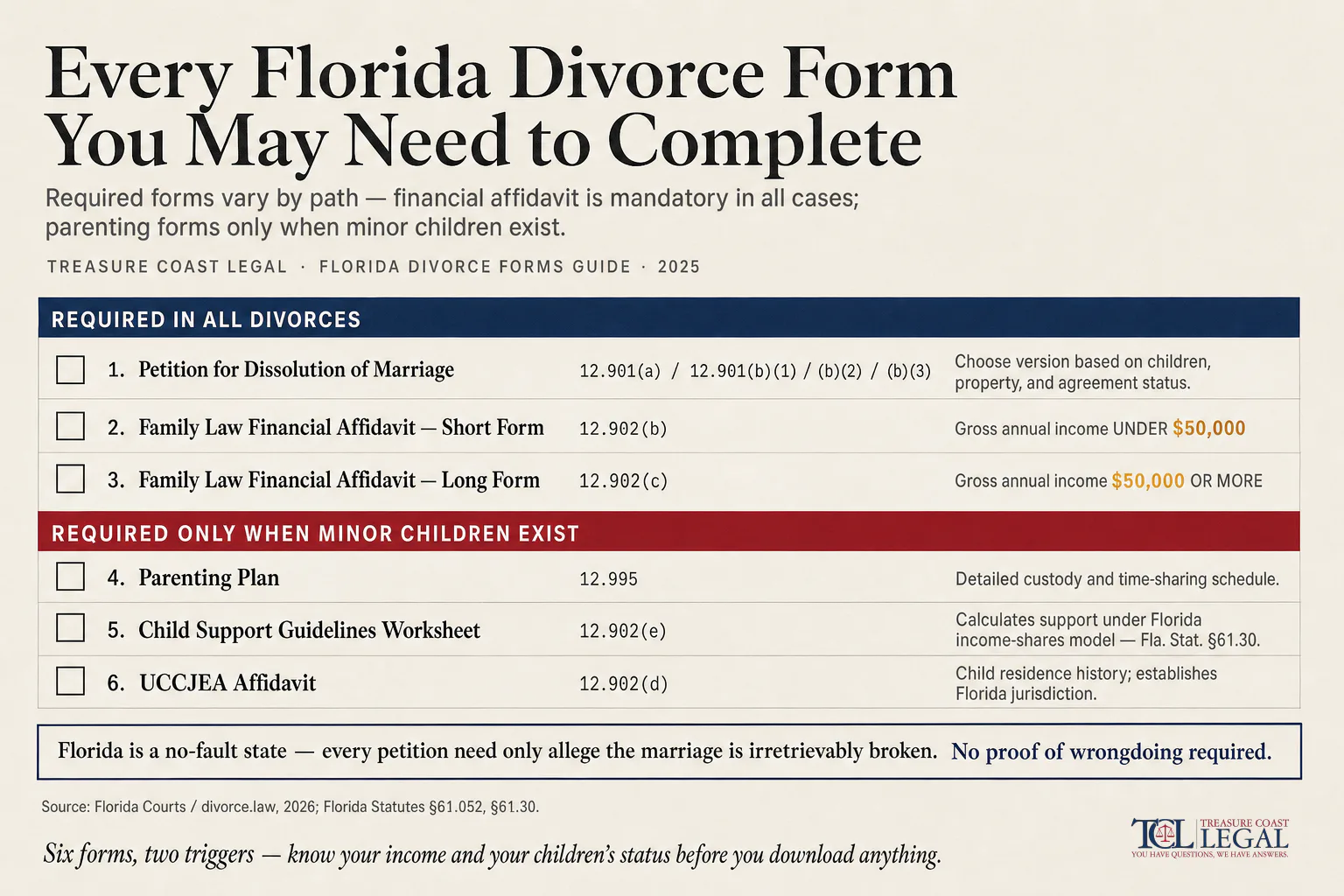
Every Florida divorce begins with a Petition for Dissolution of Marriage. The simplified path uses Form 12.901(a). The regular path uses Form 12.901(b)(1) with minor children, (b)(2) with property but no children, or (b)(3) with neither. Florida is a no-fault state, so the only required ground is that the marriage is irretrievably broken under Florida Statute 61.052. Every other form supplements the petition.
Financial Affidavit and Marital Settlement Agreement
A family law financial affidavit is required in virtually all dissolutions. Florida uses the short form (12.902(b)) when individual gross income is under $50,000 and the long form financial affidavit (12.902(c)) at $50,000 or more. The marital settlement agreement, sometimes called a property settlement agreement, documents property division and any spousal support. If alimony is on the table, the 2023 Florida alimony reform changed what you can request.
Parenting Plan and Child Support Forms When Children Are Involved
With a dependent child, a parenting plan time sharing schedule (Form 12.995) and a child support guidelines worksheet (Form 12.902(e)) are mandatory. A uniform child custody jurisdiction act affidavit (Form 12.902(d)) establishes Florida jurisdiction, and each minor child's social security number appears on many forms throughout the packet. Each dependent child's social security number is also required, so gather school, medical, and income records first.
Where to Get Official Florida Divorce Forms Without Paying for Them
The Florida Courts Self-Help Center Website
All standardized Florida divorce forms are free at floridacourts.gov. These are Florida Supreme Court approved legal documents that carry authority no third-party site can match.
Your Local Clerk of Court Office on the Treasure Coast
The Martin County Clerk of Courts in Stuart and the St. Lucie County Clerk in Fort Pierce and Port St. Lucie both offer packets at the courthouse and online. Clerk staff can confirm which packet fits your situation but cannot give legal advice or legal counsel. If the online forms feel overwhelming, visiting in person is a legitimate option.
Florida Courts E-Filing Portal for Electronic Submission
The Florida Courts e-filing portal at myflcourtaccess.com lets you file electronically. Register for a free account, upload PDFs, and pay online.
How to File Divorce Papers at the Martin or St. Lucie County Courthouse
Filing In Person: What to Bring and What to Expect
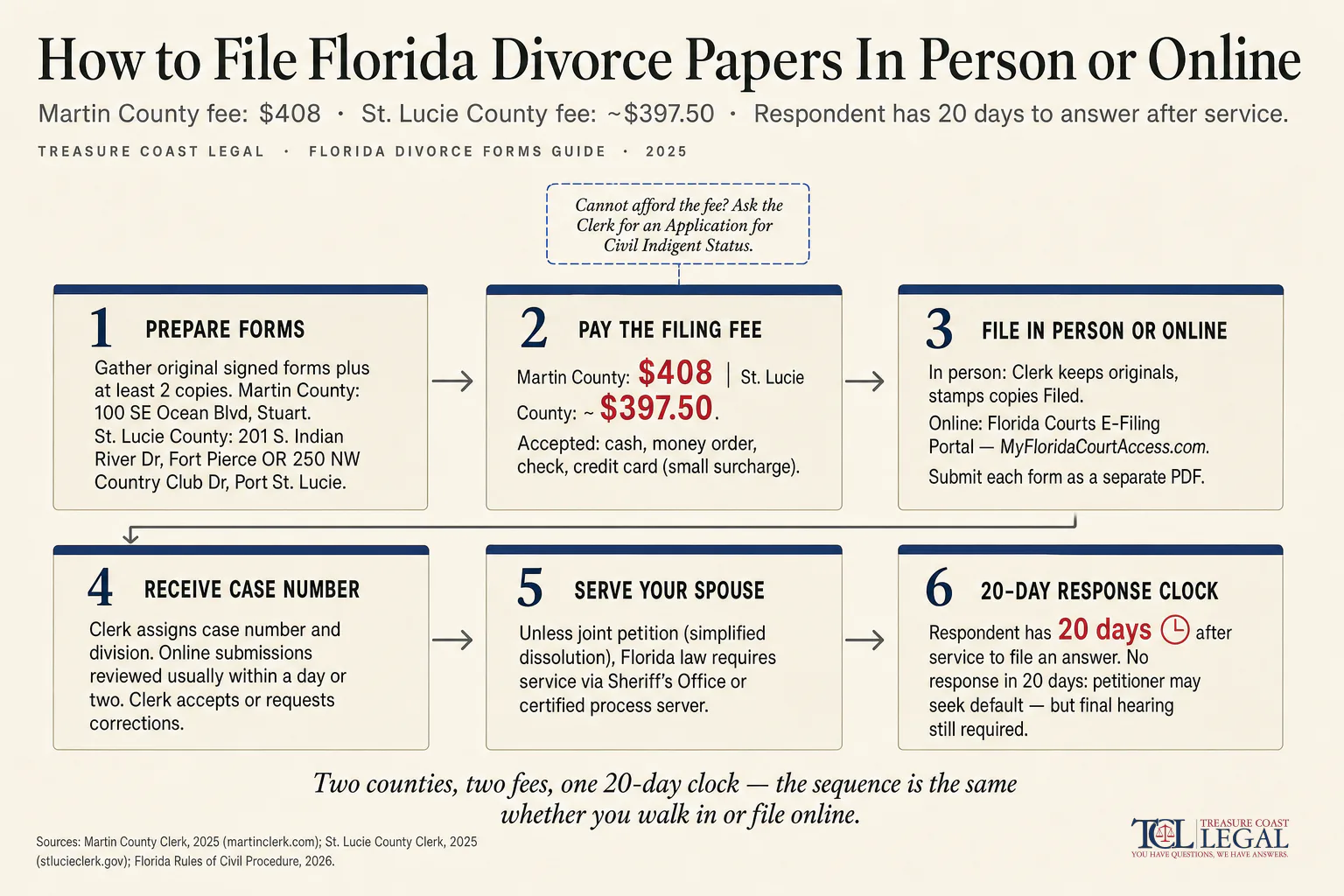
When filing at the Martin County circuit court (100 SE Ocean Blvd, Stuart) or the St. Lucie County clerk at the Lawson E. Thomas Courthouse Center in Fort Pierce, bring the original signed petition, two copies of every document, a photo ID, and payment. Martin County's fee is $408 and St. Lucie County's runs about $397.50. Cash, check, money order, and credit card are accepted. Those who qualify can request a civil indigent status waiver.
Filing Through the Florida Courts E-Filing Portal
Log in, select Martin or St. Lucie County, upload each form as a separate PDF, and pay online. The clerk reviews filings within a day or two and may return documents for correction. Name each PDF by form number to prevent rejection.
Serving Your Spouse After Filing
After the clerk accepts the petition, a court order directing service is not required, but you must serve your spouse, usually through the sheriff's office or a certified process server, under the Florida Family Law Rules of Procedure. Once served, the respondent has 20 days to respond. In simplified dissolution cases, both spouses sign a joint petition and service is not required.
What Happens After You File and When the Final Judgment Comes
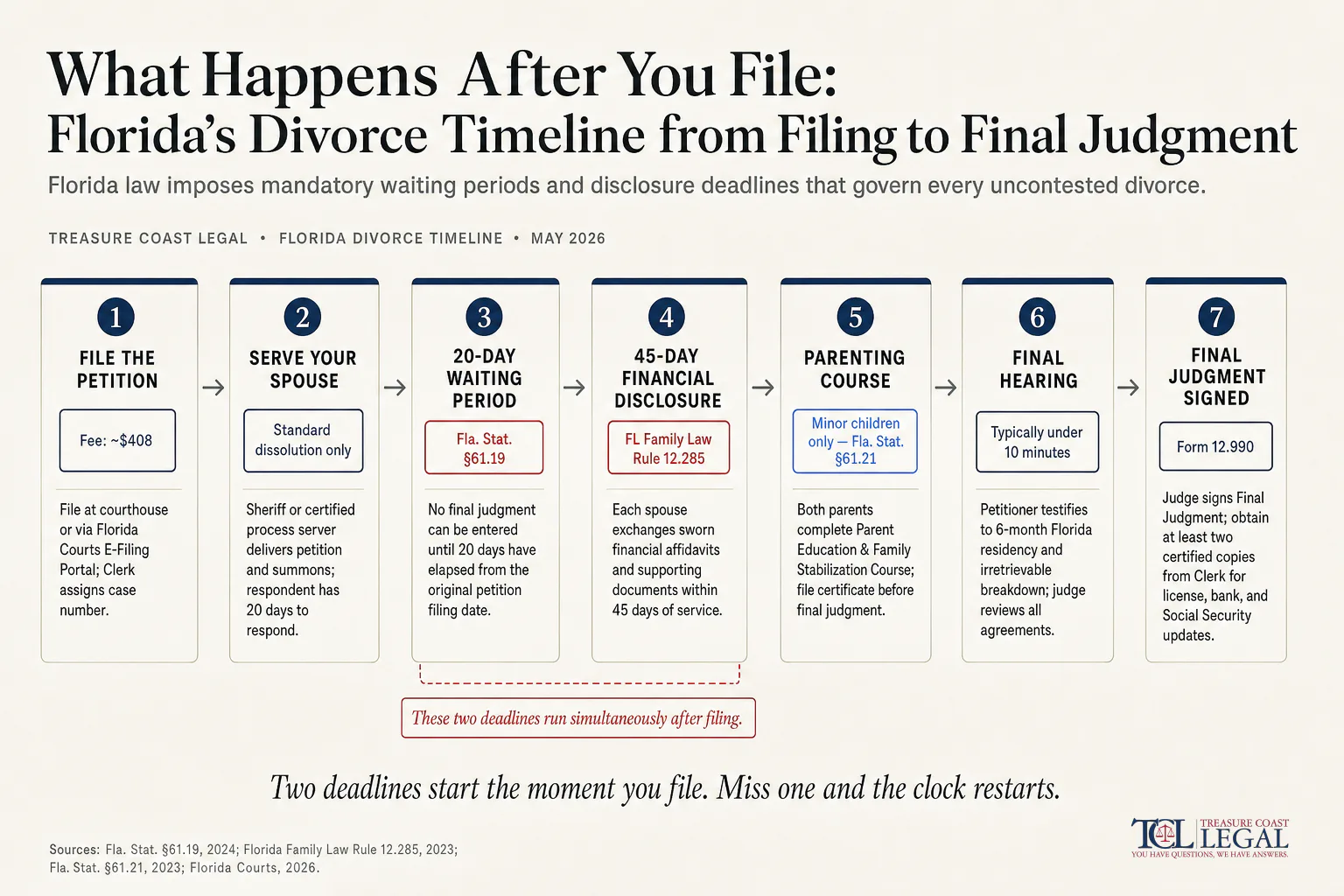
The Waiting Period and Mandatory Disclosures
Florida imposes a mandatory 20-day waiting period after filing before a final judgment can be granted under Florida Statute 61.19. Both parties must exchange financial disclosures within 45 days of service under Florida Family Law Rule 12.285, which may also apply to other relief sought in the petition. Parents must also complete a Parent Education and Family Stabilization Course before finalization. These timelines drive how long a Florida divorce takes.
The Final Hearing and What to Bring
For an uncontested dissolution, the final court hearing is brief, often ten minutes or less. The judge reviews the marital settlement agreement, parenting plan, and child support worksheet, then signs the final judgment. In a simplified dissolution, both spouses attend together, and one must prove six-month Florida residency. Bring certified copies of all signed agreements.
When the Final Judgment Makes It Official
The final judgment of dissolution of marriage (Form 12.990), signed by the circuit court judge, legally ends the marriage. The clerk provides certified copies of these court documents for a small fee. Order at least two for name changes, financial accounts, and property transfers.
When a Free Form Is Not Enough and You Need a Family Law Attorney
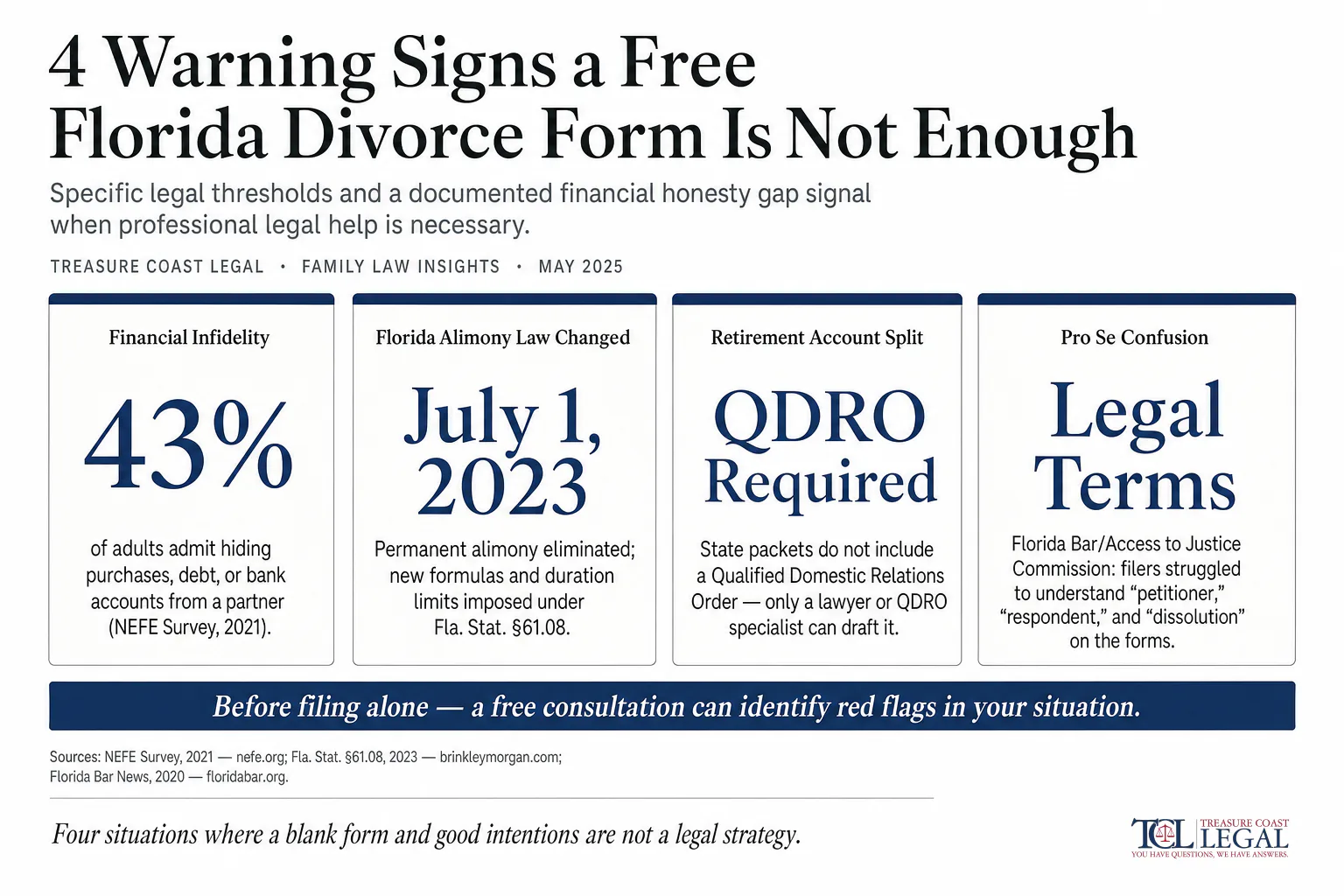
Situations Where Self-Help Forms Create More Problems Than They Solve
Self-represented filers hit trouble when retirement accounts require a QDRO, when one spouse suspects hidden assets, or when a time sharing dispute over a dependent child stays unresolved. A NEFE survey found 43% of adults admit to hiding purchases, debt, or bank accounts from their partner. Florida's July 2023 reforms ended permanent alimony and changed time sharing, and the grounds to later modify alimony add complexity standard forms do not explain.
What Treasure Coast Legal Can Do That the Clerk's Office Cannot
The clerk can stamp your forms. An attorney can review them for errors, negotiate terms you may not know to request, advise you on certain legal rights, and represent you if the other side turns uncooperative. The Florida Bar has noted that many self-represented filers struggle with court procedures and legal terms, and recommends competent legal counsel for complex matters. Treasure Coast Legal handles both uncontested and contested dissolutions across Martin and St. Lucie counties. Our Port St. Lucie divorce attorneys and our spousal support team offer a paid consultation to assess your case.
Frequently Asked Questions About Divorce Forms for Florida
What forms do I need to file for a divorce in Florida?
With no minor children, no pregnancy, and full agreement, you need Form 12.901(a). Otherwise you need the standard petition (12.901(b)(1), (b)(2), or (b)(3)), a financial affidavit, and, with children, a parenting plan, child support worksheet, and child custody jurisdiction affidavit. All are free at floridacourts.gov.
Can I file my own divorce papers in Florida?
Yes. Florida law allows self-represented filers, but errors or incomplete disclosures can delay your case.
What is the first step to file for divorce in Florida?
Determine which path applies, download the correct packet from floridacourts.gov to direct legal research on your situation, complete the petition and attachments, and file at your circuit court clerk or through the e-filing portal. At least one spouse must have lived in Florida for six months.
Can I get divorce papers online in Florida?
Yes. The Florida Courts website provides every approved form as a free PDF, and you can e-file through myflcourtaccess.com. Avoid non-government sites that charge for the same free forms.
Your Next Step Is Simpler Than the Forms Make It Look
Simplified dissolution works for fully agreed cases without children. Standard dissolution covers everything else. Every official form is free through floridacourts.gov and your local clerk office. The forms are manageable for straightforward cases, but contested property, parenting plans, and child support disputes carry stakes self-help packets cannot protect against. Treasure Coast Legal offers a free consultation to review whether self-filing makes sense for you. Call 772-238-7755 or reach us through the online form.
The information provided in this blog is for general informational and educational purposes only and is not intended as legal advice. Laws and legal outcomes vary based on specific facts and circumstances, and the information contained herein may not reflect the most current legal developments. You should not act or refrain from acting based on any information in this blog without first seeking legal advice from a qualified attorney licensed in your jurisdiction. This blog may be produced, in whole or in part, with the assistance of generative artificial intelligence tools and is reviewed by legal professionals before publication; however, no representations are made as to its accuracy, completeness, or applicability to any specific situation. Reading or interacting with this blog does not create an attorney-client relationship between you and the firm. An attorney-client relationship is formed only through a written agreement signed by both you and the firm. This blog may be considered attorney advertising under applicable laws and ethical rules. Prior results do not guarantee a similar outcome. The firm disclaims all liability for actions taken or not taken based on the content of this blog.
Shaun Plymale Founding Attorney Treasure Coast Legal