

Key Takeaways
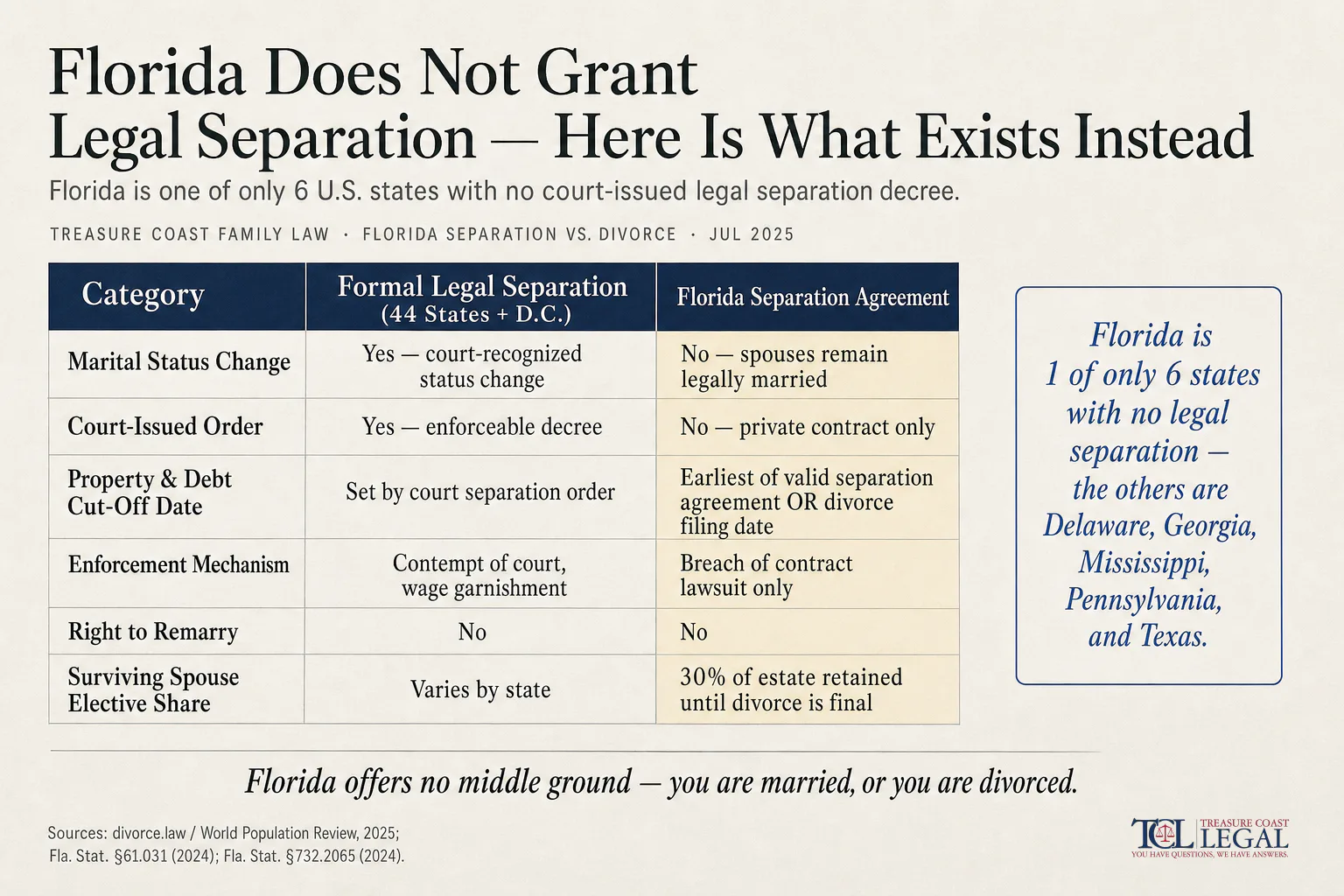
- Florida does not recognize formal legal separation. You are legally married until a final judgment of dissolution is entered.
- A separation agreement is a private contract. It cannot be enforced through family court contempt unless folded into a divorce decree.
- Health insurance coverage often ends at divorce, leaving a dependent spouse exposed.
- Couples near the 10-year marriage mark may delay divorce to preserve Social Security spousal benefits.
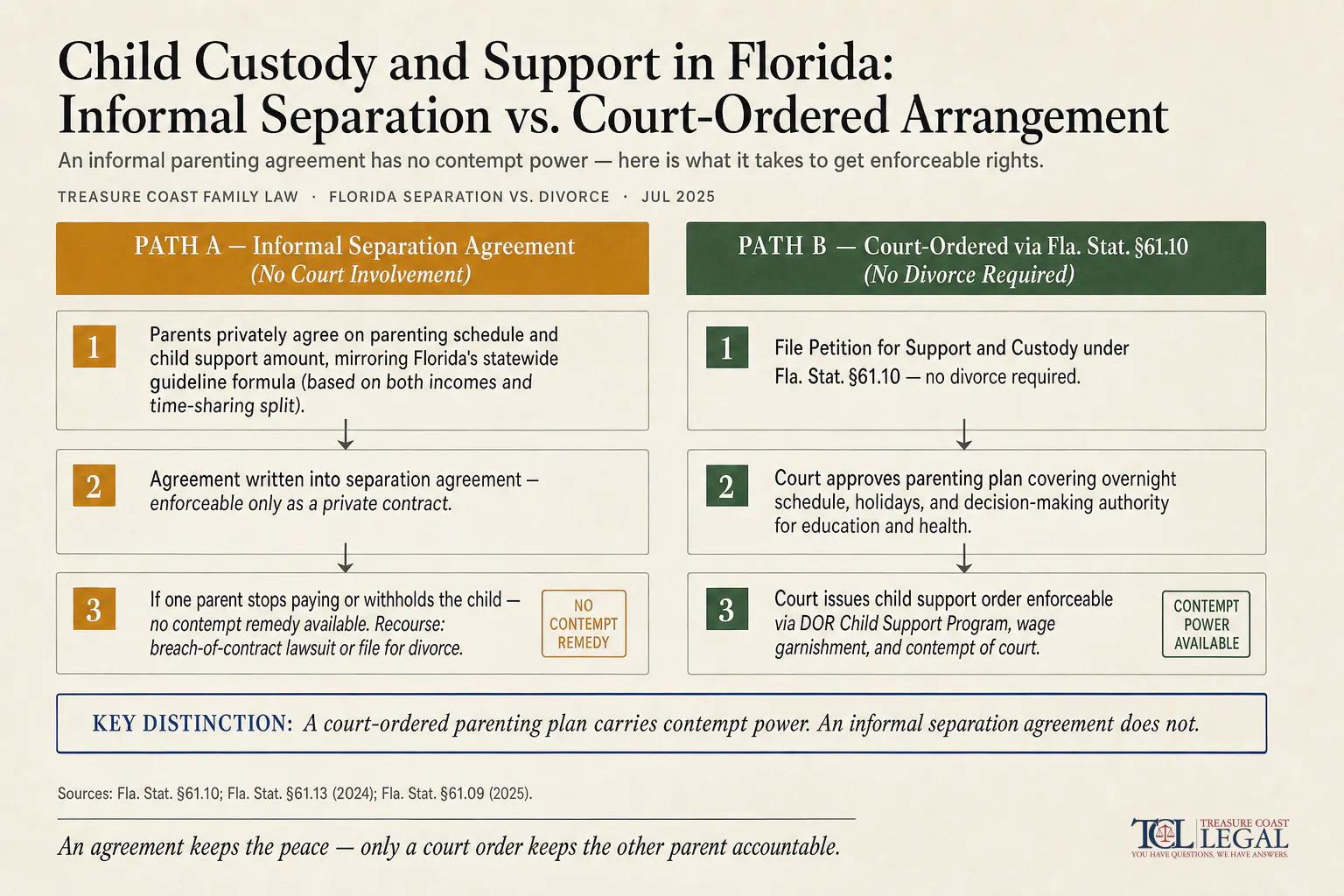
- For child custody and child support, only a court order gives you real enforcement power.
Written by Shaun Plymale, Founding Attorney.
When weighing legal separation vs. divorce, many Martin County and Port St. Lucie residents assume they can simply file for separation. They cannot. This article explains how Florida handles living apart, what a separation agreement does, and which choice protects your finances, health insurance, and parental rights.
Florida Does Not Recognize Legal Separation the Way Most States Do
Most states allow court-issued legal separations. Florida does not, according to Florida Statute 61.031, which provides only for dissolution "from bonds of matrimony." We often see couples in Stuart or Fort Pierce surprised to learn they remain legally married until a final judgment is entered.
What Legal Separation Actually Means in Florida
Here, legal separation simply means spouses living apart under a private agreement. Florida does let one spouse petition for support without divorce under Statute 61.09, but marital status never changes.
How a Separation Agreement Works Without a Court Order
A separation agreement is a contract covering property division, spousal support, child support, and custody. It is enforceable as a contract, not a court order, unless incorporated into a divorce decree. Separated couples should understand that one spouse can breach it with limited immediate consequence.
The Difference Between Living Apart and Being Legally Separated
Living in separate homes changes nothing legally. The legal implications of this are significant — Every month apart without resolution is continued shared financial exposure, and the distinction matters the moment that exposure costs you money — whether you live off Indian River Drive or deep in western Martin County.
The Key Differences Between Divorce and a Florida Separation Agreement
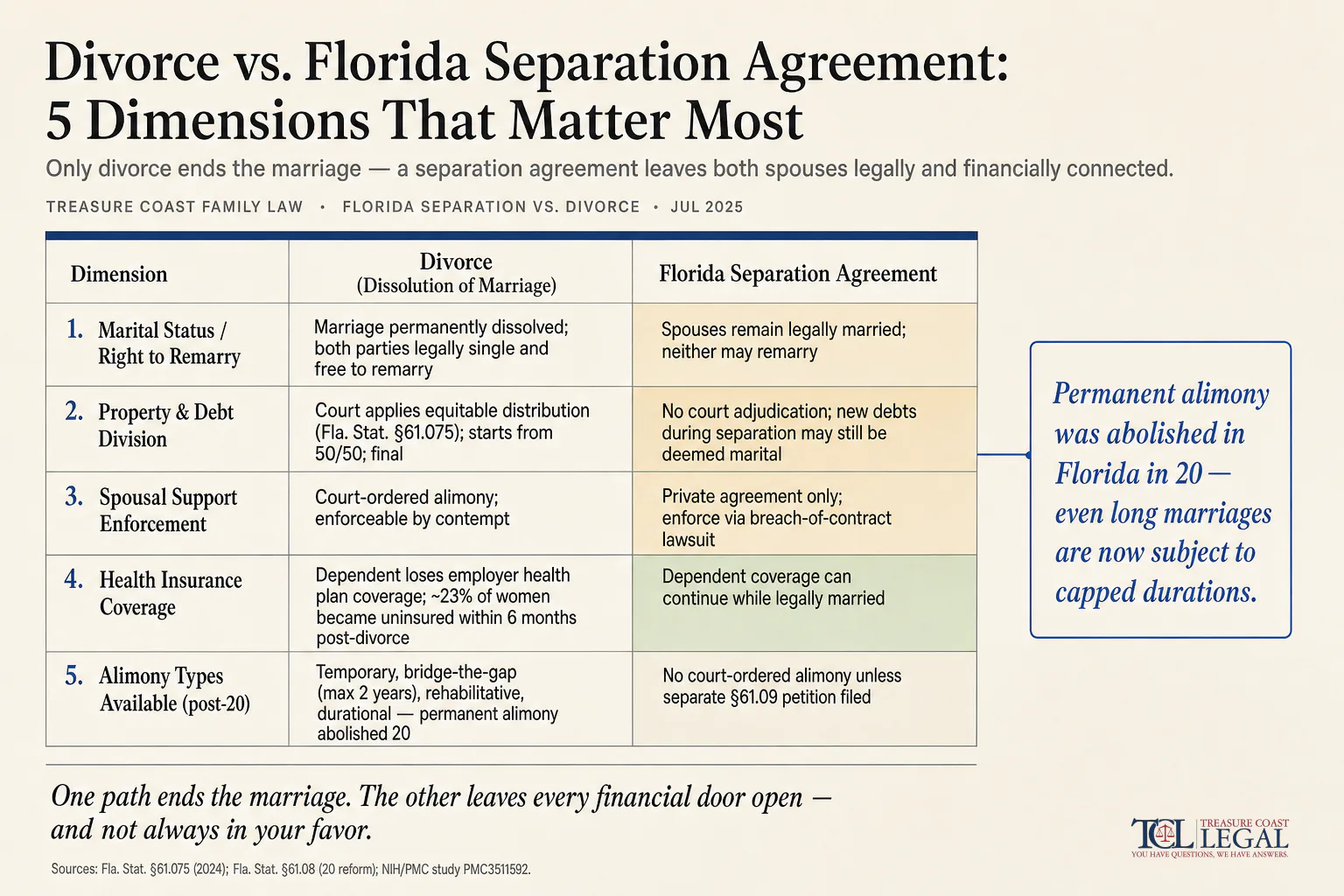
Understanding legal separation vs. divorce comes down to finality. Divorce permanently ends the marriage. An agreement only structures the pause.
Marital Status and the Right to Remarry
Only a final dissolution allows either spouse to remarry. Under a separation agreement, both parties remain legally married. If remarriage matters, divorce is the only route.
Property Division and Debt Liability
In divorce, Florida's equitable distribution divides marital property and debt permanently under Statute 61.075. Under a separation agreement, both spouses stay married, so new debt one spouse runs up could still be argued as marital rather than separate property, leaving property and debt boundaries legally ambiguous.
Spousal Support and Health Insurance Coverage
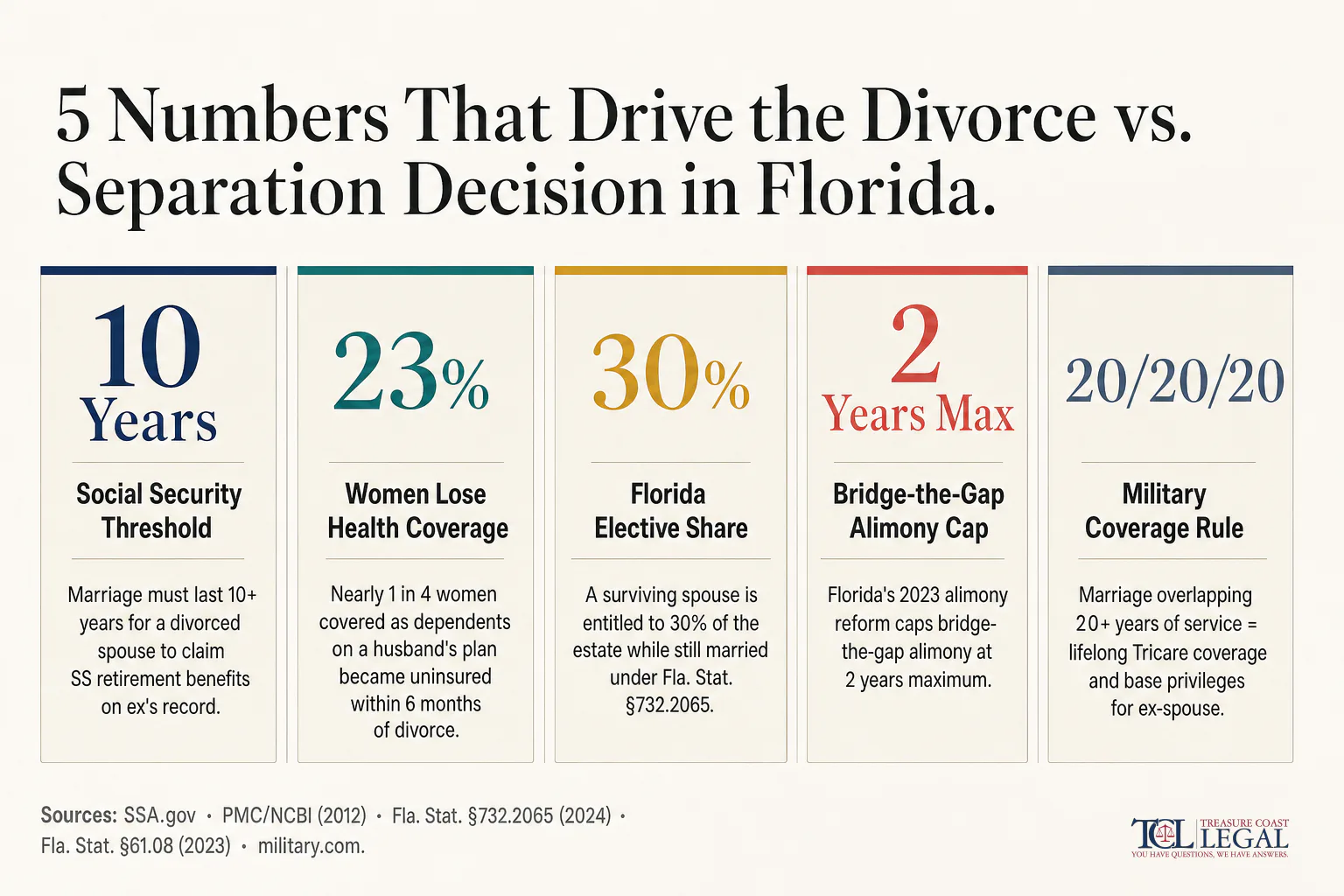
A divorce court can order temporary, rehabilitative, bridge-the-gap, or durational alimony. Florida's 2023 reform eliminated permanent alimony, a change we cover in our guide to the Florida alimony reform. Health insurance is the practical sticking point, divorce ends a spouse's dependent eligibility under many employer plans, though federal COBRA rules let a divorced spouse elect continuation coverage for a limited period or explore other health insurance options, so couples where one spouse depends on the other's coverage — particularly those relying on network access through providers like Cleveland Clinic or Lawnwood Regional Medical Center — should model that loss first.
When a Separation Agreement Makes Sense for Treasure Coast Families
Some couples have legitimate reasons to stay legally married while living apart.
Religious Beliefs and Personal Values
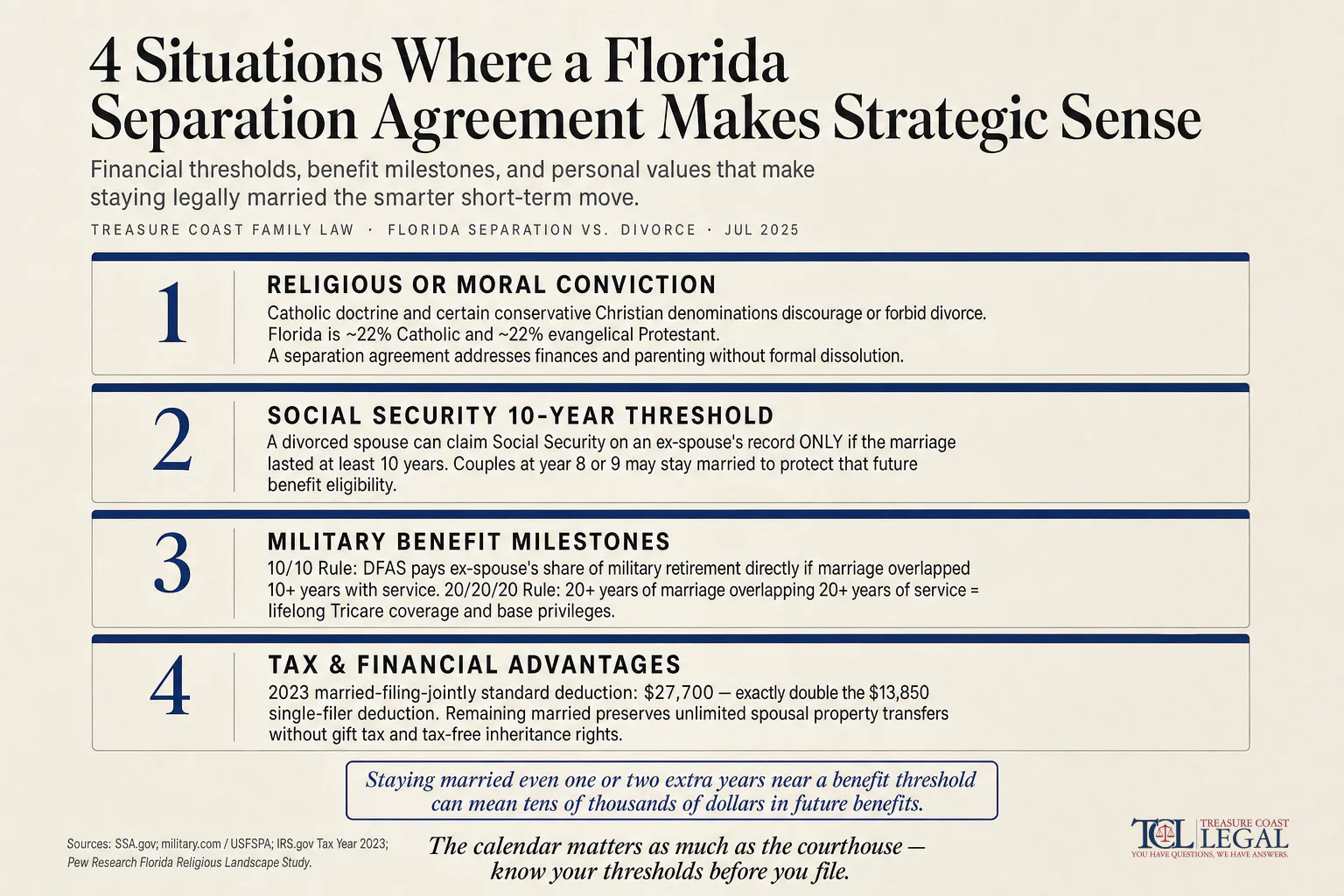
, faiths that often discourage divorce. For couples who hold those beliefs, a separation agreement formalizes finances and parenting while honoring the conviction that the marriage stays intact. Sometimes that pressure builds quietly, a dynamic we explore in what empty nest syndrome actually does to a marriage.
Preserving Social Security and Military Benefits
A divorced spouse can claim Social Security benefits on an ex's record only if the marriage lasted at least 10 years, per the Social Security Administration. Couples approaching the 10-year mark should calculate whether waiting preserves significant benefits.
Protecting Certain Financial Benefits During a Trial Separation
Married filing jointly carried a $27,700 standard deduction in 2023, double the single figure, per the IRS. Married status also preserves spousal inheritance rights. Before signing, meet with a family law attorney and a financial advisor.
How Child Custody and Child Support Work in Both Scenarios
How parental rights are handled depends heavily on whether a court is involved.
Parenting Plans and Timesharing Under Florida Law
Florida requires a parenting plan in every dissolution involving minor children under Statute 61.13. A separation agreement can include timesharing terms, but those are not enforceable through contempt unless a court adopts them — an important distinction of legal rights for any married couple navigating this process. For timesharing and child support, only a court order gives you real enforcement power.
Child Support Obligations During Separation Versus After Divorce
Without a court order, a parent who stops paying cannot be held in contempt. A married couple relying solely on a private agreement should enforce child support through the court, not just a contract.
The Financial Implications of Choosing One Path Over the Other
Cost and timeline drive this decision as much as emotion.
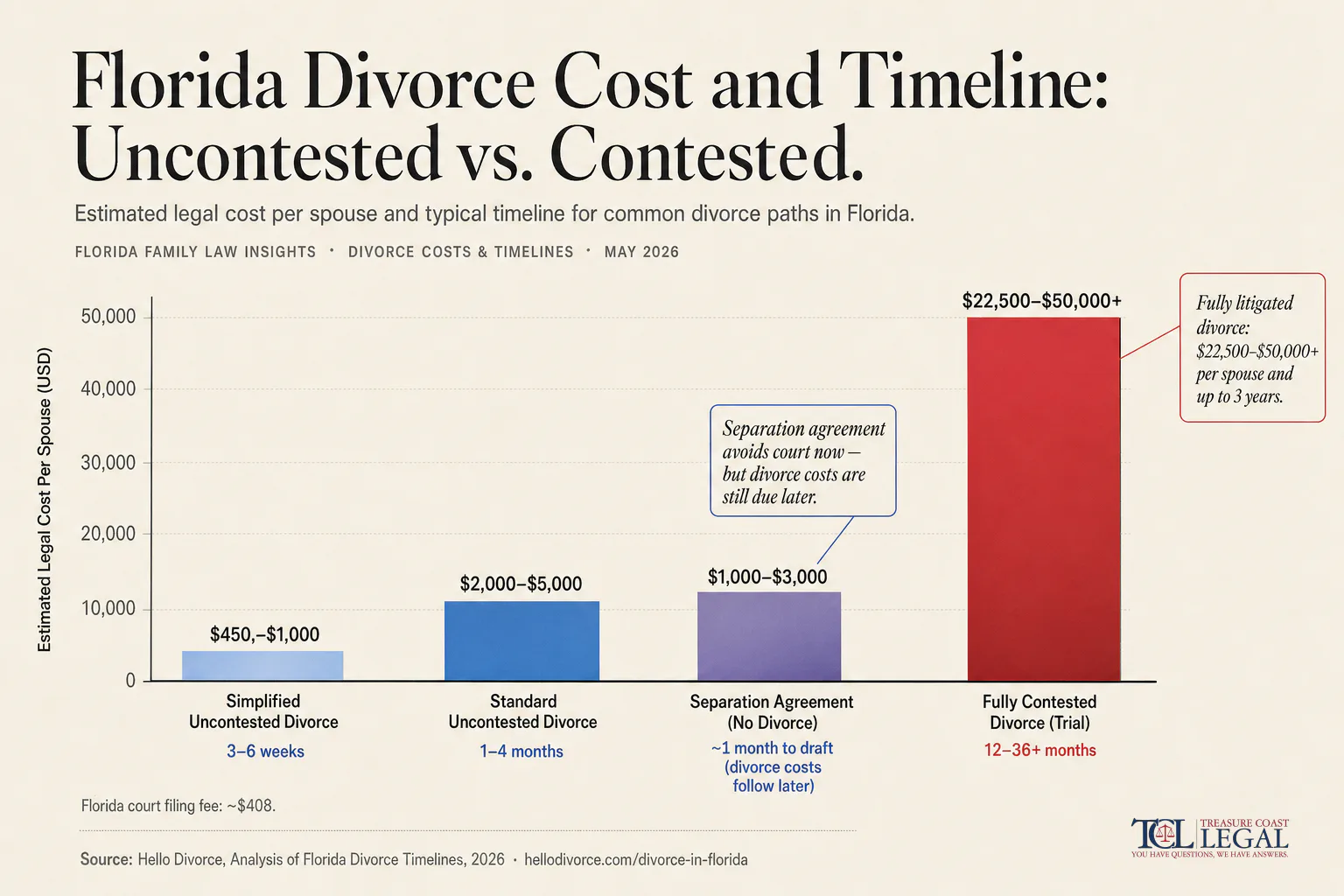
What Divorce Costs in Florida and How Long It Takes
Cost of Drafting a Separation Agreement
A well-drafted separation agreement typically costs less upfront than a contested divorce. But if the couple later divorces, much of that work repeats, so it is not always cheaper.
Frequently Asked Questions About Divorce Versus Legal Separation in Florida
Is it better to stay separated or get a divorce in Florida?
It depends on your goals. A separation agreement may preserve health insurance, Social Security benefits, or honor religious beliefs, divorce provides finality, remarriage, and enforceable court orders. The legal process for each path differs significantly in cost and timeline.
Why get legal separation instead of divorce?
Common reasons include religious beliefs, keeping health insurance, preserving benefits tied to marriage length, or buying time to resolve finances before divorce. Some couples also choose this path for religious reasons tied to their community or family.
What are the disadvantages of a legal separation in Florida?
Enforceability. A legal separation agreement cannot be enforced through family court contempt unless folded into a dissolution order.
Is legal separation cheaper than a divorce in Florida?
It may cost less upfront, but couples who eventually divorce incur additional fees to finalize the dissolution.
Why is legal separation being discouraged by some Florida attorneys?
The lack of court enforceability makes it weaker protection than a final decree, especially for timesharing and support.
What Treasure Coast Couples Should Do Before Making This Decision
This choice directly affects your marital status, property rights, health insurance, child custody, and financial future. Understanding the full legal process of divorce versus legal separation is essential, and our team can review your separation agreement, advise whether dissolution is the stronger path, and represent you from Martin County and St. Lucie County to Indian River County and Palm Beach County. Family law consultations are paid and are the fastest way to get clear answers. Schedule your consultation at our Stuart or Fort Pierce offices by visiting this link, or call 772-238-7755. Around here, local matters.
The information provided in this blog is for general informational and educational purposes only and is not intended as legal advice. Laws and legal outcomes vary based on specific facts and circumstances, and the information contained herein may not reflect the most current legal developments. You should not act or refrain from acting based on any information in this blog without first seeking legal advice from a qualified attorney licensed in your jurisdiction. This blog may be produced, in whole or in part, with the assistance of generative artificial intelligence tools and is reviewed by legal professionals before publication; however, no representations are made as to its accuracy, completeness, or applicability to any specific situation. Reading or interacting with this blog does not create an attorney-client relationship between you and the firm. An attorney-client relationship is formed only through a written agreement signed by both you and the firm. This blog may be considered attorney advertising under applicable laws and ethical rules. Prior results do not guarantee a similar outcome. The firm disclaims all liability for actions taken or not taken based on the content of this blog.
Shaun Plymale
Founding Attorney
Treasure Coast Legal