
Key Takeaways
- Sharp, point-specific pain over the breastbone that worsens with deep breaths or pressure is the hallmark of a fractured sternum, unlike the diffuse ache of a bruise.
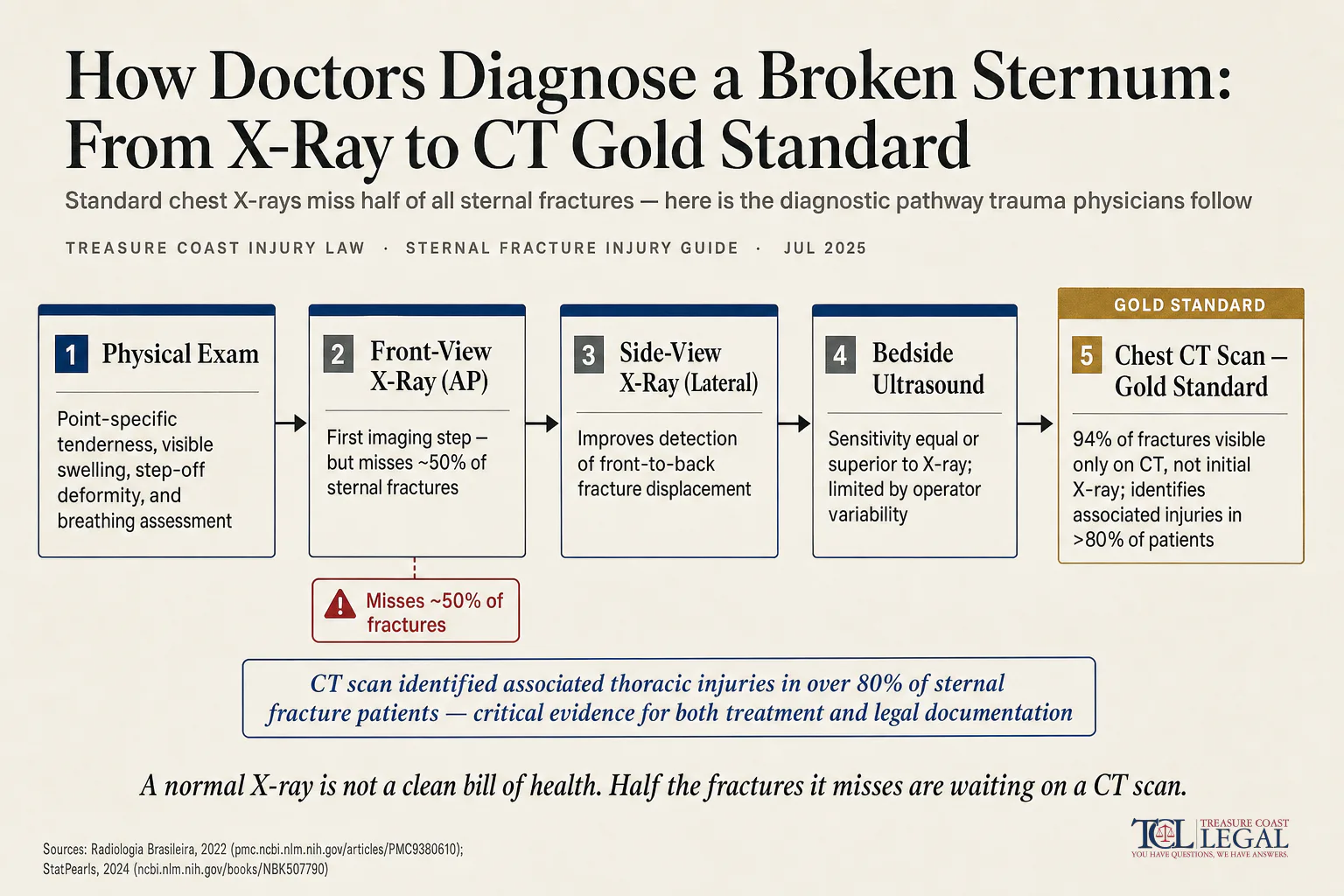
- A standard chest X-ray misses roughly half of sternal fractures, so insist on a chest CT scan after a high-impact crash.
- Most sternal fractures heal in about 10 to 12 weeks without surgery, but breathing exercises are critical to prevent a dangerous chest infection.
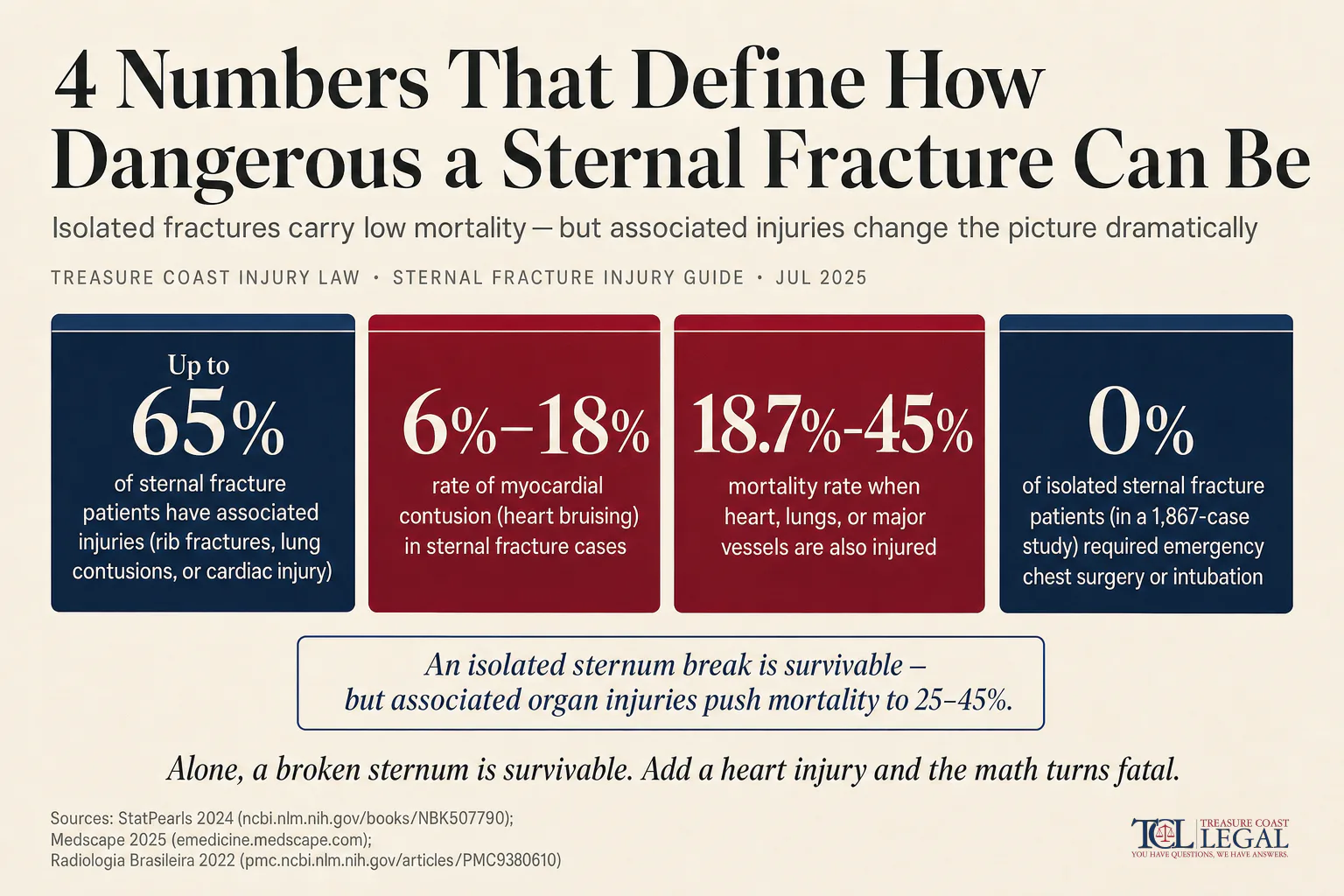
- Up to 65% of sternal fracture patients have other injuries to the heart, lungs, or ribs, which is why a full trauma workup matters.
- A sternal fracture usually clears Florida's serious injury threshold, letting you pursue the at-fault driver beyond your $10,000 PIP coverage.
Written by Shaun Plymale, Florida Attorney and Managing Partner, Treasure Coast Legal.
The Treasure Coast takes its name from the 1715 Spanish treasure fleet that wrecked off its shores, and coins from those ships still wash up on local beaches today. The seatbelt that saved your life in a crash on US-1 or I-95 may have left a different kind of injury to recover from. The same belt that kept you from going through the windshield can leave you with a fractured sternum, the long flat bone down the center of your chest. A broken sternum is not a minor bruise, yet many victims dismiss the pain as soreness and never get diagnosed. This article walks you through the broken chest bone symptoms to watch for, when they signal an emergency, how doctors confirm the injury, what recovery involves, and your legal options.
What a Broken Chest Bone Actually Is and Why Car Accidents Cause It
The Sternum's Job and Why It Breaks Under Impact
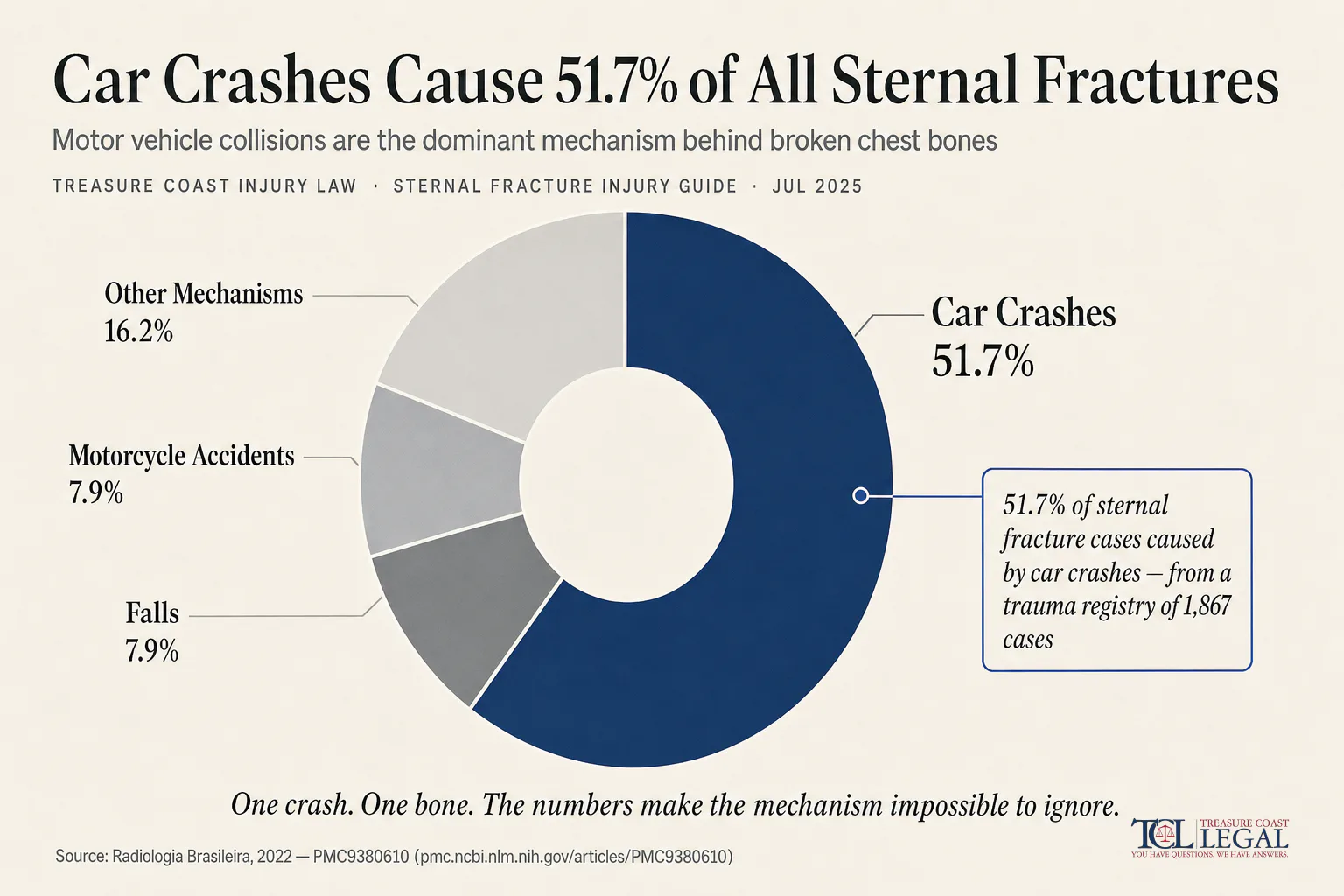
The sternum is a long flat bone forming the front of the chest area, connecting your ribs and shielding your heart and lungs. Motor vehicle collisions account for roughly half of all sternal fractures, with falls, pedestrian incidents, and high impact sports making up most of the rest, per StatPearls. Most fractures happen when the chest strikes the steering wheel or a restraint forces the body back at high speed. If your car accident involved significant forward deceleration, treat chest pain as a possible sternal fracture until a clinician rules it out.
Which Accidents on the Treasure Coast Create This Risk
Blunt chest trauma and chest wall injuries are common in high-speed rear-end and head-on collisions on I-95, US-1, and near Confusion Corner in Stuart, and blunt chest trauma from motor vehicle accidents remains the leading cause of sternal fractures. Boating accidents at the St. Lucie Inlet add another local mechanism, as do motorcycle accidents along A1A. Document the crash mechanism in detail, where your body struck the vehicle interior matters for both your medical and legal record of chest injuries.
Why Older Adults and Certain Patients Face Higher Fracture Risk
Isolated sternal fractures are more common in older adults whose bone density has declined and in patients with prolonged steroid use or a history of intravenous drug abuse. Osteoporosis and reduced chest wall compliance show roughly 2.5-fold higher incidence in patients over 65, per Medscape. Age or medication history does not reduce a negligent driver's liability.
The Core Broken Chest Bone Symptoms You Need to Know
Immediate Pain Signals That Distinguish Fracture From Bruising
The hallmark broken chest bone symptoms are sharp, localized anterior chest wall pain that spikes when you take deep breaths, cough, or press on the sternum. Almost all patients report point-specific anterior chest pain, often severe enough to limit breathing, according to [StatPearls](https www.ncbi.nlm.nih.gov/books/NBK507790/). A simple bruise improves in a day or two, while a fracture's pain remains severe. If pressing a single spot on your breastbone produces a spike of pain, that is a red flag requiring imaging.
Swelling, Tenderness, and Visible Deformity
About half of sternal fracture patients show visible swelling, bruising, or a palpable "step-off" deformity over the bone, StatPearls reports. A displaced sternal fracture may show obvious misalignment, and you might feel grinding (crepitus) when touched. Photograph any visible swelling or bruising as soon as possible to support both your diagnosis and your claim.
Breathing Difficulty and Secondary Warning Signs
Many patients take shallow breaths instead of regular deep breaths to avoid pain. More than one-third develop respiratory complications from pain-limited breathing, raising the risk of chest infection, other pulmonary complications, and other injuries. Shortness of breath at rest, low blood pressure, or a racing heartbeat alongside chest pain points to other associated injuries. If you cannot take a full breath without severe pain 12 to 24 hours after a crash, go to an emergency room, not urgent care. Locally, that means a Cleveland Clinic emergency department in Martin or St. Lucie County or Lawnwood Regional Medical Center in Fort Pierce.
When Broken Chest Bone Symptoms Signal a Life-Threatening Emergency
Four Signs That Demand a 911 Call Right Now
Four signs signal internal injuries that can be fatal without immediate care, severe difficulty breathing, coughing or vomiting blood, low blood pressure with confusion or fainting, and visible chest wall instability where a section moves paradoxically with breathing (flail chest). These are not symptoms to monitor at home, per StatPearls. Call 911 and do not drive yourself. Sudden cardiac arrhythmia is a documented complication of sternal fractures with cardiac contusion.
Associated Injuries That Make a Sternal Fracture More Dangerous
More than 80% of patients with a sternal fracture have additional injuries, with rib fractures present in about 74% of cases and pulmonary contusions in about 42%, per a 2024 study in the European Journal of Trauma and Emergency Surgery. Blunt cardiac injury (myocardial contusion) is an important but relatively uncommon complication of sternal fractures, and guidelines recommend ECG and, when indicated, cardiac enzyme testing to screen for it in blunt chest trauma patients; an isolated break has very low mortality while combined heart or lung injury pushes that figure far higher. Insist on a full trauma workup, not just a chest X-ray. A chest CT scan is the standard for detecting hidden co-injuries.
How Doctors Diagnose a Broken Sternum After a Crash
Why X-Rays Miss What CT Scans Catch
A standard front-view chest X-ray misses many sternal fractures because the sternum overlaps the spine, according to Radiologia Brasileira. Chest CT (especially multidetector computed tomography) is much more sensitive than plain radiography for detecting sternal fractures, and many fractures are missed on initial chest X-rays, per contemporary trauma imaging literature. If an ER doctor orders only an X-ray after a high-impact crash, ask whether a chest CT scan is warranted.
What a Diagnosis Means for Your Legal Record
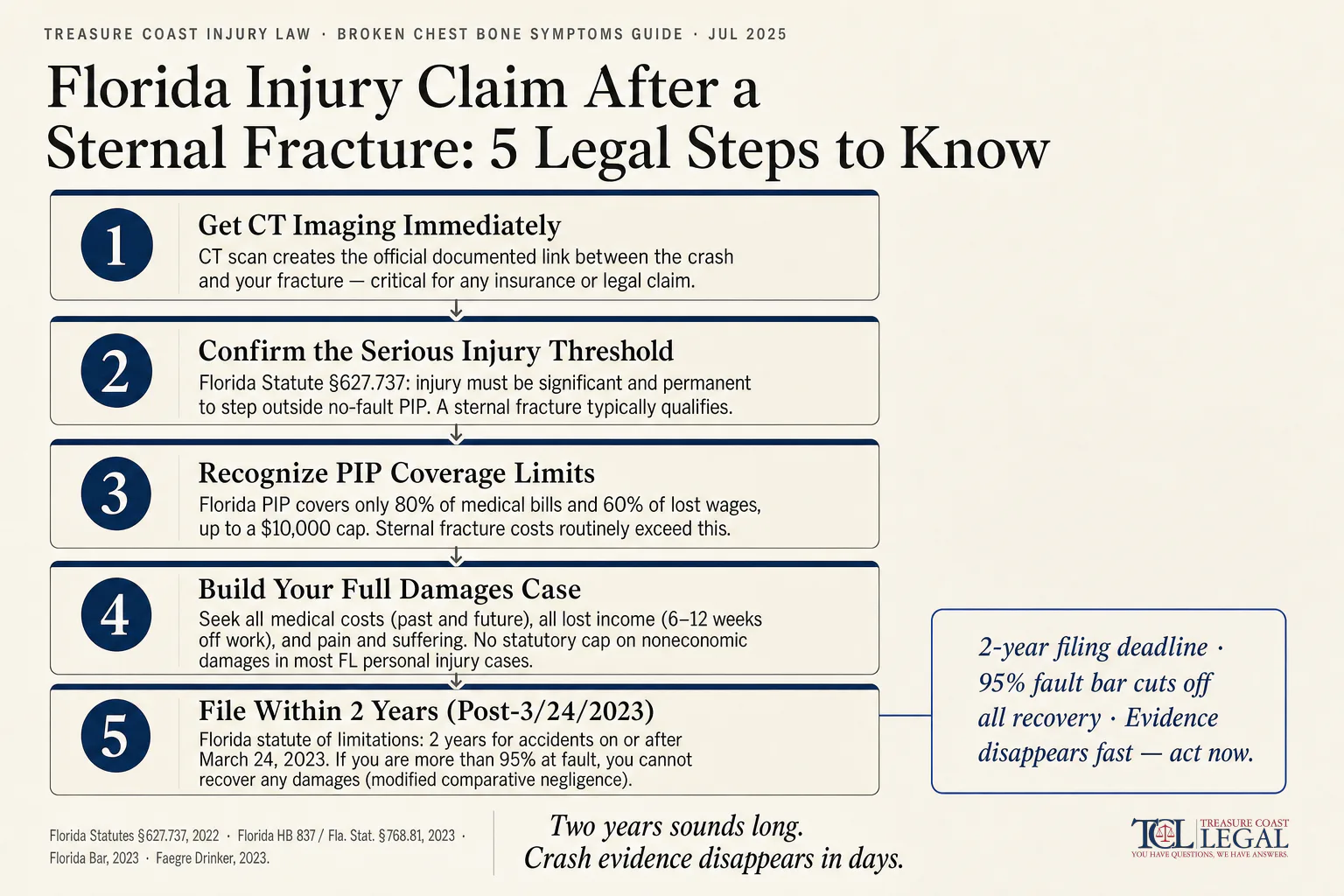
A formal sternal fracture diagnosis creates the documented medical evidence your personal injury claim requires, linking the injury to the crash. Florida shortened its personal injury statute of limitations to two years for accidents on or after March 24, 2023, under Florida Statutes § 95.11. Request copies of all imaging and reports before leaving the hospital. Our firm handles these claims on a contingency fee, so you pay nothing unless we win.
How Long Recovery Takes and What to Expect at Home
The 10 to 12 Week Healing Timeline Most Patients Face
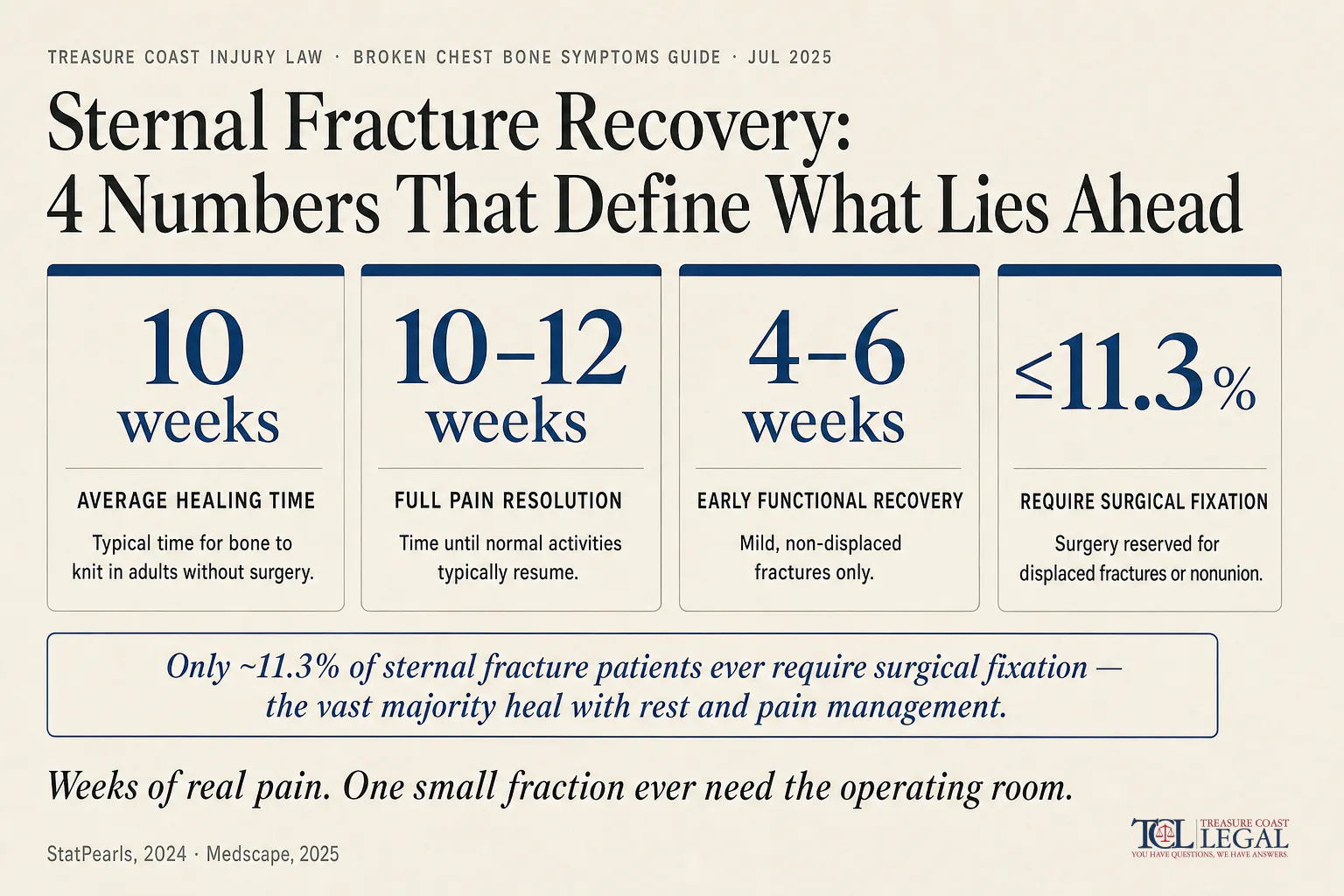
Most sternal fractures heal without surgery in an average of about 10 weeks, with full pain resolution and return to normal activity often taking 10 to 12 weeks, per StatPearls. Mild, non-displaced fractures may be fairly functional in 4 to 6 weeks. Pain is usually worst in the first few days. Track your pain levels and functional limits daily, that record is directly relevant to a pain-and-suffering calculation.
Preventing Chest Infection During Recovery
The biggest home-care risk is a chest infection from inadequate breathing. Patients must perform deep breathing exercises even though it hurts, to prevent pneumonia or atelectasis, Medscape warns. Holding a pillow firmly against the chest makes coughing more tolerable. A preventable chest infection extends your recovery and time away from work, both of which matter to your damages.
When Surgery or a False Joint Becomes the Reality
A displaced fracture that fails to heal can form a false joint, a fibrous non-union, causing chronic sternal pain and instability. Non-union is rare, and surgical fixation with plate osteosynthesis is reserved for those cases; autologous bone grafting is generally added only when there is significant bone loss or defects, per Medscape. If your pain has not improved meaningfully after 8 weeks, return to your physician. A delayed diagnosis of non-union can affect both your health and the long-term value of your claim.
Your Legal Rights After a Sternal Fracture in a Treasure Coast Accident
What a Broken Sternum Is Worth as a Personal Injury Claim
A sternal fracture carries real economic damages, emergency imaging, specialist visits, lost wages during a 10 to 12 week recovery, and possible surgical costs, plus non-economic damages for pain and suffering. Under Florida's PIP statute, Florida Statutes § 627.736, your insurer generally pays 80% of reasonable medical expenses up to the policy limit (typically $10,000, or $2,500 if no emergency medical condition is diagnosed). A sternal fracture with complications will almost certainly exceed that cap, triggering your right to pursue a wrongful injury claim against the at-fault driver.
Why Prompt Legal Action Protects Your Claim
Evidence from a US-1 or I-95 crash deteriorates quickly. Traffic camera footage is overwritten, witnesses scatter, and adjusters start building a defense immediately. Florida's modified comparative negligence rule bars recovery if you are 51% or more at fault (i.e., greater than 50% at fault) and reduces your award by your fault percentage, under Florida Statutes § 768.81. Contact a personal injury lawyer as soon as your immediate medical needs are addressed, since experienced personal injury lawyers know how to preserve this evidence.
Frequently Asked Questions About Broken Chest Bone Symptoms
How do I know if I broke a chest bone?
Sharp, point-specific pain over the sternum that intensifies with deep breaths, coughing, or pressure, combined with a high-impact mechanism. A CT scan is definitive, since X-rays miss many of these breaks, per Radiologia Brasileira.
How do you know if your chest is bruised or broken?
A bruise produces diffuse discoloration that improves within days, per the Mayo Clinic. A break produces localized pain that worsens with breathing and does not improve over 48 hours, visible deformity or crepitus are fracture indicators.
What are four signs of a serious chest injury?
Severe difficulty breathing at rest, coughing or vomiting blood, low blood pressure with dizziness or confusion, and visible paradoxical chest wall movement, per StatPearls. Any one warrants a 911 call.
Do chest fractures heal on their own?
Most isolated sternal fractures heal without surgery in 10 to 12 weeks with rest, pain management, and breathing exercises, StatPearls confirms. A displaced fracture or false joint may need surgical fixation.
What to Do Right Now If You Recognize These Symptoms
A broken sternum dismissed as soreness can lead to chest infection, chronic pain, or worse, and an unrecognized injury is a claim that quietly expires under Florida's two-year deadline. Treasure Coast Legal represents accident victims across Martin, St. Lucie, and Indian River counties and into Jupiter and Palm Beach County on a contingency basis, no fee unless we win. Contact our legal team, with offices in Stuart, Fort Pierce, and Port St. Lucie, today for a free case review. If you were hurt in a crash on US-1, I-95, A1A, or anywhere on the Treasure Coast, call 772-238-7755 or request your free consultation today. Around here, local matters, and so does your recovery.
The information provided in this blog is for general informational and educational purposes only and is not intended as legal advice. Laws and legal outcomes vary based on specific facts and circumstances, and the information contained herein may not reflect the most current legal developments. You should not act or refrain from acting based on any information in this blog without first seeking legal advice from a qualified attorney licensed in your jurisdiction. This blog may be produced, in whole or in part, with the assistance of generative artificial intelligence tools and is reviewed by legal professionals before publication; however, no representations are made as to its accuracy, completeness, or applicability to any specific situation. Reading or interacting with this blog does not create an attorney-client relationship between you and the firm. An attorney-client relationship is formed only through a written agreement signed by both you and the firm. This blog may be considered attorney advertising under applicable laws and ethical rules. Prior results do not guarantee a similar outcome. The firm disclaims all liability for actions taken or not taken based on the content of this blog.
Shaun Plymale
Founding Attorney
Treasure Coast Legal