

Key Takeaways
- Florida's legal limit is 0.08% blood alcohol content for adult drivers, but you can be charged with DUI below that if your normal faculties are visibly impaired.
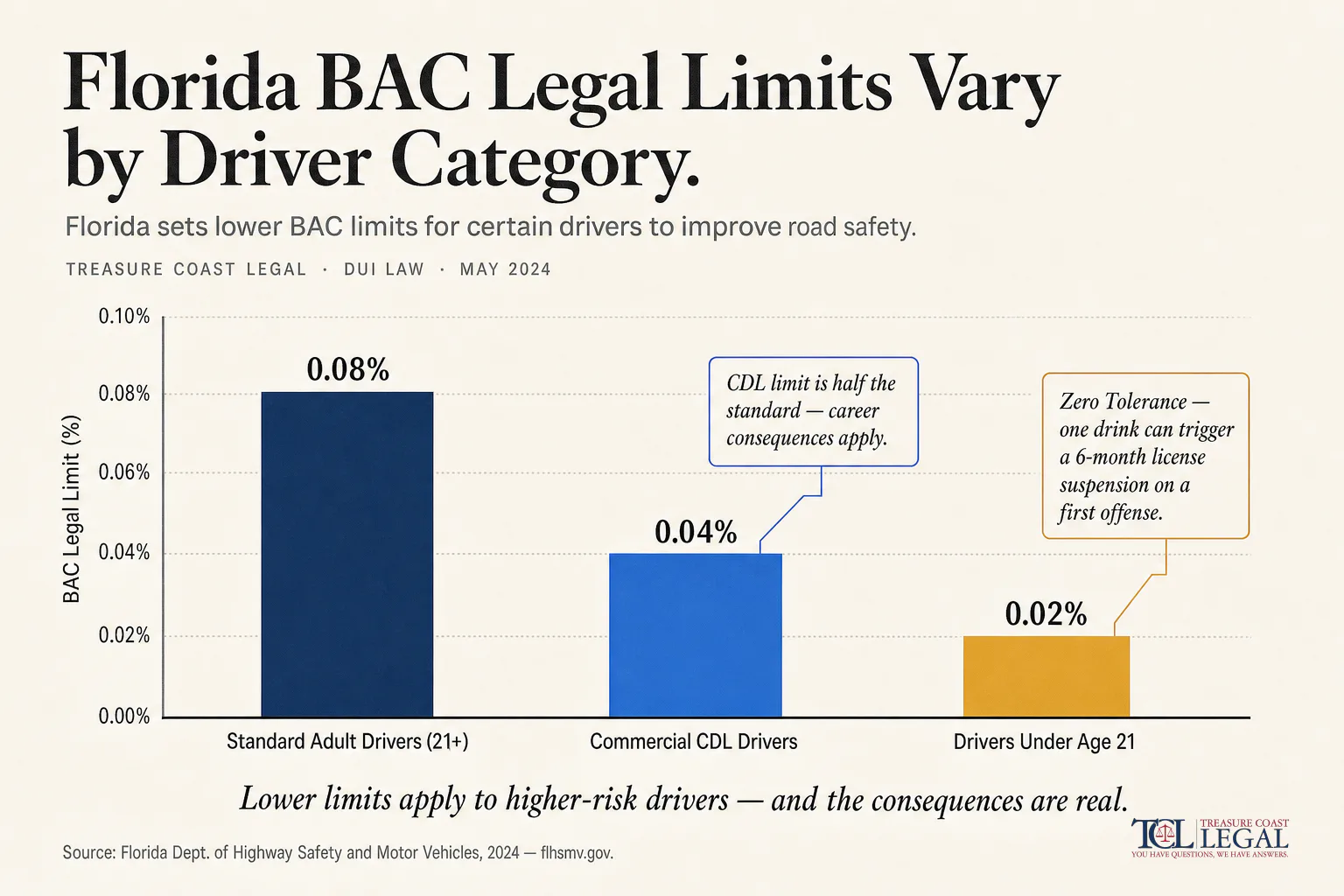
- Drivers under 21 face a 0.02% limit and CDL holders a 0.04% limit, so even one drink can cost you your license.
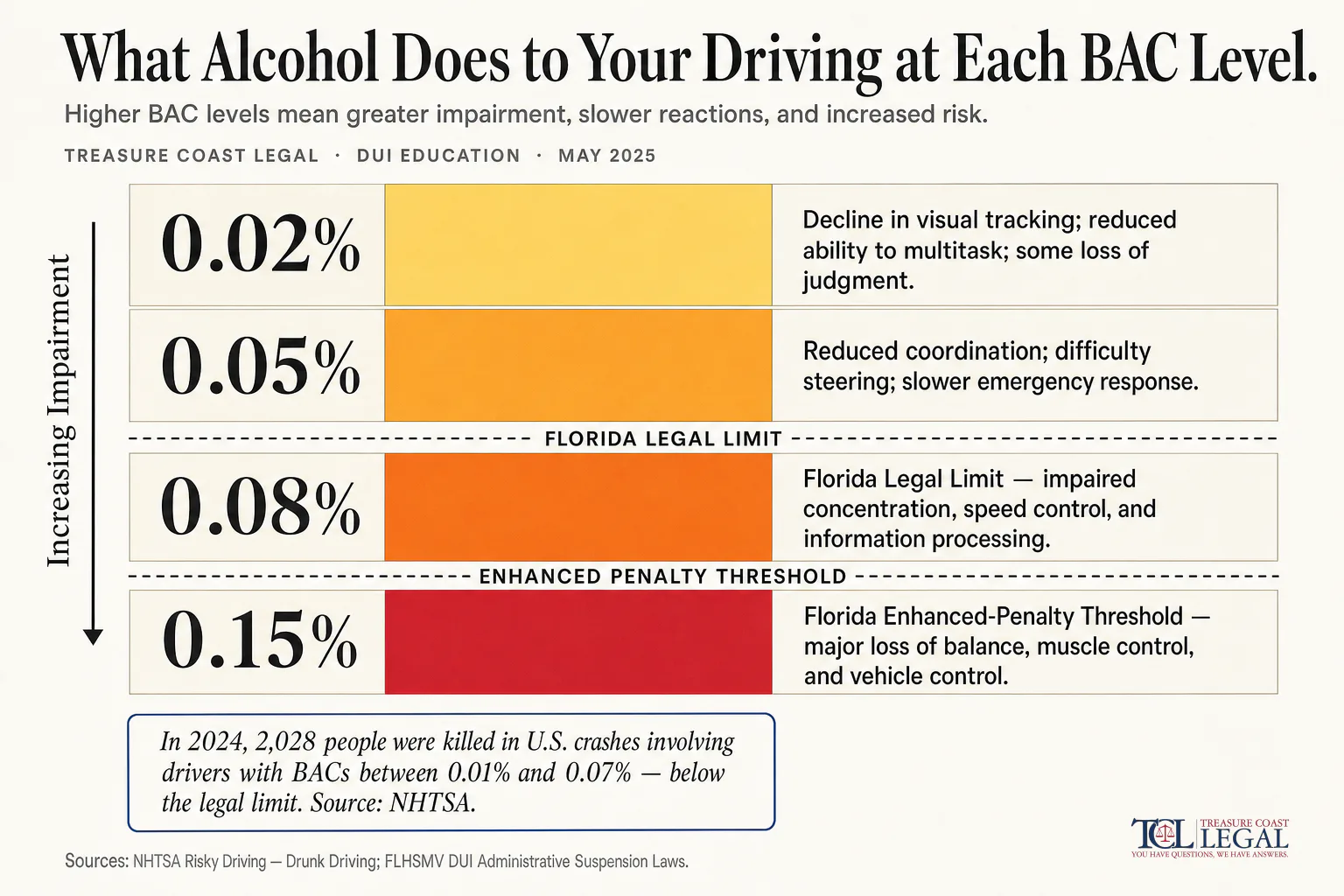
- Measurable impairment of reaction time and judgment begins around 0.02% BAC, well before the legal limit.
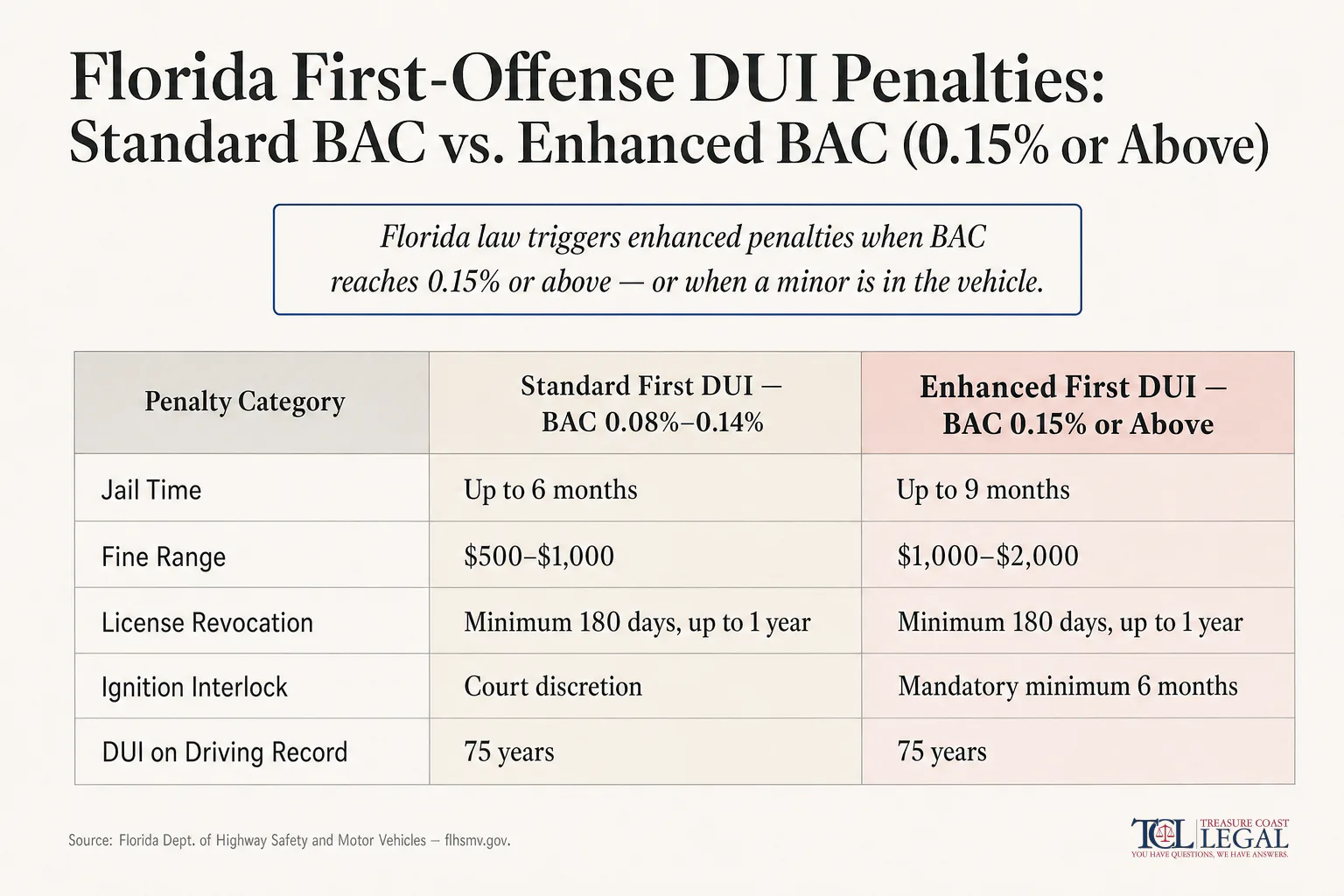
- A first-offense DUI in Florida carries up to six months jail time, fines, and license revocation up to one year.
- If a drunk driver injured you, Florida law may let you step outside PIP and pursue full compensation.
*By Shaun Plymale, Florida Attorney and Managing Partner.*
The Indian River Lagoon runs the full length of this region, making it one of Florida's most active stretches for boating, waterfront dining, and nightlife. That scene leaves a lot of drivers asking the same question after a night out in Stuart, Fort Pierce, or Port St. Lucie. Can I drive after a drink or two? This article answers it directly, the legal limit, why one drink may still impair you, what happens if you are stopped, and your options if things go wrong.
Florida's Legal Limit Is 0.08% But That Number Doesn't Mean You're Safe to Drive
Florida defines DUI as either impairment of your normal faculties or a blood alcohol content of 0.08% or above, according to the Florida Department of Highway Safety and Motor Vehicles. Being under the legal limit does not protect you. An officer who observes signs of impaired driving can charge you below 0.08% under Florida Statute §316.193.
Stricter Limits Apply to CDL Holders and Drivers Under 21
Florida's state zero tolerance laws set a 0.02% limit for drivers under 21 who have not reached the legal drinking age and 0.04% for commercial CDL holders.
How Florida DUI Law Differs From Other States
Florida uses the term DUI, not DWI. Under the state's implied consent law, refusing a lawful breath test or blood test carries an automatic one-year driver license suspension on a first refusal, regardless of your actual blood alcohol level.
Understanding Blood Alcohol Concentration and How It Builds
The one drink rule defines one standard drink as one 12 ounce beer at 5% ABV, one five ounce glass of wine at 12% ABV, or one 1.5 ounce shot of 80-proof spirits — but not all alcoholic beverages are poured to these standard sizes. A craft IPA at 8% ABV or a heavy pour is not one drink.
Factors That Affect How High Your BAC Climbs
Body weight, biological sex, fat-muscle content, hydration, food, and metabolism all change the result. A 120-pound person reaches 0.08% faster than a 200-pound person drinking the same amount. Over-the counter medications can amplify alcohol's effect and raise your blood alcohol content unexpectedly.
When Does Your BAC Clock Start and When Does It Peak
Alcohol is quickly absorbed and can be measured within 30 to 70 minutes after a person has had a drink, according to NHTSA, so a driver who felt fine leaving a Jensen Beach bar may hit peak impairment minutes into the drive home. The liver eliminates roughly 0.015% BAC per hour, which is the basis of the drink per hour rule. Coffee, water, and food do not speed it up. Time is the only thing that lowers your BAC.
Why One Drink Can Still Make You a Danger on Treasure Coast Roads
Measurable impairment begins well below the legal limit. NHTSA reports a decline in visual tracking and divided attention at just 0.02% BAC. By 0.05%, reaction time slows and steering suffers. Even drivers with a BAC between 0.01 and 0.07% are involved in hundreds of fatal crashes nationally each year. Legal does not equal safe.
Florida Crash Data and Alcohol-Involved Accidents
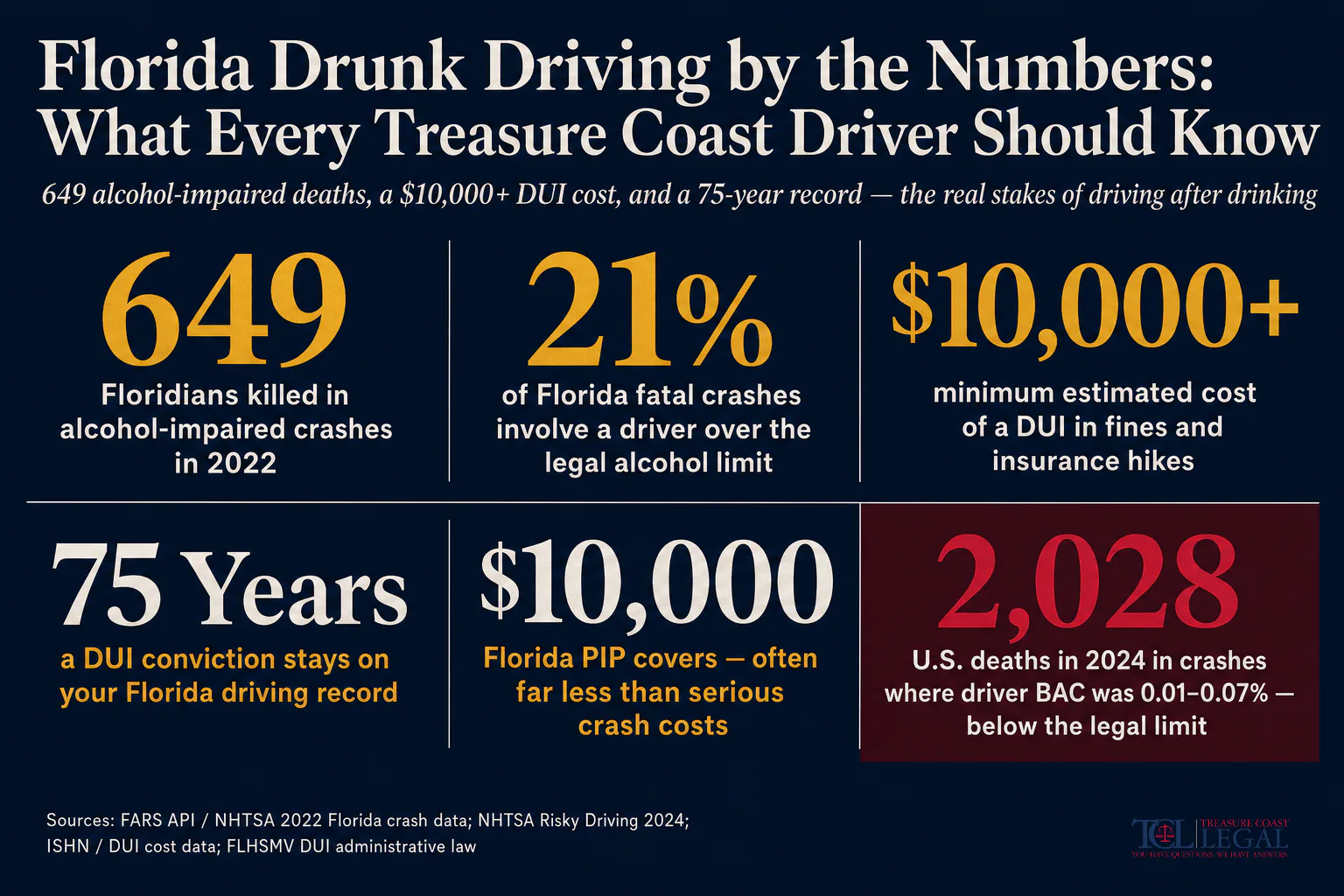
A significant share of Florida's fatal crashes involve at least one driver who had been drinking, and the state consistently records hundreds of alcohol-impaired driving deaths each year, according to NHTSA Fatality Analysis Reporting System data. High-conflict spots like Stuart's Confusion Corner compound the danger. Seriously injured crash victims in the region are often treated at Lawnwood Regional Medical Center in Fort Pierce or Cleveland Clinic Martin Health in Stuart. If you were hurt in one, our personal injury team can walk you through your options.
What Florida Law Does to Drivers Charged With DUI
A first-offense DUI in Florida is not a traffic ticket. By statute, it can mean up to six months jail time, fines of $500 to $1,000, and license revocation of 180 days to one year, plus DUI school and possible installation of an ignition interlock device, per the FLHSMV.
When a Higher BAC Escalates the Penalty
A blood alcohol content of 0.15% or above triggers enhanced penalties even on a first offense, raising the fine range to $1,000 to $2,000, allowing up to nine months jail time, and requiring a mandatory ignition interlock device for at least six months.
How a DUI Can Become a Civil Liability Problem
A drunk driver who causes serious injury faces both criminal prosecution and civil liability, and victims of such car accidents deserve experienced legal representation. Florida adopted modified comparative negligence in 2023, so a plaintiff more than 50% at fault recovers nothing, but a drunk driver will struggle to convince a court the sober victim was mostly to blame. Victims can pursue a personal injury claim, whether the crash involved a car or an e-bike.
Can I Drive Safely After Drinking? How to Actually Know
Self-assessment is unreliable because alcohol impairs the same judgment you would use to evaluate yourself, as the CDC notes. The one-drink rule fails because serving sizes, ABV, and metabolism vary too widely. Feeling fine is not evidence that you are.
Practical Alternatives When You Are Not Sure
Rideshare, designated driver planning, or a phone call all beat guessing at your blood alcohol concentration. Personal breathalyzers, including available breath testing units marketed to consumers, have accuracy limits and are not a legal defense; unlike devices using the same technology law enforcement officers rely on, consumer models vary widely in precision. When you find yourself asking can I drive after a night out, the safest answer is no. A rideshare home costs far less than a DUI.
If a Drunk Driver Hurt You on the Treasure Coast Here Is What to Do
Florida's no-fault PIP insurance covers your initial medical bills up to $10,000 regardless of fault. If you suffered a serious injury under Florida Statute §627.737, such as permanent injury or significant scarring, you can step outside no-fault and pursue the at-fault driver directly. A DUI conviction is powerful evidence in a personal injury claim, and personal injury lawyers can use it to build a strong case for victims.
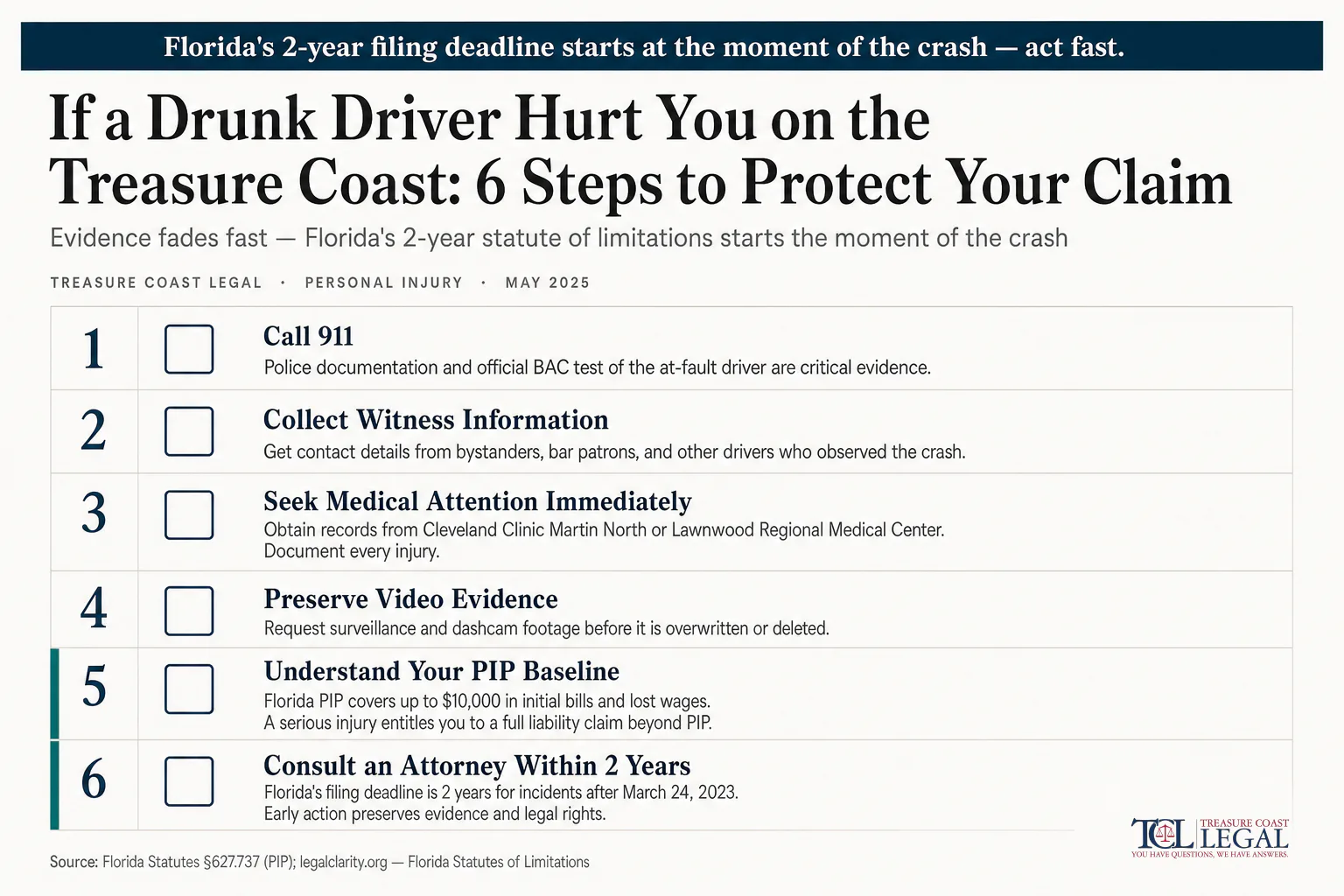
Evidence That Matters Most in Alcohol-Related Injury Claims
The police report, breathalyzer results, blood alcohol content readings — including the 0.08 bac legal driving limit as a benchmark — witness statements, dashcam footage, and medical records all strengthen a claim. Florida's two-year statute of limitations under §95.11 for post-2023 crashes means timing matters. Document everything immediately.
Frequently Asked Questions About Drinking and Driving in Florida
How do you know if you are okay to drive after drinking?
You cannot reliably self-assess, per the CDC. If you have had any alcohol and are unsure, the answer should be no.
What blood alcohol level is too high to drive in Florida?
The legal limit is 0.08% for standard drivers, 0.04% for commercial license holders, and 0.02% for drivers under 21. You can still be charged below 0.08% if your normal faculties are visibly impaired.
How bad is a .17 blood alcohol level?
A 0.17% BAC is more than double the legal limit and triggers enhanced DUI penalties even on a first offense, according to NHTSA.
How many drinks does it take to reach 0.08% BAC?
It depends on weight, sex, food, and metabolism. A 160-pound person may reach 0.08% after three to four standard drinks in two hours, while a lighter person may reach it in two. There is no universal safe number.
If a Drunk Driver Injured You Contact Treasure Coast Legal for a Free Consultation
Driving after drinking carries real legal risk for the driver and real physical risk for everyone else on Treasure Coast roads. If an impaired driver injured you on US-1, I-95, A1A, or anywhere in Martin or St. Lucie County, Florida law gives you the right to pursue full compensation. As a personal injury law firm serving Stuart, Port St. Lucie, and Fort Pierce — around here, local matters — our team — a personal injury law firm and car accident law firm serving the Treasure Coast — handles personal injury cases on contingency, so you pay nothing unless we win. The free consultation described here applies to personal injury claims; if you are facing criminal DUI charges, please contact us to confirm consultation terms for that matter. Call 772-238-7755 or schedule a free consultation at treasurecoastlegal.com.
Your Treasure Coast Neighbors
The information provided in this blog is for general informational and educational purposes only and is not intended as legal advice. Laws and legal outcomes vary based on specific facts and circumstances, and the information contained herein may not reflect the most current legal developments. You should not act or refrain from acting based on any information in this blog without first seeking legal advice from a qualified attorney licensed in your jurisdiction. This blog may be produced, in whole or in part, with the assistance of generative artificial intelligence tools and is reviewed by legal professionals before publication; however, no representations are made as to its accuracy, completeness, or applicability to any specific situation. Reading or interacting with this blog does not create an attorney-client relationship between you and the firm. An attorney-client relationship is formed only through a written agreement signed by both you and the firm. This blog may be considered attorney advertising under applicable laws and ethical rules. Prior results do not guarantee a similar outcome. The firm disclaims all liability for actions taken or not taken based on the content of this blog.
Shaun Plymale Founding Attorney Treasure Coast Legal